
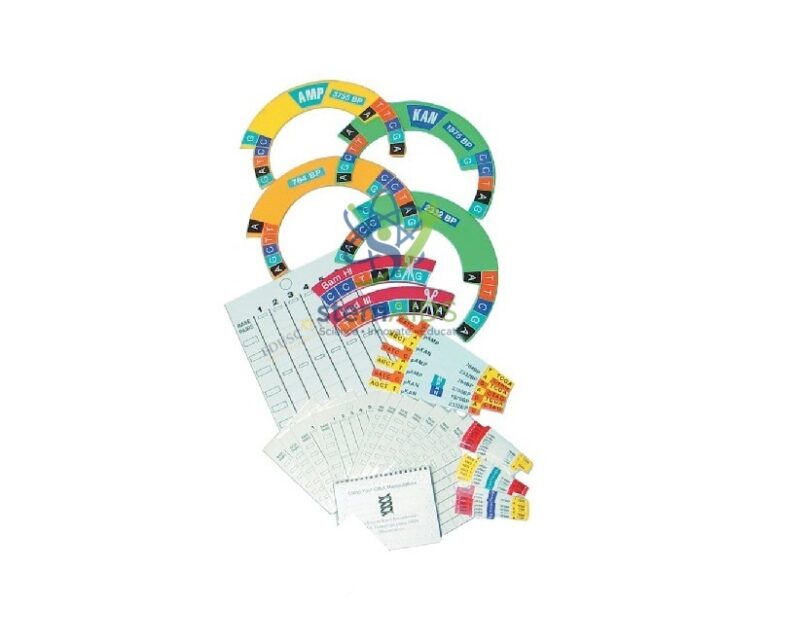
Quick Answer: The DNA Manipulatives Kit is a hands-on teaching set of pieces that students assemble into DNA strands and then take apart. It is used to teach nucleotide structure, complementary base pairing between A and T and between G and C, the antiparallel arrangement of the two strands and semi-conservative replication.
Building DNA One Nucleotide at a Time
A finished double-helix model shows what DNA looks like; manipulatives show how it is put together. Each nucleotide has three parts, a phosphate group, a deoxyribose sugar and one of four bases, and students link these into a sugar-phosphate backbone with bases pointing inwards. When they add a second strand, the pieces only make sense in one way: adenine opposite thymine, guanine opposite cytosine. The rule stops being something to memorise and becomes something the pieces enforce.
The same set supports the next step, replication. Students separate their two strands, use loose nucleotides to build a new partner for each, and end with two molecules, each made of one old strand and one new strand. Using a different colour for the new strands makes the semi-conservative pattern obvious at a glance. A deliberate wrong base added during copying can introduce the idea of a point mutation.
For a three-dimensional view of the finished helix, the DNA structure simulation kit complements this flat, hands-on approach.
Specifications
| Item | Manipulative pieces for building DNA strands |
| Represents | Phosphate, deoxyribose sugar and the bases A, T, G and C |
| Concepts | Base pairing, antiparallel strands, replication, point mutations |
| Format | Printed pieces and cards, per the listing photograph |
Applications
- Building a short double-stranded sequence from a given single strand
- Modelling semi-conservative replication with different colours for old and new strands
- Showing why the two strands run in opposite directions
- Introducing substitution mutations before a lesson on protein synthesis
Care & Handling
- Sort pieces by base type into labelled bags at the end of each session to speed up the next setup.
- Keep printed pieces dry and flat; bent cards no longer line up neatly in a strand.
- Check each set against its contents list at the end of term and replace lost bases before the next class.
Why Choose LabEquip
Biology departments use DNA manipulatives in lower and upper secondary genetics, often followed by protein synthesis. LabEquip lists this kit in Biology Lab Products with the Protein Synthesis Manipulatives Kit that continues the story from gene to protein. Confirm contents and set numbers through the LabEquip contact page.
Related Products
- Protein Synthesis Manipulatives Kit: Takes students from DNA to messenger RNA, transfer RNA and a peptide chain, the step after building strands.
- Meiosis Manipulatives Kit: Chromosome pieces printed with allele letters for modelling meiosis, crossing over and independent assortment.
- DNA Structure Model, Plastic Assembly Kit: A plastic kit for building the full three-dimensional double helix from sugar, phosphate and base units.
- DNA Double Helix Model: A three-dimensional double helix model showing the twist and backbones that flat pieces cannot show.
Frequently Asked Questions
What does building DNA with manipulatives teach that a finished model does not?
Manipulatives show how DNA is put together, not only what it looks like. Students join phosphate, deoxyribose sugar and base pieces into nucleotides, link them into a backbone and add a partner strand, so nucleotide structure and the pairing rules are learned by doing.
What are the three parts of a nucleotide in a DNA manipulatives kit?
Each nucleotide is a phosphate group, a deoxyribose sugar and one of the four bases: adenine, thymine, guanine or cytosine. In the kit these are separate pieces, so students see that the sugar sits in the middle, linked to the phosphate on one side and the base on the other.
How can DNA manipulatives show that the two strands are antiparallel?
Lay the second strand beside the first with its sugars pointing the opposite way: one strand runs 5′ to 3′ downwards and its partner runs 5′ to 3′ upwards. Marking the 5′ end of each strand with a small label makes the opposite directions easy to see on the desk.
How can a point mutation be modelled with DNA manipulatives?
Build a short sequence, then swap one base card for a different one and pair a new strand against it. One changed base alters one base pair, and when the sequence is read in groups of three it may change a single codon, which links the activity to examples such as sickle-cell anaemia.
Can a DNA manipulatives kit be used for protein synthesis lessons?
It covers the DNA side: nucleotides, pairing, replication and point mutations. To carry on to codons, transfer RNA and amino acids, it is used with a protein synthesis set in which a DNA template is transcribed into messenger RNA and then translated.
Which classes is a DNA manipulatives kit suitable for?
It suits secondary biology from the first lesson on nucleotides through to replication and mutation, and works for introductory college revision. The printed pieces and cards lie flat, so groups can work on an ordinary desk and photograph the finished strand for their notes.
Last Updated: November 2026






Reviews
There are no reviews yet.