











In Stock
DNA Manipulatives Kit
$6.32
Quick Answer: The DNA Manipulatives Kit is a hands-on teaching set of pieces that students assemble into DNA strands and then take apart. It is used to teach nucleotide structure, complementary base pairing between A and T and between G and C, the antiparallel arrangement of the two strands and semi-conservative replication.
Building DNA One Nucleotide at a Time
A finished double-helix model shows what DNA looks like; manipulatives show how it is put together. Each nucleotide has three parts, a phosphate group, a deoxyribose sugar and one of four bases, and students link these into a sugar-phosphate backbone with bases pointing inwards. When they add a second strand, the pieces only make sense in one way: adenine opposite thymine, guanine opposite cytosine. The rule stops being something to memorise and becomes something the pieces enforce.
The same set supports the next step, replication. Students separate their two strands, use loose nucleotides to build a new partner for each, and end with two molecules, each made of one old strand and one new strand. Using a different colour for the new strands makes the semi-conservative pattern obvious at a glance. A deliberate wrong base added during copying can introduce the idea of a point mutation.
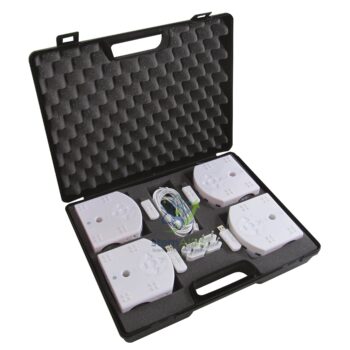
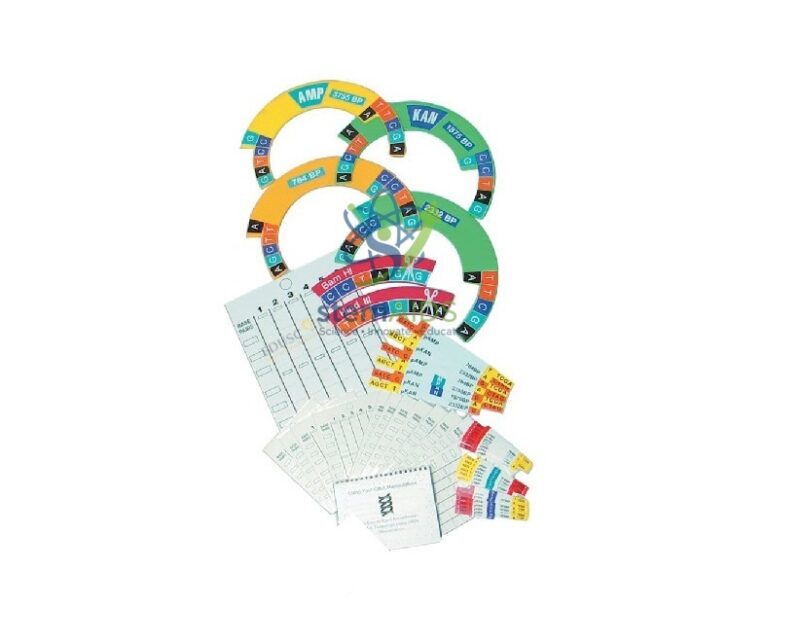
The listing photograph shows printed pieces and cards, but the title does not list the kit’s contents, the number of nucleotides or how many students it serves, so these should be confirmed before planning group sizes. For a three-dimensional view of the finished helix, the DNA structure simulation kit complements this flat, hands-on approach.
Specifications
| Item | Manipulative pieces for building DNA strands |
| Represents | Phosphate, deoxyribose sugar and the bases A, T, G and C |
| Concepts | Base pairing, antiparallel strands, replication, point mutations |
| Format | Printed pieces and cards, per the listing photograph |
| Contents and number of student sets | Confirm at enquiry |
Applications
- Building a short double-stranded sequence from a given single strand
- Modelling semi-conservative replication with different colours for old and new strands
- Showing why the two strands run in opposite directions
- Introducing substitution mutations before a lesson on protein synthesis
Care & Handling
- Sort pieces by base type into labelled bags at the end of each session to speed up the next setup.
- Keep printed pieces dry and flat; bent cards no longer line up neatly in a strand.
- Check each set against its contents list at the end of term and replace lost bases before the next class.
Why Choose LabEquip
Biology departments use DNA manipulatives in lower and upper secondary genetics, often followed by protein synthesis. LabEquip lists this kit in Biology Lab Products with the Protein Synthesis Manipulatives Kit that continues the story from gene to protein. Confirm contents and set numbers through the LabEquip contact page.
Frequently Asked Questions
What does building DNA by hand teach that a finished model does not?
Students have to choose each piece, so they see that a nucleotide has three parts and that bases can only pair in fixed ways. Taking the strands apart again also makes replication a physical process rather than a diagram.
How do the pieces show the base-pairing rules?
Adenine is always placed opposite thymine and guanine opposite cytosine. Students check every pair as they build, and any wrong pairing stands out immediately. Real A-T pairs form two hydrogen bonds and G-C pairs form three.
Can the kit be used to model DNA replication?
Yes. Students separate the two strands, build a new complementary strand against each one and end with two identical molecules. Using a different colour for new strands shows that each copy keeps one original strand.
What does antiparallel mean, and how can it be shown?
The two strands run in opposite directions: one from its 5 prime end to its 3 prime end and the other the reverse way. Students show this by laying the sugar pieces of the second strand upside down relative to the first.
How does this kit link to protein synthesis?
Once students can read a strand as a sequence of bases, the next step is transcription into messenger RNA and translation into amino acids. The companion protein synthesis kit takes that sequence through both steps.
Which classes is a DNA manipulatives kit suitable for?
It suits secondary students meeting DNA structure for the first time and older students revising replication and mutation. Younger groups work on base pairing only; older groups add strand direction and replication.
Last Updated: September 2026
You must be logged in to post a review.
Bestsellers




Reviews
There are no reviews yet.