








In Stock
Dissecting Instruments, Deluxe Set of 14 with Dissecting Tray
₹1,256.00
Quick Answer: The Dissecting Instruments, Deluxe Set of 14 with Dissecting Tray is a dissecting set of 14 instruments in a carrying case, supplied together with a tray to work in. It equips a student or bench group for plant and animal dissections in biology practicals.
A Dissecting Station in One Order
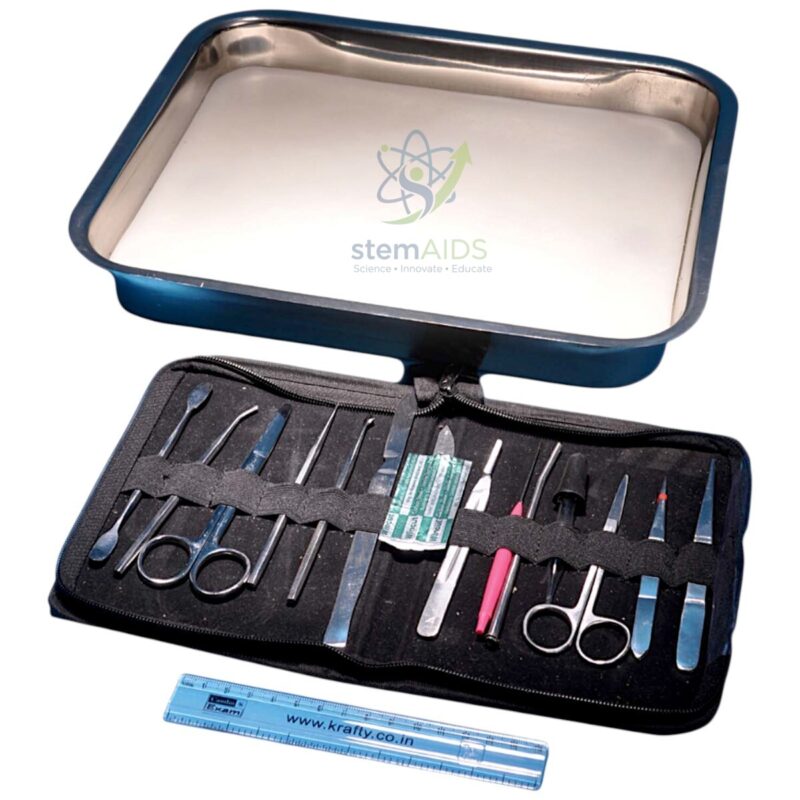
Dissection needs two things: the right instruments and a surface that contains fluids and holds the specimen still. This set supplies both. The product photo shows a zipped case with instruments held in elastic loops, including scissors, forceps and fine pointed tools, together with a ruler and a metal tray with a raised rim. Keeping the instruments in a fitted case means a teacher can see at a glance that all 14 have been returned.
Deluxe dissecting sets usually combine cutting instruments such as scalpels and straight or curved scissors, holding instruments such as fine and blunt forceps, and probing instruments such as seekers and teasing needles. The exact list of the 14 pieces in this set is not stated, so it is worth checking against the practicals you plan before ordering.
The tray turns any bench into a dissection area. Its rim keeps fluids and fragments in one place, and the specimen stays where it is placed while students work; for pinning specimens open, a wax-lined tray such as the separate Dissecting Trays is used. After the practical, instruments and tray go back into service once cleaned, which makes a set like this an economical choice over years of classes.
Specifications
| Item | Deluxe dissecting instrument set with dissecting tray |
| Number of instruments | 14, as stated in the product name |
| Case (from product photo) | Zipped case with elastic loops for each instrument |
| Tray (from product photo) | Metal tray with a raised rim |
| Itemised instrument list | Confirm at enquiry |
Dissections and Practicals
- Flower dissection to identify sepals, petals, stamens and carpels
- Examining seeds, fruits and plant stems in botany practicals
- Dissection of organs such as hearts, kidneys and eyes obtained from the food supply
- Supervised animal dissections in courses where these remain part of the curriculum
- Anatomy revision alongside a rat dissection model where live specimens are not used
Instrument Care
- Wash the dissecting instruments in warm water with detergent straight after use, then dry them completely to prevent rust spots.
- Change scalpel blades with forceps or a blade remover, never with bare fingers, and put used blades in a sharps container.
- Disinfect the tray and instruments after animal tissue has been handled.
- Check the case against the instrument count at the end of each practical.
Why Choose LabEquip
Biology departments equip each bench group with a deluxe dissecting set so that practicals start with every student holding the same tools. LabEquip supplies the set with its biology lab products; ask through the contact page for the itemised contents.
Frequently Asked Questions
What instruments does a deluxe set of 14 usually contain?
Sets of this kind generally include one or more scalpels, straight and curved scissors, fine and blunt forceps, seekers, teasing needles, a probe and small items such as a ruler or pins. The exact pieces in this set should be confirmed when you enquire.
How do I change a scalpel blade safely?
Hold the blade with forceps or a needle holder, not your fingers. To remove, lift the back end of the blade off the handle and slide it forward; to fit, slide the new blade’s slot onto the handle’s groove until it clicks. Put the old blade straight into a sharps container.
Which specimens are suitable for school dissections?
Flowers, fruits, seeds and plant stems suit younger students. For animal anatomy, many schools use hearts, kidneys, lungs and eyes from butchers or abattoirs, since these come from the food supply. Rules on whole-animal dissection vary by institution and course.
Is animal dissection allowed in Indian colleges?
The University Grants Commission issued guidelines in 2014 to discontinue dissection of animals in undergraduate and postgraduate zoology and life science teaching, recommending alternatives such as models, software and plant material. Colleges should follow the current rules of their university and regulator.
How do I stop the instruments from rusting?
Wash them soon after use so tissue fluids do not dry on the steel, dry each one thoroughly, and store them in the case in a dry cupboard. A light film of instrument oil on hinged scissors keeps the joints moving smoothly.
How should the tray be cleaned after a dissection?
Scrape tissue into a waste bag, wash the tray with warm water and detergent, then wipe with a disinfectant suitable for metal. Rinse and dry fully before storage.
Last Updated: September 2026
You must be logged in to post a review.
Bestsellers




Reviews
There are no reviews yet.