
In Stock
Concavity Slides, Glass, Thick
₹435.00
Quick Answer: Concavity slides are thick glass microscope slides with a shallow hollow ground into the upper surface. The cavity holds a drop of liquid or a small living specimen without crushing it, which suits hanging-drop preparations and observation of live organisms.
Why the Slide Is Thick and Hollowed
A normal wet mount squeezes the specimen between a flat slide and a coverslip. That is fine for thin tissues but not for a water flea, a rotifer or a swimming protozoan, which need room to move. A concavity slide solves this with a depression, usually round, ground into the glass; the extra thickness of the slide is what allows a hollow of useful depth while leaving enough glass beneath it for strength.
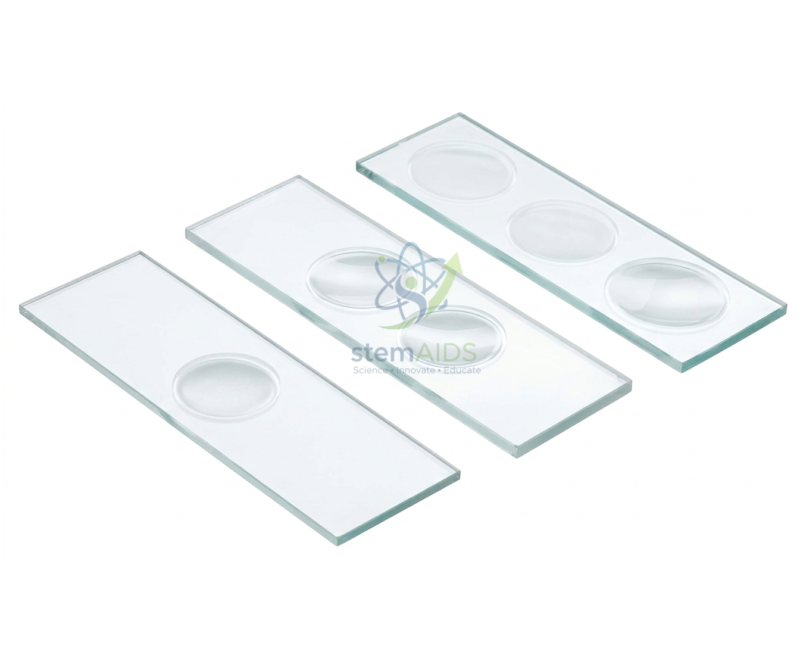
The product photo shows plain slides each with a single round cavity near the centre. Some concavity designs have two or three hollows; the number of cavities, their depth and the slide dimensions of this listing are not stated, so check them if the slides must fit a particular procedure.
The classic use is the hanging drop. A drop of culture is placed on a coverslip, the coverslip is inverted over the cavity and sealed at the edges, and the drop hangs in the hollow. Bacteria in the drop can then be watched swimming, which shows whether a species is motile without the distortion of a flattened mount.
Observations Suited to Cavity Slides
- Hanging-drop preparations to test bacterial motility
- Watching Daphnia, Cyclops, rotifers and protozoa alive
- Observing mosquito larvae or small insect stages without crushing
- Holding small seeds, pollen or crystals in a drop of liquid
- Timed observations of pollen germination in sucrose solution
Specifications
| Item | Glass microscope slides with a concave cavity |
| Glass | Thick, as stated in the product name |
| Cavity (from product photo) | Single round depression near the centre of each slide |
| Suitable for | Hanging drops, live aquatic organisms, small whole specimens |
| Number of cavities, depth and slide size | Confirm at enquiry |
Cleaning and Handling
- Clean the cavity with a cotton bud and warm detergent solution, then rinse; a cloth alone does not reach the bottom of the hollow.
- Remove petroleum jelly seals with tissue before washing, or the grease spreads across the slide.
- Disinfect slides used with bacterial cultures before cleaning.
- Store them flat or in a box with wide slots; thick slides may not fit standard slide racks.
Why Choose LabEquip
Microbiology instructors and biology teachers keep a set of concavity slides for any practical involving live, swimming organisms. LabEquip supplies them with its biology lab products, alongside plain glass slides and glass coverslips for routine mounts.
Frequently Asked Questions
How do I make a hanging-drop preparation?
Put a thin ring of petroleum jelly around the cavity. Place a small drop of culture in the centre of a coverslip, turn the slide upside down onto the coverslip so the cavity sits over the drop, then turn it right side up. The drop now hangs in the sealed hollow.
Can I use the high-power objective on a cavity slide?
Low and medium power work well. At high power the short working distance of the objective and the depth of the hollow make focusing harder, and in a hanging drop you focus on the edge of the drop, just below the coverslip. Oil immersion is not normally used with hanging drops.
How do I stop the drop from drying out?
Seal the coverslip to the slide with a thin ring of petroleum jelly around the cavity. The seal stops evaporation and also stops the coverslip sliding, so live organisms can be observed for longer.
What is the difference between a cavity slide and a plain slide?
A plain slide is flat, so the coverslip presses the specimen into a thin layer. A cavity slide has a hollow that holds liquid and small organisms without crushing them. Plain slides suit stained smears and sections; cavity slides suit living material.
Why use thick glass for a cavity slide?
Grinding a hollow removes glass from the middle of the slide. Starting from thicker glass leaves enough material under the cavity to keep the slide strong, so it does not crack in handling or washing.
How do I find a hanging drop under the microscope?
Start with the low-power objective and focus on the edge of the drop, where there is a visible line. Reduce the light with the diaphragm to increase contrast, then move carefully to a higher power.
Last Updated: September 2026
You must be logged in to post a review.
Bestsellers




Reviews
There are no reviews yet.