

Sale
In Stock
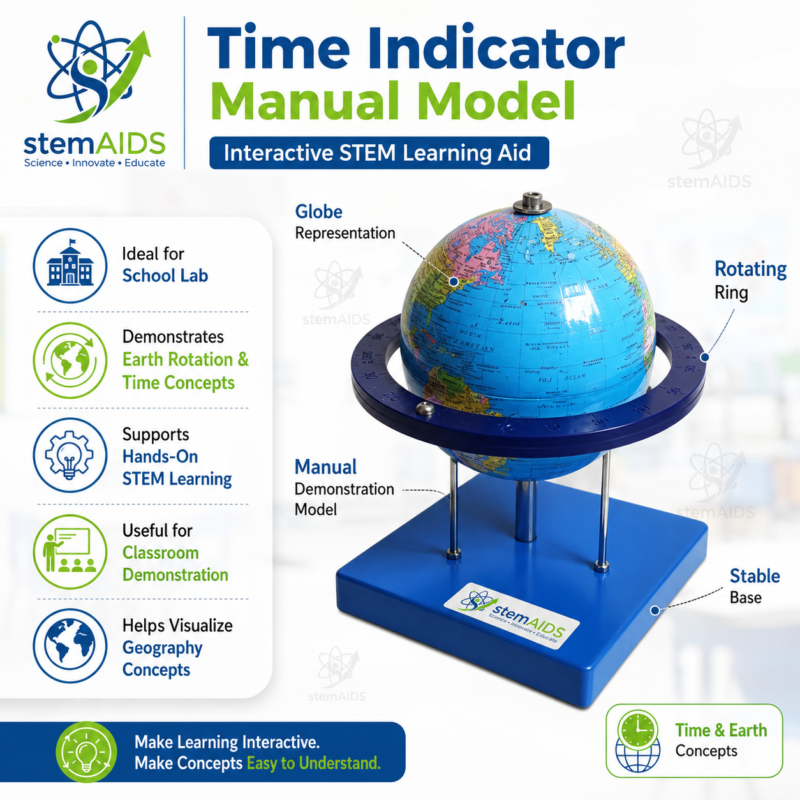
Time Indicator Manual Model
Original price was: $6.20.$2.99Current price is: $2.99.
Quick Answer: The Time Indicator Manual Model is a teaching clock whose hands are set by hand rather than driven by a movement, so a teacher can show any time instantly. It is used to teach reading an analogue clock, from o’clock and half past through quarter hours to five-minute intervals and elapsed time.
Teaching Time With a Hand-Set Clock
A real wall clock is too slow for teaching: the class cannot wait twenty minutes to see what twenty past looks like. With the time indicator manual model the teacher moves the hands to whatever time the lesson needs, asks students to read it, then lets them set times for each other. Most curricula build the skill in stages, starting with o’clock and half past, moving on to quarter past and quarter to, and then to five-minute steps around the dial.
One of the most common errors the model helps correct is the position of the hour hand. At half past three it should sit halfway between the 3 and the 4, not pointing straight at the 3. If the model’s hands are geared, turning the minute hand carries the hour hand round automatically, which shows this movement clearly; with free hands, the teacher places both deliberately and can use the error as a discussion point.
From Clock Face to Earth’s Rotation
The model also links arithmetic to astronomy. A day is one rotation of Earth, and dividing 360 degrees by 24 hours gives 15 degrees per hour, the basis of time zones. Placing the clock beside a globe lets older students see why noon in one country is early morning in another.
Applications
- Early-primary lessons on o’clock, half past, quarter past and quarter to
- Five-minute and one-minute reading practice with the whole class
- Elapsed-time problems, such as how long a lesson or journey lasts
- Converting between 12-hour and 24-hour time for timetables
- Linking time zones to Earth’s rotation in geography
Specifications
| Type | Manual demonstration clock face |
| Hands | Hour and minute hands set by hand |
| Topics | Analogue time reading, elapsed time, 12- and 24-hour time |
| Level | Early and upper primary mathematics |
| Geared or free hands, size | Confirm at enquiry |
Care & Handling
- Move the hands of the time indicator manual model clockwise and by the hand tips rather than the centre boss, to avoid loosening the fixing.
- Keep it flat or hung on a hook when not in use so the hands are not bent.
- Wipe the face with a slightly damp cloth and dry it immediately.
Why Choose LabEquip
Primary teachers and maths departments usually buy a demonstration clock for the front of the room and sometimes smaller clocks for pairs of students. LabEquip includes this model with its Astronomy Lab Kits, and it pairs with the Political World Globe for time-zone work. Ask about quantities through the contact page.
Frequently Asked Questions
Does the hour hand move when the minute hand is turned?
That depends on whether the clock is geared, which should be confirmed when you enquire. Geared clocks move both hands together and show the hour hand’s gradual progress; free-hand clocks let the teacher set each hand independently.
Why does the hour hand sit between two numbers at half past?
The hour hand moves steadily over the whole hour, not in jumps. At half past three it has travelled halfway from the 3 to the 4. Pointing it straight at the 3 is one of the most common mistakes children make.
In what order should analogue time be taught?
Most schemes start with o’clock, then half past, then quarter past and quarter to, then five-minute intervals, and finally reading to the nearest minute. Each step builds on the idea of the minute hand going round the clock once per hour.
How can the model help with elapsed time?
Set the start time, then move the minute hand forward while students count the minutes or hours passed. Seeing the hand travel makes it easier to solve problems such as a film starting at 4:40 and ending at 6:15.
How do I connect the clock to the 24-hour system?
Show a time on the clock, then ask whether it is morning or afternoon. For afternoon and evening times, add 12 to the hour: quarter past seven in the evening becomes 19:15. Railway and bus timetables make good practice material.
How does time relate to Earth’s rotation?
Earth turns once in about 24 hours, which is 15 degrees of longitude per hour. That is why time zones are roughly 15 degrees wide and why it is later in the day in countries to the east.
Last Updated: September 2026
You must be logged in to post a review.
Bestsellers

Sale
Sale

Sale
Sale

Sale

Sale

Sale


Reviews
There are no reviews yet.