








Sale
In Stock
Ten Metal Collection
Original price was: $5.64.$2.71Current price is: $2.71.
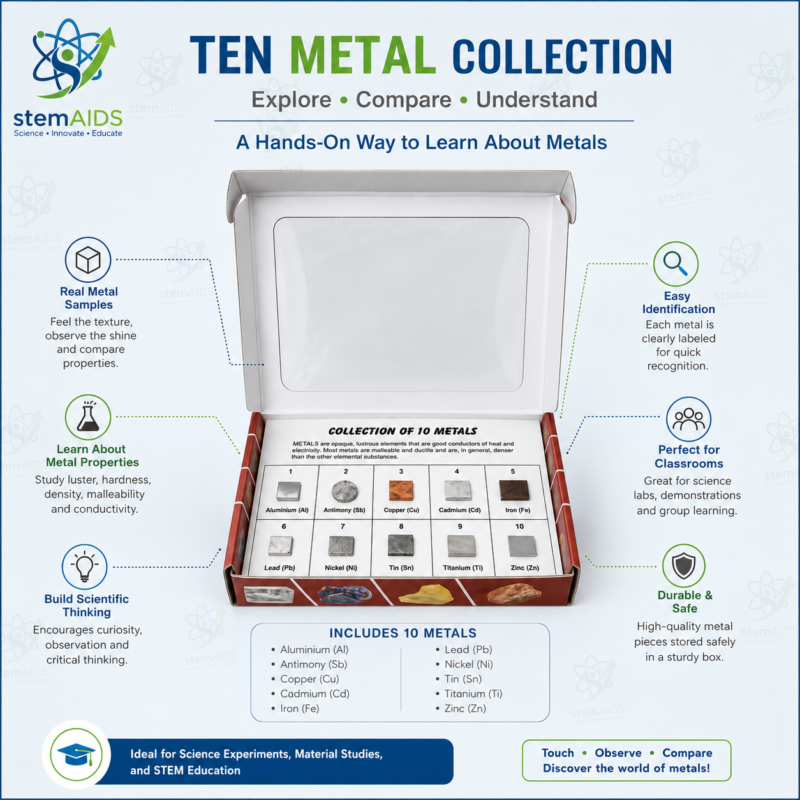
Quick Answer: The Ten Metal Collection is a set of ten real metal specimens that students can hold and test side by side, comparing colour, lustre, density, magnetism and how well each conducts heat. It turns the textbook list of metallic properties into observations made on actual samples.
Why Real Specimens Beat a Table of Properties
A table can say that aluminium is light and lead is heavy, but a student who picks up two similar-sized pieces feels the difference immediately. The ten metal collection gives a class ten such comparisons at once. Colour separates copper and brass-type alloys from the grey and silver metals; lustre shows on freshly cleaned faces and fades where a sample has oxidised; and a simple magnet test divides the set sharply into the few metals that are attracted and the many that are not.
That magnet test is often the most useful lesson in the box, because many students assume every metal sticks to a magnet. Iron, nickel and cobalt and most steels are attracted; aluminium, copper, zinc, tin, lead and brass are not. With a balance and a measuring cylinder the same specimens can also be used for density measurements, and the calculated values can be checked against published figures to identify an unknown sample.
Specifications
| Contents | Ten metal specimens |
| Properties observable | Colour, lustre, relative density, magnetic behaviour, feel of heat conduction |
| Used with | Magnet, balance, measuring cylinder, simple conductivity circuit |
| Level | Middle school to senior secondary science and chemistry |
| Metals included and specimen size | Confirm at enquiry |
Classroom Uses
- Sorting metals into magnetic and non-magnetic groups with a bar or horseshoe magnet
- Measuring mass and volume by displacement to calculate density
- Showing that all metals conduct electricity using a cell, bulb and leads
- Comparing tarnished and freshly cleaned surfaces to discuss oxidation and corrosion
- Identifying an unknown sample from its measured density and appearance
Care & Handling
- Wash hands after handling the specimens, and do not let younger students put samples near their mouths.
- Keep the set dry and in its box or tray so that iron-based samples do not rust and labels stay with the right metal.
- Do not heat the specimens or place them in acids unless the teacher has planned a specific experiment, since some metals react or melt easily.
Why Choose LabEquip
Science departments often keep one metal collection per bench group for properties-of-materials lessons. LabEquip lists this set in its Astronomy Lab Kits section; for the magnetism test, the Horseshoe Magnet does the job well. Ask about the specimen list and quantities through LabEquip’s contact page.
Frequently Asked Questions
Which metals are in the set?
The listing confirms ten specimens but not the exact metals, so confirm the list when you enquire. School collections usually draw on common metals such as aluminium, copper, iron, zinc, lead, tin and nickel, often with an alloy such as brass.
How can students tell which samples are magnetic?
Bring a magnet close to each specimen. Iron, nickel, cobalt and most steels are attracted; aluminium, copper, zinc, tin, lead and brass are not. It is a quick way to correct the idea that all metals are magnetic.
How do we measure the density of a specimen?
Weigh the sample on a balance, then lower it into a measuring cylinder of water and note the rise in level, which equals its volume. Divide mass by volume and compare the result with a data table.
Why do some samples look dull instead of shiny?
Most metals react slowly with air to form a thin oxide or tarnish layer. Copper darkens and lead turns grey. Rubbing a small area with fine emery paper exposes the metallic lustre underneath and shows students the difference.
Why do the metals feel colder than wood at the same temperature?
Metals conduct heat quickly, so they draw warmth away from the hand faster than wood or plastic, which feels like coldness. All the specimens are actually at room temperature, which is a useful point for a lesson on thermal conduction.
Are the specimens safe for students to handle?
Yes, with sensible precautions: handle over a tray, wash hands afterwards, particularly if a lead sample is included, and keep samples away from mouths and food. Heating or acid tests should be demonstrated by the teacher.
Last Updated: September 2026
You must be logged in to post a review.
Bestsellers
Sale
Sale
Sale

Sale
Sale

Sale
Sale


Reviews
There are no reviews yet.