

Sale
In Stock
Solar System Working Model
Original price was: $7.90.$3.84Current price is: $3.84.
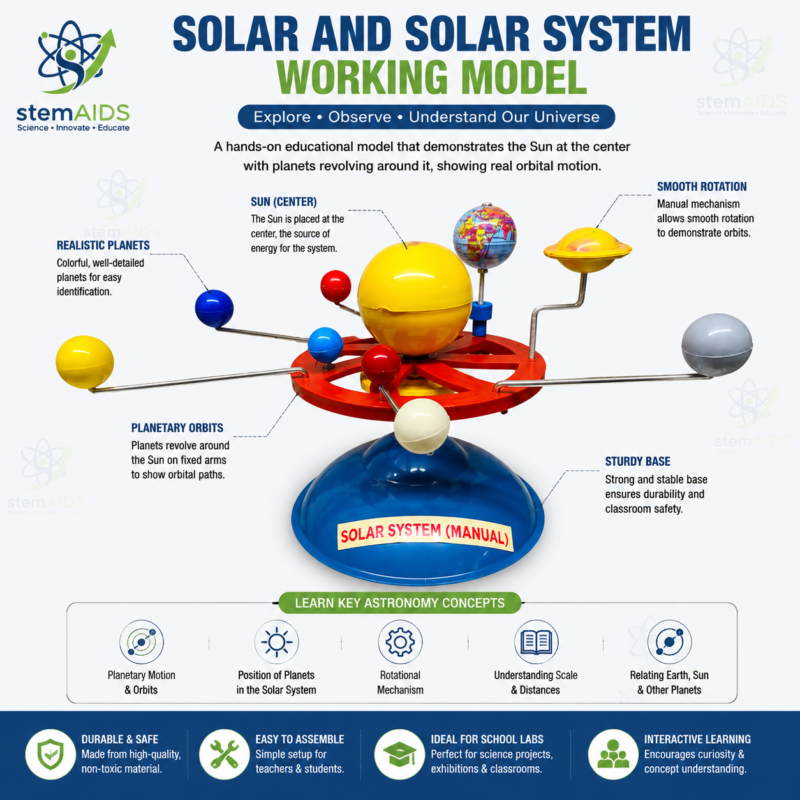
Quick Answer: The Solar System Working Model is a teaching model in which the planets can be moved around a central Sun, showing their order outwards from Mercury to Neptune and the idea of revolution. It is used to introduce the solar system as a moving system rather than a static poster.
A Moving Picture of the Solar System
A poster shows the planets in a straight line; the solar system working model shows them in orbit. Moving the planets round the Sun lets the teacher explain the difference between revolution, one trip around the Sun that defines a planet’s year, and rotation, the spin on its axis that gives day and night. The order of the planets becomes a spatial memory rather than a list: small rocky worlds close in, gas and ice giants far out.
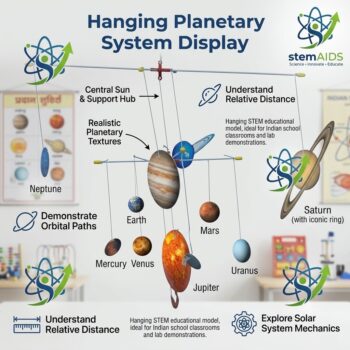
The model is also the place to discuss what a model cannot do. No classroom model can show sizes and distances to the same scale: if Earth were a 1 cm bead, the Sun would be about a metre across and some 117 metres away, and Neptune would sit more than three kilometres off. Asking students to work this out is an effective lesson in scale. For a static display alternative, the Hanging Planetary System Display suits ceilings and corridors.
Applications
- Teaching the order of the planets and grouping them into rocky and giant planets
- Showing revolution versus rotation, and relating a planet’s year to its distance from the Sun
- Introducing Kepler’s observation that inner planets orbit faster
- Discussing dwarf planets and the asteroid belt between Mars and Jupiter
- Science exhibitions and open days
Specifications
| Type | Working (moving) model of the solar system |
| Shows | Sun with the planets in order from Mercury to Neptune |
| Concepts | Revolution, rotation, planetary order |
| Scale | Not to scale for size or distance (as with all classroom models) |
| Drive (manual or motorised) and size | Confirm at enquiry |
Care & Handling
- Operate the solar system working model gently and in one direction; do not push planets past a stop or bend their support arms.
- Keep it covered on a stable shelf; long arms are easily knocked.
- If it is motorised, remove batteries or unplug it after lessons.
Why Choose LabEquip
Primary and middle-school science teachers use this model as the centrepiece of a solar system unit, often next to the Sun Structure Model for the star itself. LabEquip offers both within its Astronomy Lab Kits. Share the quantities your school needs on the contact page.
Frequently Asked Questions
Why is Pluto no longer counted as a planet?
In 2006 the International Astronomical Union defined a planet as a body that orbits the Sun, is nearly round and has cleared its orbital neighbourhood. Pluto shares its region with many other icy bodies, so it was reclassified as a dwarf planet.
Is the model to scale?
No classroom model can be. At a scale where Earth is 1 cm across, the Sun would be about a metre wide and 117 metres away. Working models use equal spacing or compressed distances so the order and motion can be seen.
Why do the inner planets move faster?
The Sun’s gravity is stronger closer in, so inner planets must travel faster to stay in orbit, and they also have shorter paths. Mercury circles the Sun in about 88 days, while Neptune takes about 165 years.
What is the difference between rotation and revolution?
Rotation is a planet spinning on its own axis, which gives day and night. Revolution is its journey around the Sun, which defines its year. Earth rotates once a day and revolves once a year.
How can students remember the order of the planets?
A mnemonic helps: My Very Educated Mother Just Served Us Noodles, for Mercury, Venus, Earth, Mars, Jupiter, Saturn, Uranus and Neptune. Students enjoy writing their own versions.
Where is the asteroid belt?
Between the orbits of Mars and Jupiter. It holds many rocky bodies of different sizes, including the dwarf planet Ceres, and marks the boundary between the rocky inner planets and the giant outer planets.
Last Updated: September 2026
You must be logged in to post a review.
Bestsellers

Sale
Sale
Sale

Sale
Sale
Sale
Sale


Reviews
There are no reviews yet.