
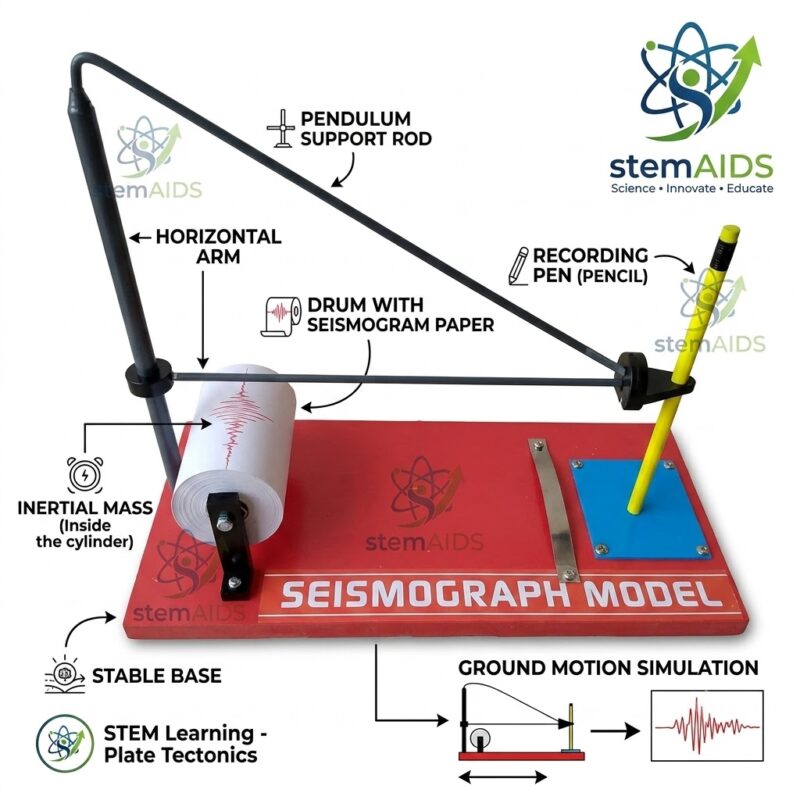
Quick answer: The Geological Seismograph Apparatus is an Earth-science teaching model that demonstrates how ground motion can be detected and recorded as a trace, illustrating the basic operating principle behind real seismographs used in earthquake monitoring.
Product Description
The LabEquip Geological Seismograph Apparatus provides a physical reference for explaining how relative motion between a supporting frame and an inertial mass can reveal vibration. In a conventional seismograph, ground movement causes the instrument frame to move while a suspended mass resists rapid motion because of inertia, and this relative motion is recorded as a trace.
The apparatus supports lessons on earthquake monitoring, seismic vibration and the inertia principle behind real seismographs.
Specifications
| Specification | Detail |
|---|---|
| Product name | Geological Seismograph Apparatus |
| Brand | LabEquip |
| Product category | Earth science / geology laboratory apparatus |
| Primary function | Demonstrating how ground motion is detected and recorded via inertia |
Suggested Use
- Set up the apparatus on a stable surface following the supplied instructions.
- Gently move or vibrate the supporting frame to simulate ground motion.
- Observe how the suspended mass resists this motion due to inertia.
- Relate the observed trace or relative movement to how real seismographs record earthquakes.
Care & Maintenance
- Keep the frame and recording components clean and free of dust.
- Handle the suspended mass and its mounting gently to avoid misalignment.
- Store the apparatus in a stable, dry location when not in use.
- Check moving parts periodically for wear before classroom demonstrations.
Why Choose LabEquip
For related Earth-science and geology teaching resources, visit the LabEquip homepage to browse our full catalogue.
Related Products
- Seismograph Model: A seismograph model offered as an alternative design for comparing how ground motion is detected.
- Earth Layers Working Model: An Earth layers model showing the interior that earthquake waves travel through and reveal.
- Earth Globe Internal Structure: An Earth globe with its internal structure exposed, for relating earthquake depth to the layers.
Frequently Asked Questions
How does a seismograph detect ground movement?
A seismograph relies on inertia. Its frame is fixed to the ground and moves when the ground shakes, while a heavy suspended mass tends to stay still. The movement between the frame and the mass is what gets recorded, and this apparatus demonstrates that principle in a form students can watch.
What is the difference between a seismograph, a seismometer and a seismogram?
The seismometer is the sensor that responds to ground motion. A seismograph is the full instrument that records the motion, and the seismogram is the record it produces, a wavy trace on paper or screen. In everyday use seismograph and seismometer are often used for the same thing.
How can a seismograph be demonstrated in a classroom?
Stand the apparatus on a table and tap or shake the table gently, then more strongly, while students watch the suspended mass and the frame. Where the setup includes a pen and paper, pulling the paper at a steady speed during the shaking gives a trace whose height grows with the strength of the motion.
What are P-waves and S-waves on a seismogram?
P-waves, or primary waves, are push-pull waves that travel fastest and arrive first. S-waves, or secondary waves, shake the ground side to side, travel more slowly and cannot pass through liquid. On a seismogram the P-wave arrival is followed by the larger S-wave arrival, and the gap between them grows with distance from the earthquake.
How do scientists find where an earthquake started?
The time gap between the P-wave and S-wave arrivals at a station tells seismologists how far away the earthquake was. Drawing a circle of that radius around at least three stations on a map gives the epicentre where the circles meet, a method called triangulation.
What is the difference between earthquake magnitude and intensity?
Magnitude measures the energy released at the source and is a single number for each earthquake; each whole step on the scale means much more energy. Intensity describes how strongly shaking is felt and what damage it causes at a particular place, so one earthquake has many intensity values.
Last Updated: November 2026









Reviews
There are no reviews yet.