


Sale
In Stock
Anemometer Model
Original price was: $10.72.$5.25Current price is: $5.25.
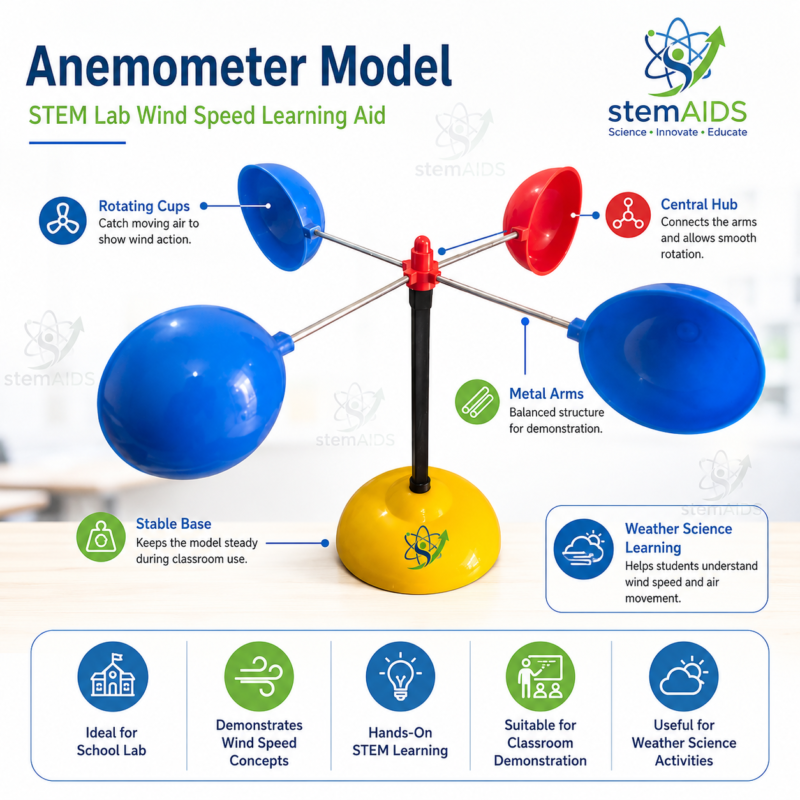
Quick Answer: The Anemometer Model is a teaching version of the instrument meteorologists use to measure wind speed. In the familiar cup design, cups mounted on arms turn about a vertical shaft, and the stronger the wind, the faster they spin.
How Spinning Cups Measure the Wind
Each cup catches more wind on its hollow side than on its rounded back, so the pressure difference turns the rotor in one direction whatever way the wind blows. Because rotation speed rises with wind speed, counting turns over a fixed time gives a measure of the wind. That independence from direction is why cup anemometers have been the standard design at weather stations for well over a century.
With an anemometer model students can do a first version of the measurement themselves. Marking one cup with tape, counting its turns for thirty seconds and repeating in different places around the school shows how buildings shelter or funnel the wind. Converting counts into a speed needs care: the cups move more slowly than the air, so a raw calculation gives a relative figure unless it is compared with a reference instrument.
Where It Sits in a Weather Unit
The anemometer measures speed only. A wind vane gives direction, and together they describe the wind as a weather report would. Linking the class readings to the Beaufort scale, which describes wind force from calm smoke rising straight up to storm damage, connects the numbers to what students can see outside.
Specifications
| Type | Educational model of a wind-speed instrument |
| Principle | Cups rotate faster as wind speed increases |
| Measures | Relative wind speed by counting rotations |
| Subjects | Geography, environmental science, physics |
| Construction and mounting | Confirm at enquiry |
Applications
- School weather-station projects recording daily wind alongside temperature and rainfall
- Comparing sheltered and exposed spots in the school grounds
- Indoor demonstrations with an electric fan at different settings
- Introducing the Beaufort scale and the difference between wind speed and direction
Care & Handling
- Check that the rotor of the anemometer model spins freely before each use; a light touch of oil on a metal bearing helps if it sticks.
- Bring it indoors after outdoor readings, particularly before rain or strong winds.
- Store with the cups protected so they are not dented or bent out of line.
Why Choose LabEquip
Geography teachers building a school weather station, and primary teachers running a weather topic, are the usual buyers. LabEquip lists this model within its Astronomy Lab Kits, and a complete Weather Station is also available for fuller recording. Use the contact page for quantities.
Frequently Asked Questions
How does a cup anemometer measure wind speed?
Wind pushes harder on the open side of each cup than on the curved back, so the rotor turns. The rotation rate increases with wind speed, and counting turns over a set time gives a measure of how fast the air is moving.
Can students get an accurate wind speed from the model?
They get a reliable comparison, such as which part of the grounds is windiest. An absolute speed needs a conversion factor, because the cups travel slower than the wind, and that factor comes from checking against a calibrated instrument.
What is the difference between an anemometer and a wind vane?
An anemometer measures wind speed. A wind vane swings to point into the wind and shows its direction. Weather reports need both, which is why the two usually stand side by side at a weather station.
Where should the anemometer be placed outdoors?
In an open spot, well away from walls and trees that block or channel the wind, and as high as practical. Official weather stations measure wind 10 metres above open ground so readings from different sites can be compared.
What is the Beaufort scale?
A scale from 0 to 12 that describes wind force by its visible effects, from calm, when smoke rises vertically, through branches swaying, up to hurricane force. Students can match their counts to it as a cross-check.
Can the model be used indoors?
Yes. An electric fan on low, medium and high settings gives three steady wind speeds, and students can count rotations at each to show the relationship between air speed and rotor speed before going outside.
Last Updated: September 2026
You must be logged in to post a review.
Bestsellers

Sale
Sale

Sale

Sale

Sale

Sale

Sale


Reviews
There are no reviews yet.