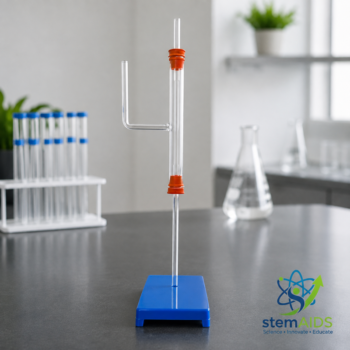
The Ostwald Viscosity Tube is a capillary laboratory instrument used for determining or comparing the viscosity of liquids from their gravity-driven flow time. It is intended for supervised chemistry, pharmacy, college, university, and research laboratory experiments where users need a simple method for studying viscosity under controlled temperature conditions.
Product Description
The STEMAids Ostwald Viscosity Tube is intended for capillary-flow viscosity experiments. An Ostwald viscometer uses two reference marks and a narrow capillary section. The time required for a liquid meniscus to pass between the marks provides the experimental flow-time value used in viscosity calculations.
Reliable results require clean glassware, vertical positioning, stable temperature, and consistent filling technique. The exact STEMAids glass grade, nominal capacity, capillary bore, calibration constant, dimensions, and viscosity range are [confirm]. Related equipment is available under Laboratory Glassware and General Lab Products.
Key Features
- Capillary viscosity measurement: Uses gravity-driven flow through a narrow capillary for viscosity experiments.
- Timed-flow method: Allows users to record the time taken for a liquid meniscus to pass between reference marks.
- Comparative measurements: Supports comparison of an unknown liquid with a reference liquid of known viscosity.
- No electrical power required: Operates through gravity and capillary flow.
- Useful for physical chemistry: Demonstrates relationships between viscosity, density, temperature, and flow time.
- Reusable laboratory format: Can be cleaned and reused when handled according to laboratory procedures.
- Critical specifications: Glass grade, capillary bore, constant, capacity, and tolerance are [confirm].
Technical Specifications
|
Specification |
Detail |
|
Product Name |
Ostwald Viscosity Tube |
|
Brand |
STEMAids |
|
Product Type |
Gravity-flow capillary viscometer |
|
Application |
Determination or comparison of liquid viscosity |
|
Material |
Glass; grade |
What’s Included in the Kit
- Ostwald Viscosity Tube
- Rubber suction tubing
- Clamp or support
- Instruction sheet
- Additional accessories
Applications / Uses
- Comparing viscosities of compatible Newtonian liquids.
- Determining relative viscosity using a reference liquid.
- Studying the effect of temperature on viscosity.
- Physical chemistry practical experiments.
- Pharmacy and formulation laboratory demonstrations.
- Teaching capillary flow and fluid-property measurement.
How to Use the Ostwald Viscosity Tube
- Clean and dry the viscometer according to the laboratory procedure.
- Add the required quantity of test liquid to the appropriate section.
- Mount the tube vertically and bring it to the specified test temperature.
- Draw the liquid above the upper timing mark using the approved suction method.
- Allow the liquid to flow freely under gravity.
- Start timing as the meniscus crosses the upper mark and stop when it crosses the lower mark.
- Repeat the measurement until consistent flow times are obtained.
- Calculate viscosity using the appropriate viscometer equation, density data, and calibration information.
Safety note: Secure the glass tube vertically and avoid excessive suction or pressure. Handle test liquids according to their safety data and maintain the specified temperature during measurements.
Care & Maintenance
- Clean the capillary thoroughly after every test because residues can alter flow time.
- Use cleaning agents compatible with both the sample and the confirmed glass grade.
- Inspect the capillary and bulbs for contamination, cracks, or blockage before use.
- Store the tube where the narrow capillary sections are protected from impact.
Why Choose STEMAids
STEMAids supplies laboratory instruments, educational apparatus, science models, and STEM learning products for institutional users. Its online catalogue includes laboratory analytical instruments and general laboratory equipment for academic and professional applications. Buyers sourcing complementary equipment can explore Lab Experiment Practice Kits and the complete STEMAids product catalogue.
Frequently Asked Questions
What is an Ostwald Viscosity Tube used for?
An Ostwald Viscosity Tube is used to determine or compare liquid viscosity by measuring the time required for a liquid to flow through a calibrated capillary between reference marks.
How does an Ostwald viscometer work?
The liquid flows through a narrow capillary under gravity. Its flow time, density, and applicable viscometer constant or reference-liquid data are used to determine viscosity.
Why is temperature important in viscosity measurement?
Liquid viscosity changes with temperature. Accurate comparisons therefore require measurements to be performed at a controlled and recorded temperature.
Can an Ostwald viscometer measure relative viscosity?
Yes. A test liquid can be compared with a reference liquid of known viscosity and density when both are measured under equivalent conditions.
What glass is the STEMAids Ostwald Viscosity Tube made from?
The apparatus is made from glass, but the exact glass grade is [confirm]. Borosilicate 3.3 or another specific composition should not be claimed until verified.
Is the Ostwald Viscosity Tube suitable for college laboratories?
Yes. Its operating principle is suitable for supervised college, university, pharmacy, and physical chemistry practicals involving viscosity and capillary flow.