
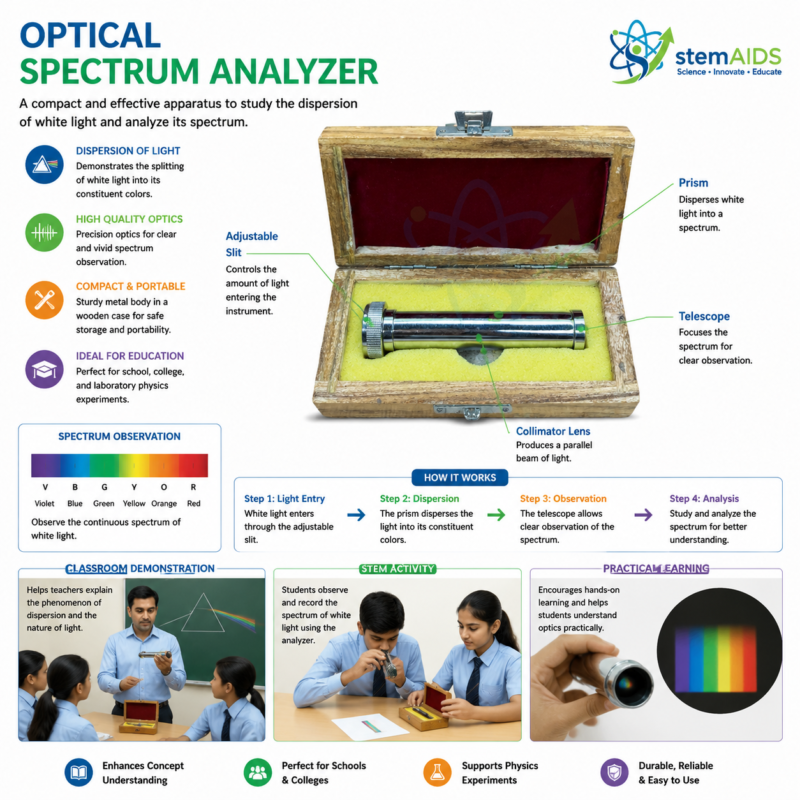
Quick Answer: The Optical Spectrum Analyzer is a hand-held direct-vision spectroscope: a metal tube with a narrow slit at one end and a dispersing prism system inside, kept in a fitted wooden case. Pointed at a light source, it shows the source’s spectrum as a band of colour or a set of bright lines, so students can compare lamps, flames and daylight.
Looking Through a Pocket Spectroscope
In the listing image the optical spectrum analyzer is a polished metal tube with a knurled end, resting in a hinged wooden box lined with soft material. The labels on the image mark an adjustable slit at the entry end, a collimating lens and a prism inside the tube. In pocket spectroscopes of this direct-vision type, the prism is usually a train of glass prisms of different kinds that spreads the colours while keeping the middle of the spectrum in line with the tube, so the user looks straight at the source.
The slit sets the quality of the view. Narrowed, it gives sharp lines that are easy to tell apart; opened, it lets in more light for faint sources at the cost of blurring. What students see depends on the source. A filament lamp gives a continuous band from red to violet. Sodium in a flame gives a bright yellow line, and a fluorescent tube shows the violet, green and yellow lines of mercury on top of broader glowing bands. Daylight reflected from a white cloud shows a continuous spectrum crossed by thin dark Fraunhofer lines.
Those bright and dark lines are what make spectroscopy useful: each element emits and absorbs at its own set of wavelengths, which is how chemists identify metals in flame tests and how astronomers learn what stars are made of. For a larger bench viewer suited to a first lesson on dispersion, see the Wooden Optical Spectrum Analyzer. Whether this tube has a wavelength scale should be confirmed at enquiry.
Specifications
| Instrument type | Hand-held direct-vision spectroscope |
| Body | Metal tube with knurled slit end, as pictured |
| Optics | Slit, collimating lens and prism system, as labelled in the listing image |
| Case | Fitted wooden box with lined interior |
| Viewing | By eye, looking along the tube at the source |
| Wavelength scale | Confirm at enquiry |
Applications
- Comparing continuous and line spectra from different lamps
- Identifying sodium and other metal lines during flame tests
- Observing Fraunhofer absorption lines in reflected daylight
- Introducing spectroscopy in chemistry and astronomy lessons
Care & Handling
- Never point the spectroscope at the Sun, a laser or a welding arc.
- Keep dust out of the slit by storing the tube closed in its case; blow dust away rather than wiping it.
- Do not unscrew the tube, as the prisms inside are aligned.
- Keep the tube at a safe distance from flames during flame tests.
Why Choose LabEquip
Physics and chemistry teachers buy pocket spectroscopes for flame tests and for lessons on atomic spectra, and astronomy clubs use them to introduce stellar composition. LabEquip supplies this one through the STEM kits range; our contact page can confirm the scale and slit details.
Frequently Asked Questions
Is this an electronic optical spectrum analyser?
No. It is a visual instrument with no electronics or display. Electronic optical spectrum analysers measure signal power against wavelength in fibre-optic networks, whereas this spectroscope lets a person see the colours and lines in visible light directly.
What is the difference between a continuous spectrum and a line spectrum?
A hot solid such as a lamp filament gives an unbroken band of colours from red to violet. A hot gas or vapour, such as sodium in a flame or mercury in a fluorescent lamp, gives only bright lines at particular colours, which identify the element.
How should the slit be adjusted?
A narrow slit gives sharp, well-separated lines but less light, while a wider slit is brighter but blurs the lines together. Open it to find the spectrum first, then close it until the lines look crisp.
How can students see the dark lines in sunlight safely?
Point the spectroscope at sunlight reflected from a white cloud or a sheet of white paper, never at the Sun itself. Thin dark Fraunhofer lines then appear across the continuous spectrum, caused by gases absorbing light in the Sun’s outer layers.
What does direct vision mean?
In a direct-vision spectroscope, a combination of prisms spreads the colours while keeping the middle of the spectrum in line with the tube. The user looks straight at the source instead of viewing at an angle, as a single prism would require.
Which light sources work well in class?
Filament and LED lamps, fluorescent tubes and flame tests with metal salts give a good range. Gas discharge tubes of hydrogen, helium or neon show clear line spectra that students can compare with published wavelengths.
Last Updated: September 2026






Reviews
There are no reviews yet.