
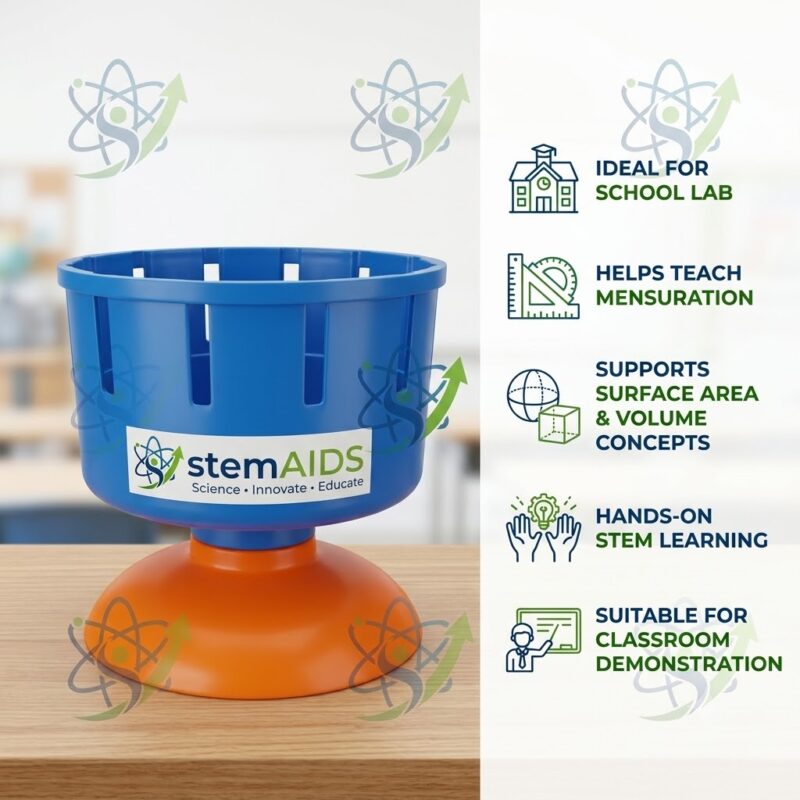
The Zoetrope Working Model is an educational optical-animation device used for demonstrating how a rapid sequence of still images can create the appearance of continuous movement. It helps students, art teachers, science instructors and media educators explore animation frames, visual perception, rotation speed and early motion-picture technology.
Product Description
The STEMAids Zoetrope Working Model uses a rotating cylindrical drum with regularly spaced viewing slots. A strip of sequential drawings is placed around the inner wall so that each image shows a slightly different stage of an action.
When the drum rotates and the viewer looks through the slots, the slots separate the images into brief visual samples. The sequence is perceived as an animated movement rather than a set of independent drawings. The exact drum construction, image-strip size, frame count and rotation method must be confirmed against the current STEMAids specification.
Key Features
- Creates apparent motion: Converts a sequence of static images into a repeating animated scene.
- Demonstrates frame sequencing: Shows how small changes between consecutive pictures produce movement.
- Uses a slotted viewing drum: Helps reduce visual smearing by revealing one image position at a time.
- Supports speed comparison: Allows learners to observe how rotation rate affects animation clarity and playback speed.
- Introduces early animation technology: Provides a practical reference for pre-cinema optical devices.
- Encourages creative production: Learners can design compatible image strips where blank templates are supplied.
- Suitable for interdisciplinary teaching: Supports science, art, design, media and history activities.
Technical Specifications
|
Specification |
Detail |
|
Product name |
Zoetrope Working Model |
|
Brand |
STEMAids |
|
Product category |
Optical-animation model / visual-perception teaching aid |
|
Display capacity |
One rotating sequential-image animation setup |
|
Learning concepts |
Animation frames, apparent motion, visual sampling, rotation and image sequencing |
|
Power requirement |
No power required for a manual model; [confirm current configuration] |
|
Intended users |
School students, science teachers, art instructors and media-learning centres |
|
Standards or certifications |
No product-specific certification publicly verified |
What’s Included in the Kit
- Slotted cylindrical zoetrope drum
- Sequential animation strips
- Blank strip templates for student activities
- Motor, switch or power accessory
- Operating and activity instructions
Applications and Uses
- Demonstrating apparent motion from sequential still images.
- Teaching frames, loops and animation timing.
- Investigating the effect of rotation speed on image clarity.
- Introducing historical optical toys and early cinema.
- Creating student-designed animation sequences.
- Supporting art, physics, media and STEAM exhibitions.
How to Use the Zoetrope Working Model
- Place the model on a stable, level surface.
- Select a compatible sequential-image strip.
- Position the strip around the inner wall with the images facing inward.
- Align the frames with the viewing slots where required.
- Rotate the drum smoothly using the supplied mechanism.
- Look through the slots toward the images on the opposite side.
- Adjust the rotation speed until the motion appears clear.
- Compare different strips or create a new looping sequence.
Safety and handling: Keep fingers, hair and loose clothing clear of rotating parts. Do not overspeed the drum or operate a motorised version with damaged wiring or an unstable base.
Care & Maintenance
- Remove dust from the drum and slots with a soft, dry cloth.
- Keep the spindle or rotating base free from paper fragments and debris.
- Store animation strips flat or gently rolled to prevent creasing.
- Disconnect any motorised version before inspection or cleaning.
Why Choose STEMAids
STEMAids develops educational models, STEM kits and laboratory products for practical classroom instruction. Buyers can explore related educational science models, physics laboratory products, STEM learning kits and the complete scientific and educational product range. Buyers should request the current drum dimensions, frame template, rotation system, component list and product photographs before procurement.
Frequently Asked Questions
What is a Zoetrope Working Model used for?
It is used to demonstrate how sequential still images can appear to move when viewed rapidly through slots in a rotating drum.
Why does a zoetrope have viewing slots?
The slots provide brief, separated views of successive frames and reduce the continuous blur that would otherwise occur during rotation.
Does the model require electricity?
A manually rotated zoetrope requires no electricity. Confirm whether the current STEMAids version includes a motor or powered base.
Can students make their own animation strips?
Yes, provided the strip dimensions and frame spacing match the drum. Confirm whether blank templates are supplied.
Why does the animation appear blurred?
Blur may result from incorrect speed, poor lighting, misaligned frames, unsuitable slot spacing or viewing from the wrong position.
Is the Zoetrope Working Model suitable for schools?
Yes. It is suitable for supervised science, art, media, design and STEAM activities.
Explore more educational science models from STEMAids for optics, visual perception and classroom demonstrations.
Recommended primary image ALT text: Zoetrope Working Model with slotted rotating drum and sequential animation strip.
Recommended detail image ALT text: Educational zoetrope showing viewing slots, image frames and rotating base.
Recommended application image ALT text: Student observing animated images through a rotating Zoetrope Working Model.


Reviews
There are no reviews yet.