
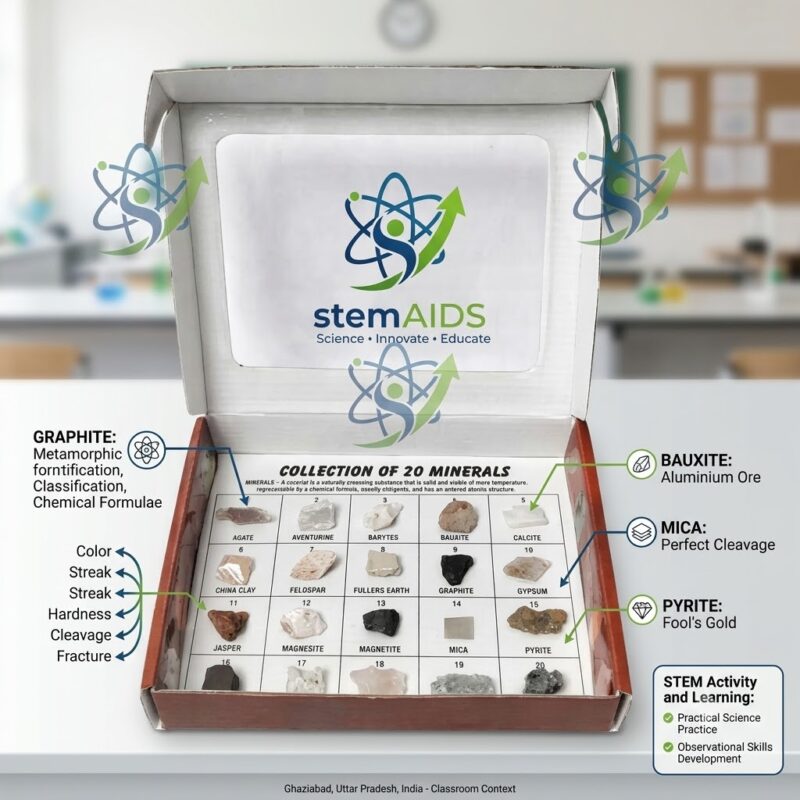
Quick answer: The Twenty Mineral Specimen Collection is a set of 20 real mineral samples for hands-on Earth-science study, letting students examine colour, lustre, texture and crystal form to learn mineral classification and properties.
Product Description
The LabEquip Twenty Mineral Specimen Collection brings 20 mineral samples together for comparative Earth-science study. Learners can examine observable properties such as colour, lustre, texture, crystal form and surface features before using an approved identification key.
Physical specimens make mineral classification more tangible than photographs alone, supporting lessons on mineral properties and geological significance.
Specifications
| Specification | Detail |
|---|---|
| Product name | Twenty Mineral Specimen Collection |
| Brand | LabEquip |
| Product category | Earth science / geology laboratory specimen collection |
| Number of specimens | 20 mineral samples |
Suggested Use
- Distribute or display specimens for students to examine under supervision.
- Ask students to record observations on colour, lustre, texture and crystal form before identification.
- Use an approved identification key to confirm each mineral after initial observation.
- Discuss the geological significance and common uses of each identified mineral.
Care & Maintenance
- Handle specimens carefully to avoid chipping or breakage.
- Return each specimen to its labelled position in the collection after use.
- Store the collection in a dry location to prevent moisture damage to labels or softer specimens.
- Wash hands after handling specimens, particularly before eating.
Why Choose LabEquip
For related Earth-science teaching resources, see our Twenty Rock Specimen Collection, Geological Seismograph Apparatus, or visit the LabEquip homepage to browse our full catalogue.
Related Products
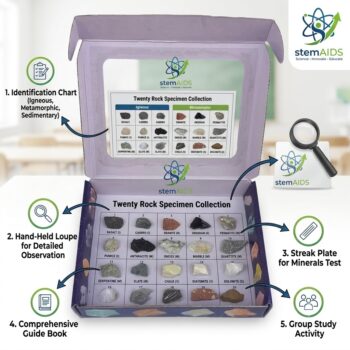
- Twenty Rock Specimen Collection: A rock collection that shows how the minerals in this set combine to form rocks.
- Mineral Test Kit: A mineral test kit for carrying out hardness, streak and other identification tests.
- Mohs Hardness Set, Collection of 9 Mohs Hardness Set: A Mohs hardness set for comparing specimens against the standard minerals on the scale.
- Streak Plates, Glass: Glass streak plates for checking the streak colour of each mineral specimen.
- Hand Lens/Magnifier All Metal: An all-metal hand lens for examining crystal shape and lustre up close.
Frequently Asked Questions
What is the difference between a mineral and a rock?
A mineral is a naturally formed solid with a definite chemical composition and an ordered crystal structure, such as quartz or calcite. A rock is made of one or more minerals mixed together, such as granite, which contains quartz, feldspar and mica. Studying minerals first makes rocks easier to identify.
How do you identify a mineral specimen?
Check several properties: colour, lustre (metallic or non-metallic), streak, hardness, cleavage or fracture, and sometimes density or magnetism. No single test is enough, so students record each result and then compare them with an identification key.
What is the Mohs hardness scale?
It ranks minerals from 1 (talc, the softest) to 10 (diamond, the hardest) by which can scratch which. A fingernail is about 2.5, a copper coin about 3.5, glass about 5.5 and a steel knife about 6.5, so these everyday objects let students estimate a specimen’s hardness.
Why is colour not a reliable way to identify a mineral?
Small amounts of impurities can change a mineral’s colour; quartz, for example, can be clear, white, pink or purple. The streak, the colour of the powder a mineral leaves on unglazed porcelain, is much more consistent. Haematite looks grey or black but always gives a reddish-brown streak.
What tools do students need for mineral identification tests?
A streak plate of unglazed porcelain or glass, a hand lens, a steel nail, a copper coin and a magnet cover most school tests. A glass plate helps with hardness. For carbonate minerals a teacher may use dilute acid to show fizzing, with goggles.
How should a mineral specimen collection be stored?
Keep each specimen in its labelled place in the box, in a dry area. Some minerals are soft or flake easily, so avoid knocking them together. Return specimens after each lesson to keep the set complete for the next class.
Last Updated: November 2026





Reviews
There are no reviews yet.