
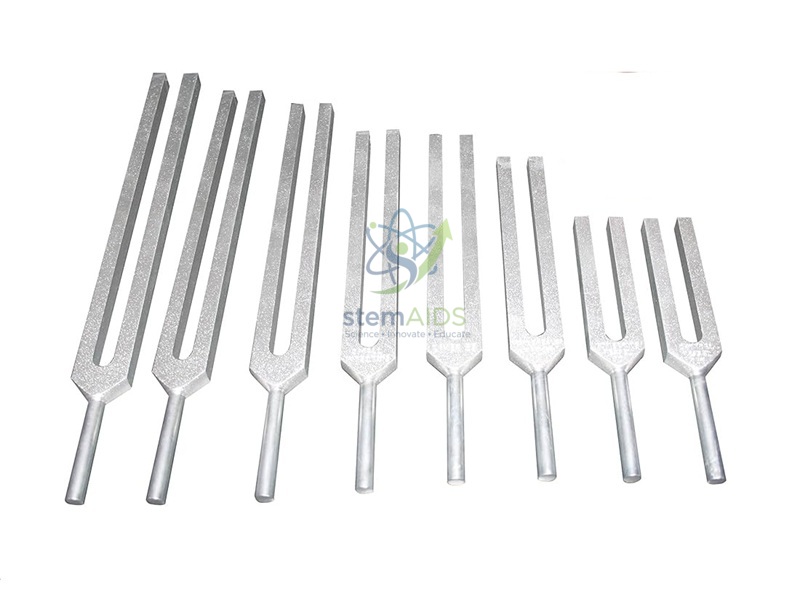
Quick Answer: A tuning fork set is a group of forks with different, graded frequencies, so that one measurement can be repeated at several pitches. The product photo shows eight forks stepping down in length, the arrangement used in resonance column and sonometer practicals where students plot a graph across the whole set.
Frequencies Found in a Typical Set
School and college sets of eight forks most often span one octave on the scientific scale, from 256 Hz (C in that scale) up to 512 Hz. The steps in between are commonly 288, 320, 341.3, 384, 426.7 and 480 Hz, following the just-intonation ratios 9/8, 5/4, 4/3, 3/2, 5/3 and 15/8. Sets with other ranges exist, so check the stamped frequencies.
The forks get shorter as the frequency rises, and laying the set out in order on the bench shows this at a glance.
Graph Methods That Need a Full Set
In the resonance column practical, the first resonance length L for each fork satisfies L + e = v/4f, where e is the end correction at the open mouth of the tube. Plotting L against 1/f for every fork gives a straight line of gradient v/4, so the speed of sound comes from the slope while the end correction appears as the negative intercept. A single fork cannot separate the two.
On the sonometer, each fork is matched to a vibrating length l of the wire at fixed tension. The law of length predicts that the product of frequency and length stays constant, so a graph of f against 1/l should be a straight line through the origin, and its gradient equals half the wave speed on the wire.
Specifications
| Item | Set of tuning forks with graded frequencies |
| Shown in the product photo | Eight forks of decreasing length |
| Range commonly supplied | One octave, 256 to 512 Hz on the scientific C scale |
| Sounded by | Striking on a rubber pad or activator |
| Main practicals | Resonance column graph, sonometer law of length, pitch and frequency |
| Frequencies and storage case of this set | Confirm at enquiry |
Uses Across a Physics Course
- Speed of sound and end correction from a resonance column graph
- Verifying the law of length on a sonometer at constant tension
- Comparing the two ends of an octave set to show that doubling the frequency raises the pitch by one octave
- Introducing musical intervals and frequency ratios
Care & Handling
- Keep each fork in its own slot of a case or padded box so the prongs never knock against each other
- Return the forks to their places in frequency order after the practical, so a missing fork is noticed at once
- Sound the forks on a rubber pad or rubber activator, not on the bench or on each other
- Wipe off finger marks and moisture before storage to keep the prongs clean and free of corrosion
Why Choose LabEquip
Physics departments usually buy one tuning fork set per practical group, so every bench can run the resonance column or sonometer across the full frequency range. Individual tuning forks are listed separately for replacing a lost fork, and the sets sit in LabEquip’s physics lab equipment range; contact LabEquip to confirm the frequencies and number of forks supplied.
Frequently Asked Questions
Why use several forks instead of one in the resonance column experiment?
With several frequencies, resonance length can be plotted against 1/f. The slope gives the speed of sound and the intercept the end correction, so neither is estimated from the tube diameter, and a poor reading shows up off the line.
Can two forks from the set be used to demonstrate beats?
Not well. Neighbouring forks in an octave set differ by more than 20 Hz, which is too fast to hear as separate throbs and sounds instead like a rough chord. For beats, use two forks of the same marked frequency and load one prong of one fork with a little wax.
Why are the higher-frequency forks shorter?
A prong vibrates like a bar fixed at one end, and its natural frequency rises as the bar gets shorter, roughly with the inverse square of its length when thickness and metal stay the same. Halving the prong length would raise the frequency about four times.
How do the forks show that pitch depends on frequency?
In an octave set running from 256 to 512 Hz, sounding the lowest and highest forks one after the other lets students hear the same note an octave apart, with the frequency doubled. Sounding them in order plays a major scale.
How do I find the sonometer length that matches each fork?
Place a small paper rider at the middle of the wire, strike the fork and press its stem on the sonometer box. Move the bridge until the rider is thrown off; that length is in resonance with the fork. Repeat with each fork at the same tension.
How should a tuning fork set be stored?
In a case or box with a separate place for each fork, in frequency order and away from damp. Forks that knock together get nicked prongs that change their frequency, and a fixed layout makes it easy to see when one is missing.
Last Updated: October 2026




Reviews
There are no reviews yet.