
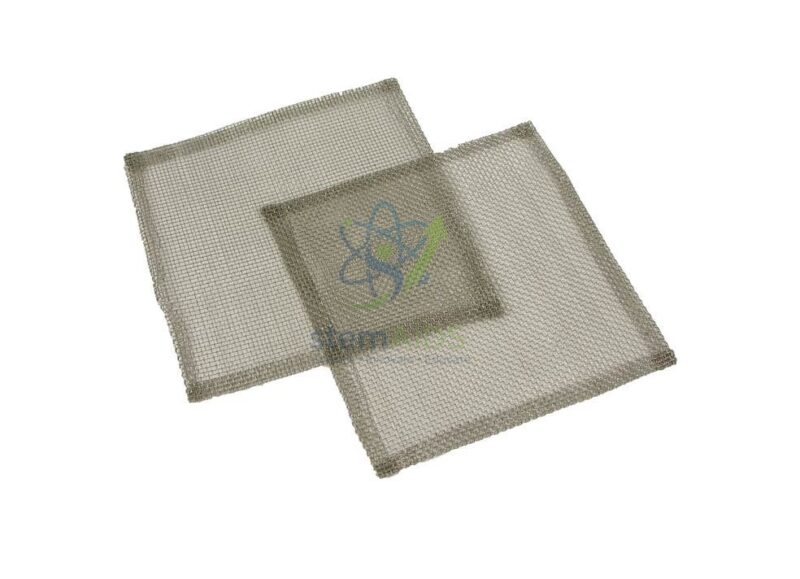
The StemAids Metal Mesh is a laboratory support accessory designed for use during heating experiments, flame-based practicals, glassware support, and controlled heat distribution. It is commonly used with a tripod stand, laboratory burner, Bunsen burner, spirit lamp, or heating setup to support beakers, flasks, crucibles, and other compatible laboratory vessels.
Product Description
The StemAids Metal Mesh provides a stable support surface between the flame source and laboratory glassware. It helps spread heat more evenly across the vessel base and reduces direct flame contact, supporting safer and more controlled heating during chemistry and general science experiments.
This metal mesh is suitable for school laboratories, college laboratories, chemistry labs, research labs, quality control labs, and educational science demonstrations. It is especially useful for heating liquids in beakers, supporting evaporating dishes, warming samples, and conducting basic laboratory heating procedures.
Product Specifications
| Parameter | Details |
|---|---|
| Product Name | Metal Mesh |
| Brand | StemAids |
| Product Type | Laboratory heating support mesh / wire gauze accessory |
| Material | Metal mesh / laboratory-grade wire mesh, depending on model |
| Application | Glassware support, heat distribution, flame heating, and laboratory demonstrations |
| Compatible Equipment | Tripod stand, Bunsen burner, laboratory burner, spirit lamp, ring stand, and heating setup |
| Suitable Vessels | Beakers, flasks, crucibles, evaporating dishes, and compatible laboratory containers |
| Use Area | School labs, college labs, chemistry labs, research labs, QC labs, and science training laboratories |
Key Features
- Designed for supporting laboratory glassware during heating
- Helps distribute heat more evenly across vessel bases
- Reduces direct flame contact with beakers and flasks
- Suitable for use with tripod stands and laboratory burners
- Useful for chemistry practicals, sample warming, and science demonstrations
- Simple, reusable, and easy to store after use
- Suitable for educational, research, and quality control laboratories
How to Use
- Place a tripod stand, ring stand, or compatible support setup on a stable laboratory bench.
- Position the StemAids Metal Mesh securely on top of the tripod or ring support.
- Place the beaker, flask, crucible, or compatible vessel carefully on the mesh.
- Set the burner or heating source below the mesh at the correct distance.
- Ignite the burner using a safe ignition method and adjust the flame as required.
- Heat the sample gradually and monitor the vessel throughout the experiment.
- After heating, turn off the flame and allow the mesh and vessel to cool.
- Use tongs or heat-resistant gloves when handling the hot mesh.
- Clean any residue after cooling and store the mesh in a dry laboratory area.
Applications
- Supporting beakers and flasks during heating
- Heat distribution in flame-based experiments
- Chemistry laboratory practicals
- Heating liquids and sample solutions
- Evaporation and warming procedures
- School and college science demonstrations
- Research and quality control laboratory heating setups
- General laboratory burner support applications
Safety and Handling Guidelines
- Use only on a stable tripod, ring stand, or suitable support system.
- Do not touch the metal mesh during or immediately after heating.
- Use tongs or heat-resistant gloves when handling hot mesh.
- Do not place cracked or unsuitable glassware on the mesh.
- Keep flammable materials away from the burner and heated mesh.
- Do not overload the mesh with heavy or unstable vessels.
- Allow the mesh to cool completely before cleaning or storage.
- Inspect the mesh regularly for rust, bending, breakage, or damage.
FAQ
1. What is the StemAids Metal Mesh used for?
It is used to support laboratory glassware during heating and to help distribute heat more evenly between the flame and the vessel.
2. Can metal mesh be used with a Bunsen burner?
Yes, it is commonly used with a Bunsen burner, laboratory burner, spirit lamp, tripod stand, or ring stand setup.
3. What vessels can be placed on the mesh?
Compatible beakers, flasks, crucibles, evaporating dishes, and laboratory containers may be placed on the mesh, depending on size and stability.
4. Why is metal mesh used during heating?
Metal mesh helps support the vessel and spreads heat across the base, reducing direct flame concentration on one point.
5. Is this product suitable for school laboratories?
Yes, it is suitable for school, college, university, chemistry, research, and general science laboratories under proper supervision.
6. Can the mesh be touched immediately after heating?
No, the mesh becomes hot during use. Allow it to cool or handle it with tongs or heat-resistant gloves.
7. Is the metal mesh reusable?
Yes, it is reusable when handled properly, cleaned after use, and stored in a dry laboratory area.
8. How should metal mesh be maintained?
After cooling, wipe off residue, keep it dry, and inspect it regularly for rust, deformation, or broken mesh sections.
9. Can it be used for direct sample heating?
It is mainly used as a support surface for laboratory vessels. Samples should generally be heated inside suitable glassware or containers.
10. When should the mesh be replaced?
Replace the mesh if it becomes badly rusted, bent, broken, unstable, or unsafe for supporting laboratory vessels.
Why Choose StemAids?
StemAids laboratory accessories are designed for practical science workflows, safe apparatus handling, and dependable daily laboratory use. The StemAids Metal Mesh supports controlled heating, stable glassware placement, and effective science demonstrations for schools, colleges, research laboratories, quality control labs, and institutional science training environments.
SEO Keywords
StemAids Metal Mesh, Laboratory Metal Mesh, Wire Gauze for Laboratory, Chemistry Lab Metal Mesh, Bunsen Burner Mesh, Tripod Stand Mesh, Laboratory Heating Mesh, Science Lab Wire Mesh, Glassware Heating Support Mesh, Educational Laboratory Equipment




Reviews
There are no reviews yet.