
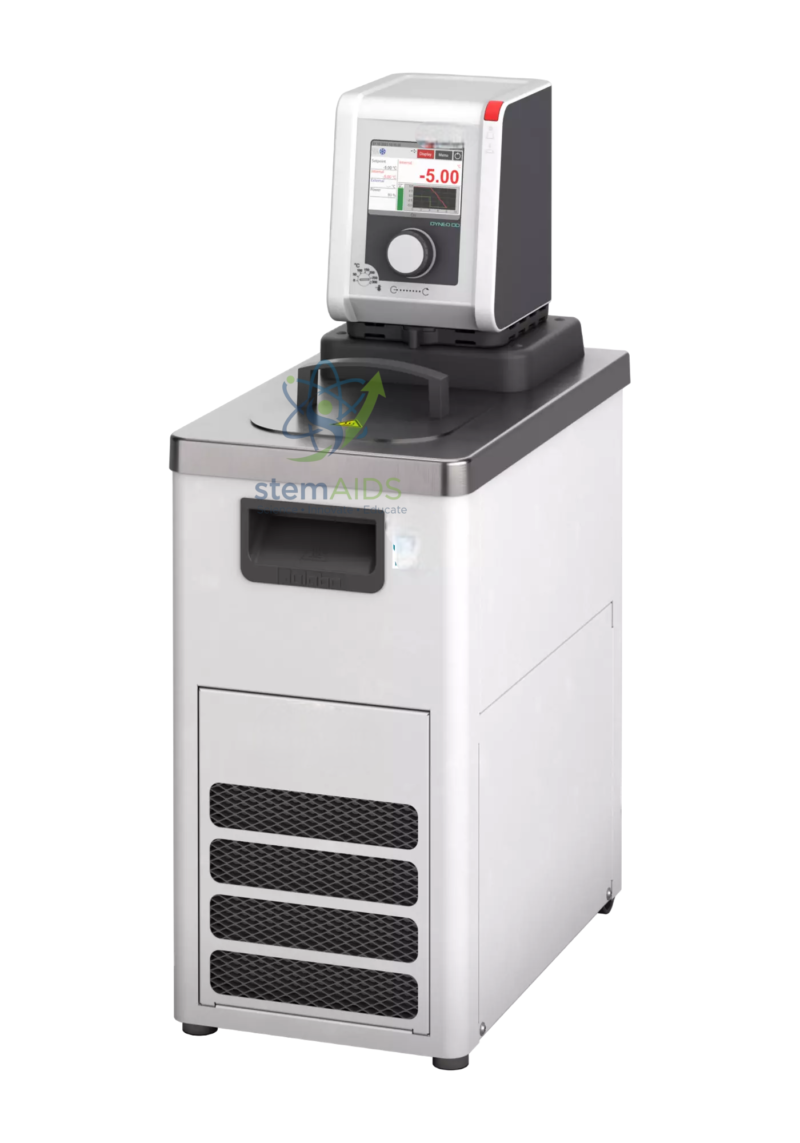
Quick Answer: The Circulating Cryostats CD-200F is a refrigerated circulating bath, pictured as a compact cabinet with air grilles at the front, a bath opening on top and a control head with a colour display, that cools, heats and pumps a bath fluid to hold samples or connected apparatus at a set temperature, including settings below room temperature.
Cooling, Heating and Pumping in One Cabinet
A circulating cryostat has three working parts. A refrigeration unit in the lower cabinet draws heat out of the bath through a cooling coil; a heater in the control head adds heat; and a pump keeps the bath fluid moving, inside the tank and, on units with outlets, out to an external vessel and back. The controller balances cooling against heating, which is how it holds a setting steadily on either side of room temperature. The display in the photo reads −5.00, a below-zero setting that a heater-only bath cannot reach.
The word cryostat can mislead. In histology, a cryostat is a refrigerated cabinet holding a microtome for cutting frozen sections; this unit is something different, a laboratory bath that controls the temperature of a fluid. Supplier catalogues often call the same kind of unit a refrigerated circulator. CD-200F matches the model code JULABO uses in its CORIO CD range of refrigerated circulators, while the CORIO C-B thermostatic bath from the same family only heats.
Near and below 0 °C, plain water stops being a suitable bath fluid, because it freezes on the cooling coil. Work in that region needs a water and glycol mixture or a thermal fluid made for the temperature range, and the fluid’s own limits matter as much as the unit’s. The working range, cooling capacity and pump connections of this model are not given in the title and should be checked against the application.
Specifications
| Type | Refrigerated circulating bath (circulating cryostat) |
| Model | CD-200F, as titled |
| Construction | Refrigeration cabinet with bath opening on top and control head, as pictured |
| Controls | Colour display with rotary knob, as pictured |
| Operating principle | Refrigeration, heater and circulation pump under one controller |
| Temperature range, bath volume and pump outlets | Confirm at enquiry |
Applications of a Refrigerated Circulator
- Holding samples or tubes in the bath at fixed temperatures below ambient, such as 4 °C or 10 °C
- Supplying temperature-controlled fluid to jacketed reaction vessels, refractometers or viscometers, where the unit has pump outlets
- Chilling condenser coolant when tap water is too warm to trap volatile solvents
- Stability and materials tests that move between cold and warm settings
Care & Handling
- Leave clear space in front of the air grilles so the refrigeration unit can shed heat, and dust the grilles regularly.
- Choose a bath fluid suited to the working temperature, and never run plain water near or below freezing.
- Keep the fluid level within the marked range and top up before long runs.
- After moving the unit, let it stand upright for a while before switching on, as is usual for refrigeration equipment.
Why Choose LabEquip
Analytical, materials and chemistry labs buy this refrigerated circulator when work must run below room temperature or when external apparatus needs a controlled fluid supply. LabEquip lists it in General Lab Products; send your temperature range and any equipment you plan to connect through the contact page so suitability can be checked.
Frequently Asked Questions
Is this the same as a cryostat used for frozen sections?
No. A histology cryostat is a refrigerated cabinet with a microtome for cutting frozen tissue. A circulating cryostat is a temperature-controlled bath that cools, heats and circulates a fluid.
Why does a refrigerated bath also need a heater?
Steady control needs heat to be added as well as removed. The cooling unit runs continuously while the heater trims the temperature, so the controller can hold a setting closely on either side of room temperature.
Can water be used as the bath fluid?
Water suits settings well above freezing. Close to or below 0 °C it freezes on the cooling coil, so a water and glycol mixture or a thermal fluid made for that range is needed.
Can it control the temperature of an external vessel?
Circulators with pump connections can send fluid through jacketed vessels, condensers or instrument cells and back. Check that the connections and pump of this model suit the apparatus you plan to connect.
Where should the unit be placed?
On a level surface with free air at the grilles, away from ovens and direct sun. Warm surroundings make the refrigeration unit work harder and leave less cooling for the bath.
What routine maintenance does it need?
Keep the air grilles free of dust, check the fluid level and condition, and replace fluid that has turned cloudy or discoloured. Wipe the top and the control head with a damp cloth only.
Last Updated: October 2026






Reviews
There are no reviews yet.