
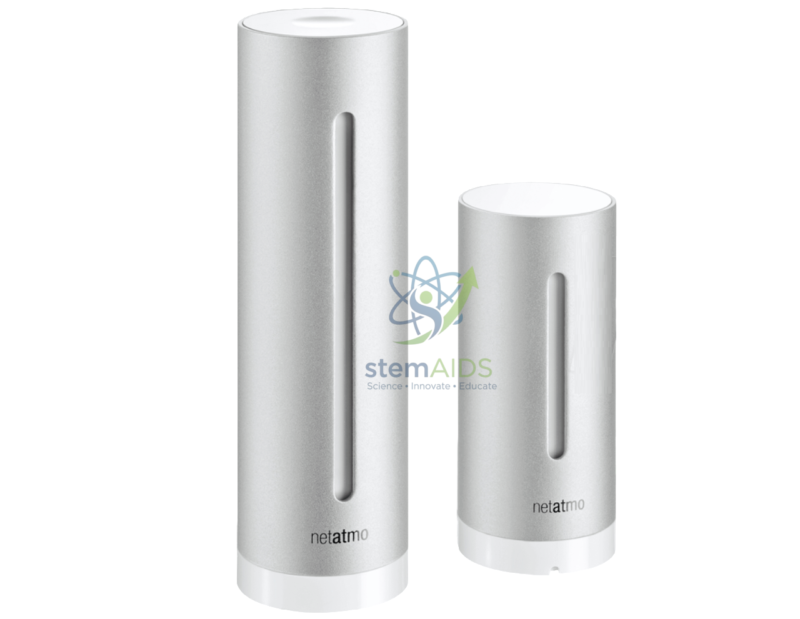
Quick Answer: The Connected Weather Station is a two-part connected weather station: the listing photograph shows a taller indoor module and a smaller outdoor module, both cylindrical with a metallic finish. Stations of this kind measure conditions indoors and outside and share the readings with a phone app or computer, so data can be logged and compared over time.
How a Connected Station Works
The outdoor module sits outside and measures the air around it, typically temperature and humidity, and sends its readings wirelessly to the indoor module. The indoor module measures the room and passes all the data to a network, usually over Wi-Fi, from where it can be viewed on a phone, tablet or computer and kept as a record. The exact sensors in each module, and whether rain or wind modules can be added, are not stated in the listing.
For a school, the value lies in the record. Readings build up automatically every day, weekends and holidays included, without anyone visiting an instrument screen. Students can download the data and plot temperature across a week, compare indoor and outdoor humidity, or relate a falling pressure trend to the rain that followed, turning weather into a data-handling exercise for geography, science and maths.
Siting decides the quality of the data. Put the outdoor module in shade, away from walls that store heat, air-conditioner outlets and paving, at about head height with air moving freely around it. The station also needs a reliable network and usually an account with the app provider, so involve the school’s IT staff before installing it. For a sensor that works with a classroom data-logging system instead, see the Wireless Weather Sensor Redy.
Classroom Projects
- Building a continuous school weather record for geography fieldwork.
- Comparing indoor and outdoor temperature and humidity through the day.
- Plotting and analysing time-series data in maths and computing lessons.
- Climate club projects comparing this year’s readings with last year’s.
Specifications
| Type | Connected (networked) weather station |
| Modules in photograph | Indoor module and outdoor module, cylindrical |
| Data | Viewed and logged on a phone, tablet or computer |
| Setup needs | Network connection and the station’s app |
| Sensors included and add-on modules | Confirm at enquiry |
Siting and Maintenance
- Keep the outdoor module shaded and out of direct rain, but in freely moving air.
- Replace the outdoor module’s batteries before they run flat, so gaps do not appear in the record.
- Wipe dust and cobwebs from the module openings regularly.
- Check the network connection after holidays, since changed Wi-Fi settings stop data from uploading.
Why Choose LabEquip
Schools and colleges buy a connected station when they want an automatic, long-running data set rather than daily manual readings. LabEquip lists it in General Lab Products, and sensor options can be discussed through the contact page.
Frequently Asked Questions
What does connected mean for a weather station?
It means the station passes its readings to a network, usually over Wi-Fi, so they can be viewed remotely on a phone or computer and stored as a history. A standalone station shows readings only on its own display.
Where should the outdoor module be placed?
In shade, sheltered from direct sun and rain, away from walls, paving and air-conditioner outlets that distort temperature, and at about head height with air moving freely around it.
Does the station need internet access?
Connected stations usually need a Wi-Fi network with internet access to upload readings to their app or online service. Check with your IT team that the device will be allowed on the school network.
What can students do with the data?
They can plot temperature and humidity over days and seasons, work out daily ranges and averages, compare indoor and outdoor conditions, and link changes in the readings to weather they observed.
How is this different from the Lacrosse Weather Station?
The Lacrosse Weather Station, as pictured, is built around a display console with a forecast icon. This connected station is built around modules that share their data with an app, which suits long-term logging and analysis.
Why do my outdoor readings seem too high on sunny days?
The module is probably in sunlight or near a warm wall. Direct sun heats the housing, so the reading rises above the true air temperature. Move it into shade with free air flow.
Last Updated: September 2026





Reviews
There are no reviews yet.