
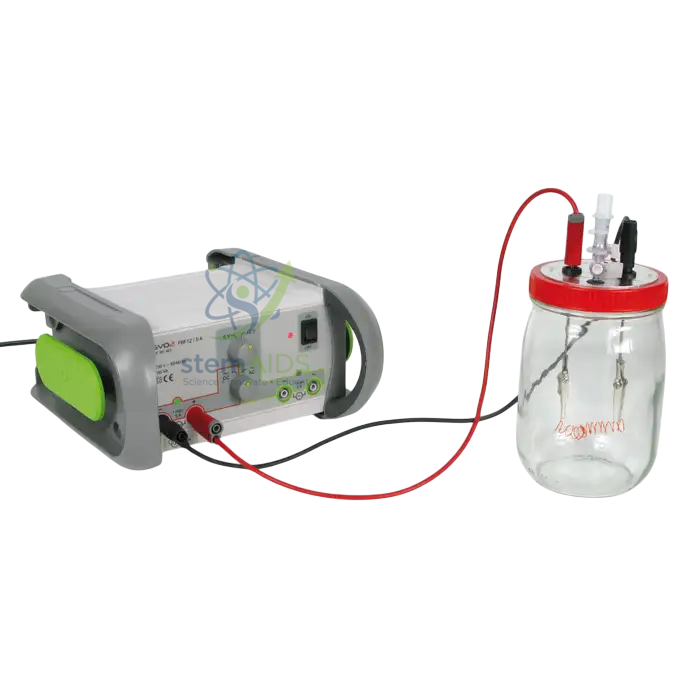
Quick Answer: Nichrome wire is a nickel-chromium alloy wire with a high electrical resistance that can glow red-hot without burning through. In school labs nichrome wire is used as a hot-wire igniter inside closed combustion jars, as pictured with a power supply and jar, and for heating-element and resistance experiments.
Why Nichrome Glows Instead of Burning
When current flows through any wire, some electrical energy becomes heat, and the heating is greater where the resistance is greater. Nichrome has a much higher resistivity than copper, so a short length gets very hot with a modest current. Unlike iron or steel, it does not simply oxidise away at red heat: the chromium forms a thin, tough oxide film on the surface that protects the metal underneath. That is why nichrome is the usual material for toaster and heater elements, and why a short loop of it can be heated repeatedly to ignite material in a closed jar.
The resistance of a length of nichrome depends on its length and its cross-sectional area, following R = ρL/A, so a longer or thinner piece has more resistance. This makes the wire useful for practicals on resistance as well as on heating.
Using It as an Igniter
For hot-wire ignition a short piece is connected between two terminals passing through the lid of a closed combustion chamber and touched against the material to be burned. A low-voltage supply is switched on for a few seconds until the wire glows and the material lights, then switched off. Keeping the length short and the supply low limits the current to what the leads and terminals can carry.
Specifications
| Product | Nichrome (nickel-chromium) resistance wire |
| Key property | High resistivity and resistance to oxidation at red heat |
| Shown in photograph | Wire connected from a power supply into a lidded jar |
| Powered by | Low-voltage laboratory supply |
| Diameter, length per coil and resistance per metre | Confirm at enquiry |
Experiments Using Nichrome Wire
- Igniting iron wool, charcoal or a candle wick inside a closed combustion jar
- Investigating how the resistance of a wire depends on its length
- Building a simple heating element and measuring the temperature rise of water
- Making a hot-wire cutter for polystyrene foam in design and technology work
Care & Handling
- Use only a low-voltage supply and switch off as soon as the wire glows
- Do not touch the wire or its terminals until they have cooled
- Keep the glowing wire away from flammable solvents and paper
- Store the coil in a dry place and straighten only the length being cut, to avoid kinks
Why Choose LabEquip
Schools buy a coil of nichrome because it supplies igniters, heating elements and resistance practicals for a year. LabEquip supplies it with the nichrome-wire rheostat and other physics lab equipment; contact LabEquip to choose a wire diameter.
Frequently Asked Questions
Why is nichrome used instead of copper for heating elements?
Nichrome has a much higher resistivity, so it heats strongly with a modest current, and its oxide film stops it burning away at red heat. Copper would carry the current with little heating and oxidise quickly.
How does the length of the wire affect its resistance?
Resistance is proportional to length, so doubling the length doubles the resistance, provided the diameter and temperature stay the same.
What supply should be used for hot-wire ignition?
A low-voltage laboratory supply with current limiting, switched on only for the few seconds the wire needs to glow.
Does the resistance change when the wire gets hot?
Slightly. Nichrome’s resistance changes much less with temperature than that of pure metals, which is another reason it is used in heaters.
Can the wire be soldered?
Not easily, because of its oxide film. It is normally fixed with screw terminals or crimped connectors.
Is it safe to handle after use?
Only once it has cooled. A glowing wire stays hot for a short time after switching off, so wait before touching it or the terminals.
Last Updated: October 2026




Reviews
There are no reviews yet.