
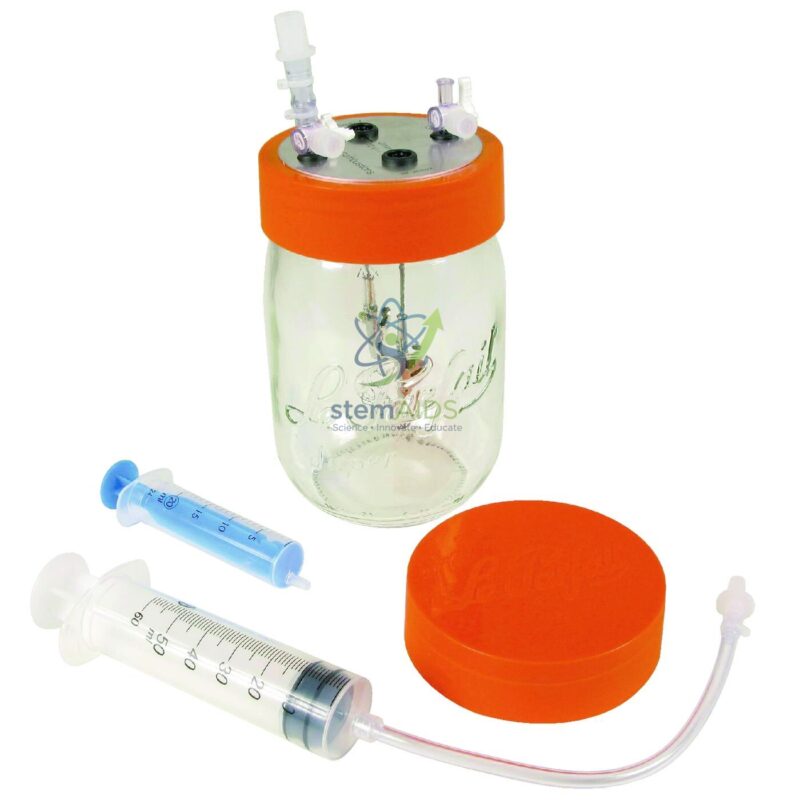
Quick Answer: This combustion chamber kit is a closed glass jar with a screw lid carrying ports and fittings, a spare lid and syringes with tubing, as pictured. The combustion chamber kit lets a small amount of material burn inside a sealed space so students can sample the gas afterwards and study what combustion uses and produces.
Why Burn Something in a Closed Jar
In open air, combustion seems to make material disappear. Sealing the reaction in a jar changes the picture. Nothing can enter or leave, so students can ask what happened to the oxygen, where the products went and whether the total mass changed. Weighing the closed jar before and after a small burn shows that mass is conserved, the idea Lavoisier used to overturn earlier theories of burning.
The ports in the lid are what make the kit more than a jar. A syringe attached through tubing can draw out a sample of the gas after the burn and pass it through limewater to show carbon dioxide, or push it into a sensor. A second port can be used to admit a measured volume of air or oxygen before a burn.
Igniting the Material Safely
Because the lid is closed, the material cannot be lit with a match. In set-ups of this kind it is usually ignited electrically by a short length of nichrome wire connected through the lid to a low-voltage supply; the wire glows and sets light to the material touching it. Small quantities of iron wool, a candle stub or charcoal are typical. The kit’s own ignition fittings and the materials it is meant for should be confirmed before first use.
Specifications
| Product | Closed combustion chamber kit |
| Shown in photograph | Glass jar with orange screw lid fitted with ports, spare lid, two syringes and tubing |
| Principle | Combustion in a sealed vessel; gas sampled through lid ports |
| Ignition | Electrical hot-wire ignition is the usual method in closed jars |
| Gas tests | Limewater for carbon dioxide; sensors if available |
| Lid fittings and full contents | Confirm at enquiry |
Investigations
- Showing conservation of mass by weighing the sealed jar before and after burning iron wool
- Sampling the gas after a candle burns out and testing it for carbon dioxide
- Comparing how long a flame lasts with different volumes of air in the jar
- Linking oxygen use in combustion with oxygen use in respiration
Care & Handling
- Burn only small amounts of material, so the pressure and temperature inside stay modest
- Let the jar cool fully before opening the lid or handling it
- Use a low-voltage supply for hot-wire ignition and switch it off as soon as the material lights
- Check the glass for cracks and the lid seal for heat damage before each use
Why Choose LabEquip
Teachers buy this kit to make conservation of mass and the products of combustion visible in one closed system. LabEquip supplies it with the combustion gas characterization device and wider physics lab equipment; contact LabEquip to confirm the lid fittings and contents.
Frequently Asked Questions
Why does the mass stay the same when something burns in the closed jar?
No gas can enter or leave, so the oxygen used and the products formed all stay inside. The atoms are rearranged, but the total mass of the closed system does not change.
How is the material lit inside a closed jar?
Usually by an electrically heated wire passing through the lid. When current flows, the wire glows red and ignites the material touching it.
Why does a candle in the jar go out?
The flame needs oxygen. As it burns, the oxygen in the jar is used up and the proportion of carbon dioxide rises, until the flame can no longer keep going.
What are the syringes for?
They draw a sample of the gas from the jar through the lid ports, so it can be bubbled through limewater or measured, without opening the jar.
Which materials are suitable to burn?
Small amounts of materials that burn steadily without violent flaring, such as iron wool, a short candle stub or a little charcoal. Avoid volatile liquids and anything that releases toxic fumes.
Why must the jar cool before opening?
Straight after a burn the gas inside is hot and its pressure differs from the room, and the glass and lid stay hot for some time. Waiting avoids burns and lets the pressure settle before the lid is loosened.
Last Updated: October 2026








Reviews
There are no reviews yet.