
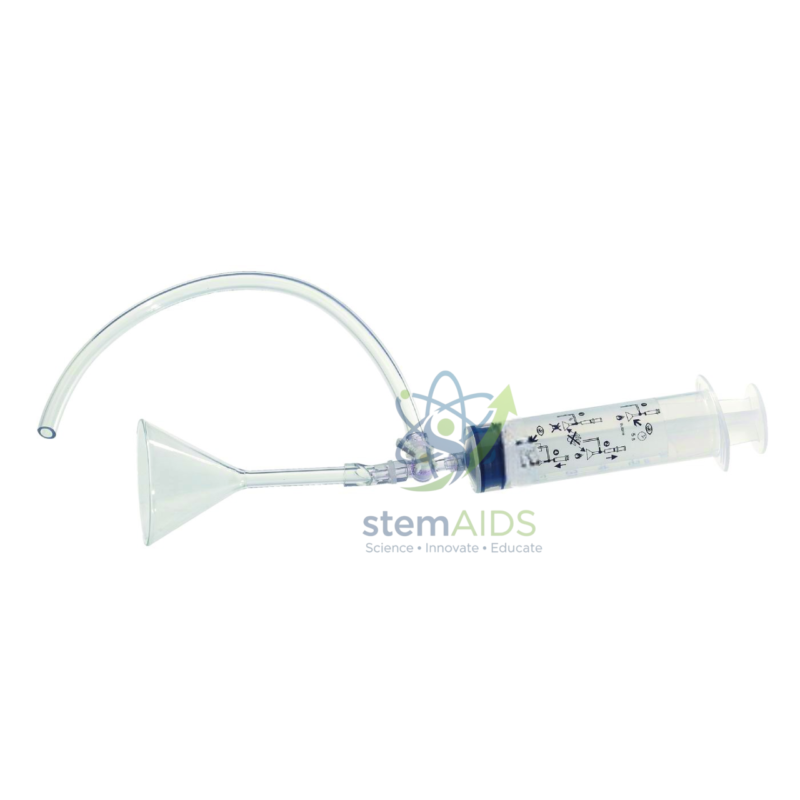
Quick Answer: The combustion gas characterization device is a small assembly of a funnel, a connector and a graduated syringe with an outlet tube, as pictured, used to draw the gases rising from a flame into the syringe. The collected sample is then pushed through limewater or onto a water-detecting paper to show that burning a fuel produces carbon dioxide and water.
What the Device Shows About Burning
When a candle, a spirit burner or a small gas flame burns, the carbon and hydrogen in the fuel combine with oxygen from the air. The products are mainly carbon dioxide and water vapour, but both are invisible, so students often think the fuel simply disappears. The combustion gas characterization device makes the products visible by catching them and passing them through a test.
The funnel is held mouth-down a little above the flame. Pulling the syringe plunger back draws the hot gases up through the funnel and the connector into the syringe barrel. Changing the connector to the outlet and pushing the plunger then sends the sample through the bent tube into a test liquid.
Running the Two Tests
For carbon dioxide, the outlet tube dips into a small volume of clear limewater. Bubbling the collected gas through it turns the limewater milky because insoluble calcium carbonate forms. Repeating the test with a syringe of room air, which contains far less carbon dioxide, gives a useful comparison.
For water, students watch for mist condensing inside the cool funnel and tube, and they can confirm it with anhydrous copper sulfate, which turns from white to blue, or with dry cobalt chloride paper, which turns from blue to pink.
Specifications
| Product | Combustion gas characterization device |
| Shown in photograph | Funnel, connector, graduated syringe and bent outlet tube |
| Principle | Draws combustion gases from above a flame for testing |
| Tests carried out | Limewater for carbon dioxide; anhydrous copper sulfate or cobalt chloride paper for water |
| Used with | Candle or spirit burner, limewater, small beaker or test tube |
| Connector type and syringe capacity | Confirm at enquiry |
Lessons That Use It
- Showing that a candle produces carbon dioxide and water as it burns
- Comparing the products of different fuels such as wax, ethanol and gas
- Comparing exhaled air, room air and flame gases with the limewater test
- Introducing the word equation for complete combustion of a hydrocarbon
Care & Handling
- Keep the funnel high enough above the flame that it is warmed, not heated directly
- Let the syringe and funnel cool before handling after sampling hot gases
- Push the plunger slowly when bubbling through limewater, so the liquid is not sprayed out
- Rinse limewater residue from the outlet tube straight after use, before it dries as a white film
Why Choose LabEquip
Science departments buy this device because it turns a familiar candle into evidence for a balanced combustion equation. LabEquip also supplies the closed combustion chamber kit for burning materials in a sealed jar and a wide range of physics lab equipment; contact LabEquip for class quantities.
Frequently Asked Questions
Why does the limewater turn milky?
Carbon dioxide reacts with calcium hydroxide in the limewater to form calcium carbonate, which does not dissolve and makes the liquid cloudy. Bubbling a large excess of carbon dioxide can slowly clear it again.
How can students show that water is produced?
Watch for mist forming inside the cool funnel and tube, then touch the moisture with anhydrous copper sulfate, which turns blue, or with dry cobalt chloride paper, which turns pink.
Does the funnel go into the flame?
No. Hold it mouth-down a short distance above the tip of the flame. Putting it into the flame overheats the funnel and the connector.
Can the device collect gases from a Bunsen burner?
Yes, with care. Keep the funnel well above the hot flame and take short samples, since a Bunsen flame heats the funnel much faster than a candle.
Why test room air as well?
Room air contains a little carbon dioxide, so it makes limewater cloudy only slowly. Comparing the two samples shows that the flame gases contain much more.
Is incomplete combustion visible with this device?
A smoky, yellow flame leaves soot on the inside of the funnel, which is a visible sign of carbon from incomplete burning. A clean blue flame leaves little or no soot.
Last Updated: October 2026








Reviews
There are no reviews yet.