
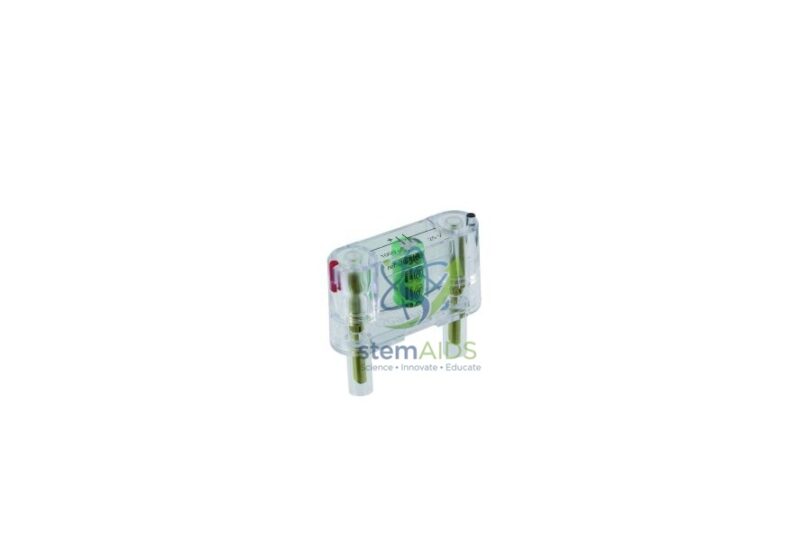
Quick Answer: The Capacitor UME 1000 µF 25 V is a plug-in module holding a capacitor of 1000 µF rated for 25 V, the two values in its name, inside a clear housing with plug pins underneath, as pictured. A 1000 µF capacitor is large enough that charging and discharging through ordinary resistors takes seconds, so students can follow it with a stopwatch and voltmeter.
Time Constants You Can Watch
Charging or discharging a capacitor through a resistor follows an exponential curve with time constant τ = RC. With 1000 µF, a 1 kΩ resistor gives τ = 1 s, 10 kΩ gives 10 s and 47 kΩ gives 47 s. After one time constant a discharging capacitor has fallen to about 37 percent of its starting voltage, and after five it is effectively empty.
Those values bring the experiment within reach of a stopwatch. Students read a voltmeter every five or ten seconds as the capacitor discharges through a large resistor, plot ln V against t, and get a straight line whose gradient is -1/RC. A data logger gives the same curve in finer detail.
Polarity, Voltage Rating and Stored Energy
A 1000 µF capacitor of this kind is normally an electrolytic type, which is polarised: its positive terminal must stay at the higher potential. Check the marking on the module, connect it the right way round, and keep the applied voltage well inside the 25 V rating. A reversed or over-voltage electrolytic capacitor can overheat and vent.
The energy stored is E = ½CV². At 12 V the module holds 0.072 J and a charge Q = CV of 12 mC; at 20 V the charge is 20 mC and the energy 0.2 J. Discharging it through a small lamp shows the energy is real but modest, and comparing two voltages shows the square law at work.
Specifications
| Product | UME capacitor module |
| Capacitance, from title | 1000 µF |
| Voltage rating, from title | 25 V |
| Housing in photograph | Clear block with plug pins underneath |
| Polarity | Follow the marking on the module |
| Format | UME plug-in module |
Care & Handling
- Never exceed 25 V and never reverse the polarity
- Discharge the capacitor through a resistor before handling or storing it
- Do not short the terminals directly; the sudden current can damage contacts
- Replace a module whose capacitor shows bulging or leakage
Practicals
- Measuring the discharge time constant and plotting ln V against time
- Smoothing the output of a diode bridge rectifier
- Calculating charge and stored energy at different voltages
- Timing circuits in which a lamp or LED fades as the capacitor discharges
Why Choose LabEquip
Physics departments using the UME system add a 1000 µF capacitor because it is the value that turns RC theory into something a class can time by hand. It pairs with the UME diode bridge for smoothing practicals; contact LabEquip to add modules, or see the wider physics lab equipment range.
Frequently Asked Questions
What time constant does it give with a 10 kΩ resistor?
τ = RC = 10 000 Ω × 0.001 F = 10 s. During discharge the voltage falls to about 37 percent of its starting value in that time.
Why does polarity matter for this capacitor?
Capacitors of this size are normally electrolytic and polarised. Connected the wrong way round they can heat up and be damaged, so the positive terminal always goes to the higher potential.
Why does my voltmeter change the discharge time?
The voltmeter is itself a resistance across the capacitor and gives the charge an extra path. A digital meter with a high input resistance has little effect; an analogue meter with a low resistance can shorten the time noticeably.
How much energy does the capacitor store at 12 V?
E = ½CV² = 0.5 × 0.001 × 144 = 0.072 J. Doubling the voltage would store four times the energy, though the voltage must always stay below the 25 V rating.
Can it smooth the output of a rectifier?
Yes. Placed across a rectifier output it charges at each peak and supplies the load in between, cutting the ripple. The larger the load current, the larger the ripple that remains.
Is the capacitor safe to touch after an experiment?
At classroom voltages the shock risk is small, but a charged capacitor can still produce a spark if its terminals are shorted. Discharge it through a resistor before putting it away.
Last Updated: October 2026




Reviews
There are no reviews yet.