
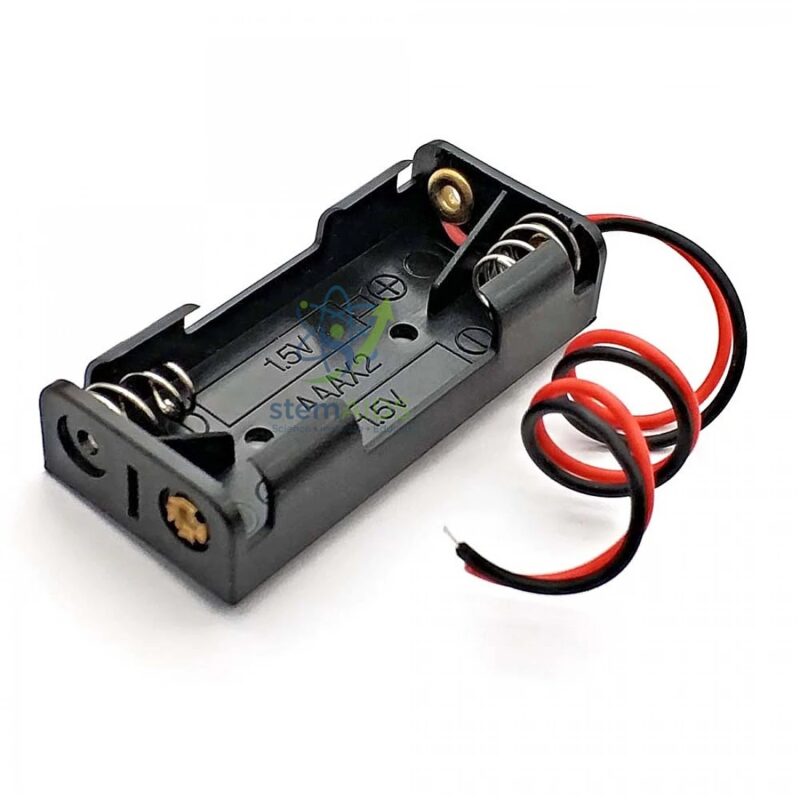
Quick Answer: This AA battery holder takes two R6 (AA) 1.5 V cells end to end in series, giving a nominal 3 V at its red and black leads. It turns loose cells into a tidy supply for small motors, lamps and simple circuits in school electricity practicals.
Why Two Cells Make 3 V
Inside the holder, a metal strip at one end joins the positive terminal of the first cell to the negative terminal of the second, so their voltages add. The red lead is connected to the free positive terminal and the black lead to the free negative one. Two 1.5 V cells in series therefore give 3 V across the leads, while the same current flows through both cells. A voltmeter across each cell and then across both makes the point in a few seconds.
Series connection also adds the internal resistances of the cells. With a light load the drop is small; with a motor that draws a large current, the terminal voltage sags, and students can measure this with the motor running and stopped. If one cell is fitted the wrong way round, its voltage subtracts and the output falls to nearly zero, a mistake that is instructive once and annoying after that.
A Matching Supply for 3 V Components
Many components in school kits are designed around 3 V: small motors, miniature lamps and LED modules. The DC electric motor rated 1.5 to 3 V is a natural partner, running noticeably faster at 3 V than at 1.5 V from a single cell, which shows the link between voltage and motor speed. The leads from the holder can be fitted with banana plugs or clipped to a circuit with insulated crocodile clips, depending on the board in use.
Specifications
| Product | Battery holder for two cells |
| Cell size | R6 (AA), 1.5 V each, as titled |
| Connection of cells | In series |
| Nominal output | 3 V with two fresh 1.5 V cells |
| Output leads | Red (positive) and black (negative) flying leads, as in the product photograph |
| Cover, switch and lead terminations | Confirm at enquiry |
Applications
- 3 V supply for small motors, miniature lamps and LED modules
- Showing that cells in series add their voltages, with a voltmeter across each cell
- Measuring terminal voltage drop under load to introduce internal resistance
- Simple circuits in primary and lower-secondary science lessons
Care & Handling
- Fit the cells with the polarity marked inside the AA battery holder
- Remove the cells when the holder is put away, to prevent leakage onto the contacts
- Do not join the red and black leads directly; a short circuit drains and heats the cells
- Clean tarnished contacts with a pencil eraser or a dry cloth
Why Choose LabEquip
Primary and secondary schools buying AA battery holders usually want a class set that matches their motors and lamp modules. LabEquip can supply holders with matching motors; send class numbers through our contact page, and see other physics lab equipment.
Frequently Asked Questions
What does R6 mean?
R6 is the international designation for the cylindrical cell commonly called AA. The holder accepts any 1.5 V cell of that size, alkaline or zinc-carbon, and rechargeable cells of the same size also fit.
Can rechargeable cells be used in the holder?
Yes. Nickel metal hydride cells of this size have a nominal voltage of about 1.2 V each, so two give about 2.4 V rather than 3 V. Motors and lamps run slightly slower or dimmer.
Why are the cells connected in series?
So that their voltages add, giving about 3 V from two 1.5 V cells. Connecting them in parallel would keep 1.5 V but share the current between the cells.
What happens if one cell is inserted backwards?
Its voltage opposes the other cell’s, so the output falls to almost zero and the circuit will not work. Check the plus and minus markings in the holder.
Is the output safe for students to handle?
Yes, 3 V is far too low to give a shock. The only hazard is a short circuit between the leads, which can make the cells and wires hot, so the leads should not be joined together.
Does the holder have a switch?
The product photograph shows an open holder with leads; whether a switch or cover is fitted can be confirmed at enquiry. A separate switch in the circuit does the same job.
Last Updated: October 2026




Reviews
There are no reviews yet.