
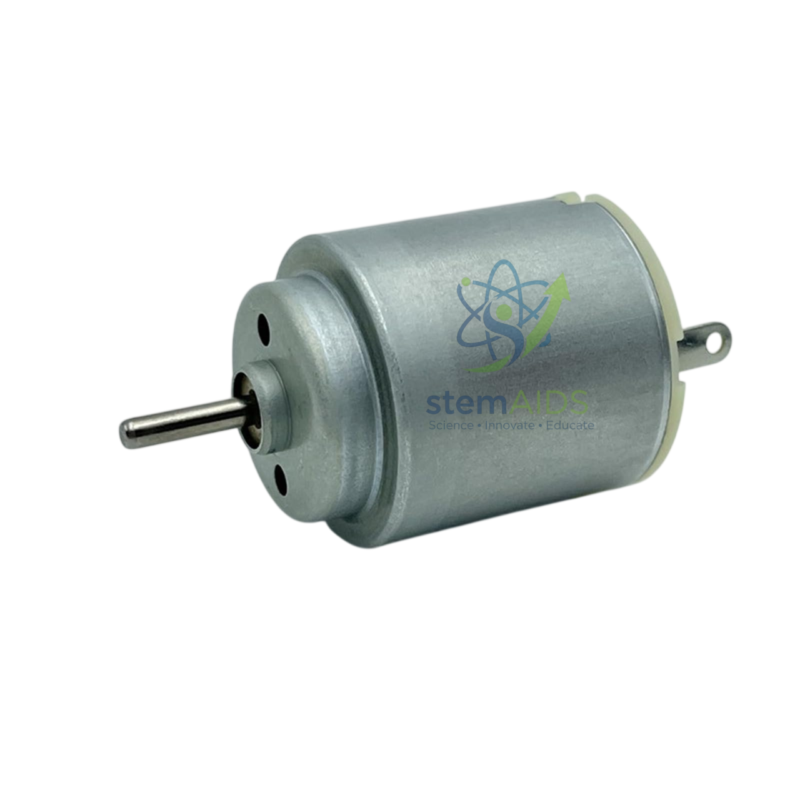
Quick Answer: This DC electric motor is a small permanent-magnet motor rated for 1.5 to 3 V, with a metal can body, a shaft at one end and two terminals at the other. It is used in school circuits and STEM models to turn electrical energy into rotation and to teach the motor effect.
Inside a Small Permanent-Magnet Motor
Within the metal can, curved permanent magnets surround a rotor wound with coils of fine copper wire. Current enters through two brushes that press on a split ring, the commutator, fixed to the shaft. A current-carrying wire in a magnetic field feels a force, F = BIL, and the forces on opposite sides of each coil turn the rotor. Just as a coil passes the point where the turning effect would reverse, the commutator swaps the current direction in that coil, so the rotation continues in the same sense.
Those parts are hidden, but their effects are easy to show. Reversing the supply leads reverses the current in the coils, and the shaft turns the other way. Raising the voltage from 1.5 V to 3 V makes the motor spin faster, because a running motor produces a back e.m.f. that rises with speed, and the speed settles where the back e.m.f. plus the voltage drop across the coil resistance matches the supply.
Motor and Generator in One
Spinning the shaft by hand, or by wrapping a string around it and pulling, turns the motor into a small generator: a sensitive voltmeter connected to the terminals responds, with polarity depending on the direction of spin. Pressing a finger lightly on the shaft of a running motor while watching an ammeter shows the current rising as the load increases. Paired with an AA battery holder for two cells, the motor needs no other supply, and it powers fans, small vehicles and winding mechanisms in project work.
Specifications
| Product | Small DC electric motor, permanent-magnet type |
| Rated voltage | 1.5 to 3 V, as titled |
| Body | Metal can with output shaft, as in the product photograph |
| Terminals | Two tabs for soldering or clip leads |
| Direction | Reverses when supply polarity is reversed |
| Shaft size and mounting | Confirm at enquiry |
Applications
- Demonstrating the motor effect and the role of the commutator
- Measuring how speed and current change with supply voltage and load
- Using the motor as a generator by turning the shaft
- Fans, vehicles, winches and other STEM models running from one or two cells
Care & Handling
- Keep within the 1.5 to 3 V rating; higher voltages overheat the windings and wear the brushes
- Do not hold the shaft stalled for long while powered, as stall current heats the coils
- Solder leads to the terminal tabs quickly, or use clips, to avoid melting the end cap
- Keep the motor free of dust and hair, which can jam the shaft
Why Choose LabEquip
Schools buy this motor in class sets for electricity lessons and STEM building projects where a low voltage keeps everything safe, either on its own or to add to electricity experiment kits for schools. LabEquip can supply it with battery holders, and the larger 12V motor on bracket suits bench demonstrations; ask through our contact page or browse physics lab equipment.
Frequently Asked Questions
Why does the motor reverse when the leads are swapped?
Reversing the supply reverses the current in the rotor coils. The magnets stay the same, so the force on each side of the coil reverses and the shaft turns the opposite way.
Can the motor run on more than 3 V?
It is rated for 1.5 to 3 V. Running it above that makes it faster but heats the windings and wears the brushes and commutator quickly.
Why does the current rise when the shaft is slowed?
A spinning motor generates a back e.m.f. that opposes the supply. Slowing the shaft reduces the back e.m.f., so more of the supply voltage drives current through the coil resistance. A stalled motor draws its largest current.
Can the motor be used as a generator?
Yes. Turning the shaft moves the coils in the magnetic field and induces a voltage at the terminals. The faster it turns, the larger the voltage, which a voltmeter shows.
How do I attach a propeller or wheel?
Push-fit propellers, pulleys and wheels with a matching bore fit directly on the shaft. Measure the shaft diameter against the part before buying accessories.
Is the motor suitable for primary school children?
Its low operating voltage makes it suitable for supervised use with one or two cells. Keep fingers and hair away from fast-spinning propellers, and supervise any soldering.
Last Updated: October 2026




Reviews
There are no reviews yet.