

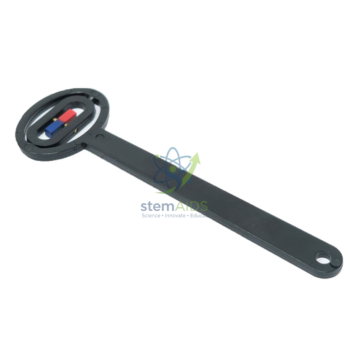
Quick Answer: The inclination compass, also called a dip circle, is a magnetic needle pivoted on a horizontal axis in front of a vertical graduated circle, on a stand that turns about a vertical axis. It measures the magnetic inclination, or dip, the angle that Earth’s magnetic field makes with the horizontal.
What Magnetic Dip Is
Earth’s magnetic field is horizontal only near the magnetic equator. Towards either magnetic pole the field points more and more steeply into or out of the ground, becoming vertical at the poles themselves. The angle between the field and the horizontal is the inclination, or angle of dip. An ordinary compass ignores it because its needle can only turn horizontally; the inclination compass is built to measure it.
Dip is one of the elements of Earth’s magnetism, together with declination and the horizontal component. Knowing the dip δ and the horizontal component B_H lets students calculate the vertical component, B_V = B_H tan δ, and the total field.
Measuring the Dip
First find the magnetic meridian. Turn the circle about its vertical axis until the needle stands vertical: the circle then lies east-west, at right angles to the meridian. Turning it through exactly 90 degrees from there puts it in the meridian, and the needle settles at the angle of dip, read from the graduated scale.
In careful work the readings are repeated with the circle turned through 180 degrees and with both ends of the needle, and the results averaged. This cancels errors from a pivot that is slightly off-centre or a scale that is not perfectly level.
Specifications
| Instrument | Dip circle with a needle on a horizontal axis |
| Scale | Vertical graduated circle |
| Mounting | Stand that rotates about a vertical axis, as pictured |
| Measures | Angle of magnetic inclination |
| Scale graduation | Confirm at enquiry |
Experiments
- Measuring the angle of dip at the school’s location
- Finding the magnetic meridian by the vertical-needle method
- Calculating the vertical component of Earth’s field
- Comparing dip readings with published geomagnetic values
Care & Handling
- Set it up on a level surface well away from steel and electrical cables
- Keep magnets out of the room while measuring
- Carry it upright so the needle does not slip off its bearings
- Dust the scale with a soft brush and never bend the needle
Why Choose LabEquip
Dip circles are bought by schools and colleges teaching the elements of Earth’s magnetism alongside the vibration magnetometer. LabEquip supplies the inclination compass as part of its physics lab equipment range; reach the team through the contact page.
Frequently Asked Questions
What does an inclination compass measure?
It measures the angle of dip, the angle between Earth’s magnetic field and the horizontal at the place where it is used.
Why does the needle stand vertical at one position?
When the circle is at right angles to the magnetic meridian, the horizontal part of the field has no effect in that plane and only the vertical part acts, so the needle points straight up and down.
Is the dip the same everywhere?
No. It is close to zero near the magnetic equator and approaches 90 degrees near the magnetic poles. It also changes slowly with time.
Why are readings averaged?
Small faults such as an off-centre pivot, or a needle whose magnetic axis does not match its pointer, shift the readings. Turning the circle and averaging cancels much of this error.
How is the vertical field component found?
Multiply the horizontal component, measured with a magnetometer, by the tangent of the dip angle.
Can it be used indoors?
Yes, if it is placed well away from steel furniture, wiring and magnets. Reinforced concrete buildings may still disturb the field, so readings outdoors are often more reliable.
Last Updated: October 2026




Reviews
There are no reviews yet.