
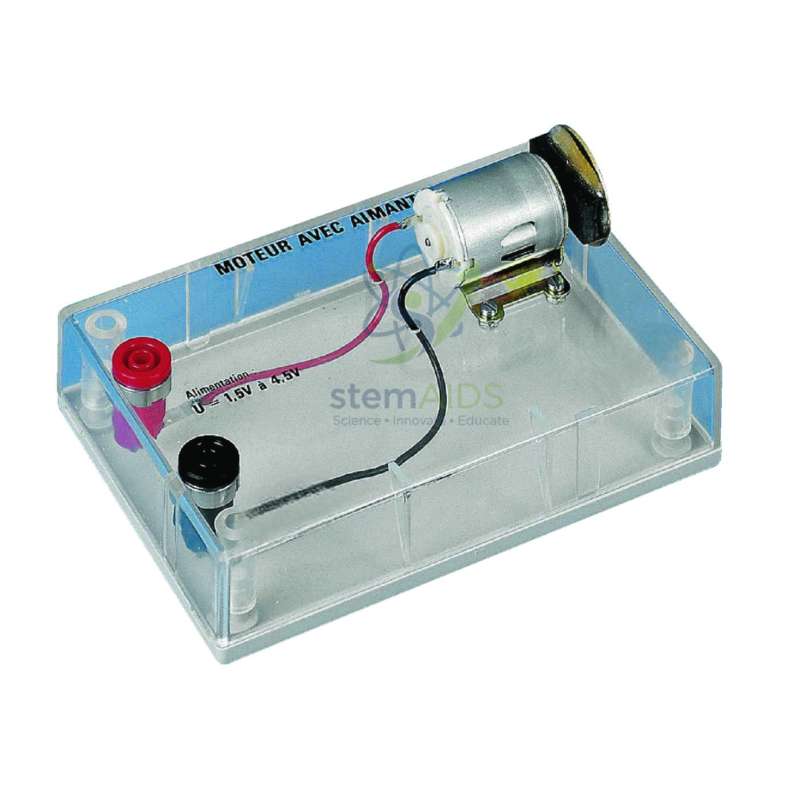
Quick Answer: The Motor Module with Magnets is a small permanent-magnet direct current motor housed in a clear case with terminal sockets, so it can be plugged into a circuit like any other component while students still see the motor and its turning shaft. The motor module with magnets is the bench-scale partner to a large demonstration motor.
Permanent Magnets Instead of Field Coils
In this motor module the magnetic field comes from permanent magnets fixed inside the motor body, rather than from a separate field winding. The rotor carries the coils, fed through a commutator and brushes. Because the field is constant, the motor’s behaviour is simple to describe: its speed rises roughly in proportion to the supply voltage, and its torque rises in proportion to the current it draws.
In the product photograph the module is a clear rectangular case with the small motor and a disc on its shaft at one end, and red and black terminal sockets at the other, with the wiring between them visible.
Using the Module in Student Circuits
As a circuit component the motor module behaves like a load whose current depends on how hard it works. Free-running, it draws little current; slowed by a finger on the disc, it draws more, because its back EMF falls with speed. Students can measure this with an ammeter in series and a voltmeter across the sockets.
The module also fits energy-chain activities: driven from a cell, a solar panel or a hand generator, it turns electrical energy into kinetic energy, and the disc gives a clear sign of direction and speed.
Applications
- Measuring current drawn by a motor when free-running and when lightly braked
- Reversing the supply polarity to reverse the direction of rotation
- Running the motor from a solar panel or hand generator in energy-chain activities
- Comparing the sealed module with the open construction of a demonstration motor
Specifications
| Device | Permanent-magnet DC motor module |
| Housing | Clear case with the motor visible |
| Connections | Red and black terminal sockets |
| Shaft | Fitted with a disc that shows rotation |
| Rated supply | Confirm at enquiry |
Care & Handling
- Keep the supply within the rating given for the module
- Brake the disc only lightly and briefly; a stalled motor draws high current and heats up
- Clean the clear case with a damp cloth only, avoiding solvents
- Store with leads unplugged and the shaft free
Why Choose LabEquip
Schools buy motor modules in sets so each bench group has a working motor that plugs straight into a circuit with standard leads. LabEquip supplies it with the open demonstration motor among its physics equipment; bench quantities can be requested through the contact page.
Frequently Asked Questions
What do the magnets do in this motor?
They provide a steady magnetic field across the rotor coils. Current in the coils experiences a force in that field, which turns the rotor.
Why does the motor draw more current when it is slowed down?
A turning motor generates a back EMF that opposes the supply, and this back EMF is proportional to speed. Slowing the motor reduces the back EMF, so more current flows.
Can the module be driven by a solar panel?
Small permanent-magnet motors often run from a solar panel in bright light, though a weak panel may only twitch the shaft. That makes a useful discussion of starting current and power.
Will reversing the leads damage the module?
No. Reversing the polarity of a permanent-magnet DC motor simply reverses its direction of rotation, as long as the supply stays within the module’s rating.
Why is the case transparent?
The clear case lets students see the motor, its wiring and the turning disc, while keeping fingers away from the moving shaft and protecting the motor from knocks.
Can the motor module produce electricity?
Spinning the disc quickly by hand makes the motor work as a generator and gives a small voltage at the sockets, which a sensitive meter shows.
Last Updated: October 2026








Reviews
There are no reviews yet.