
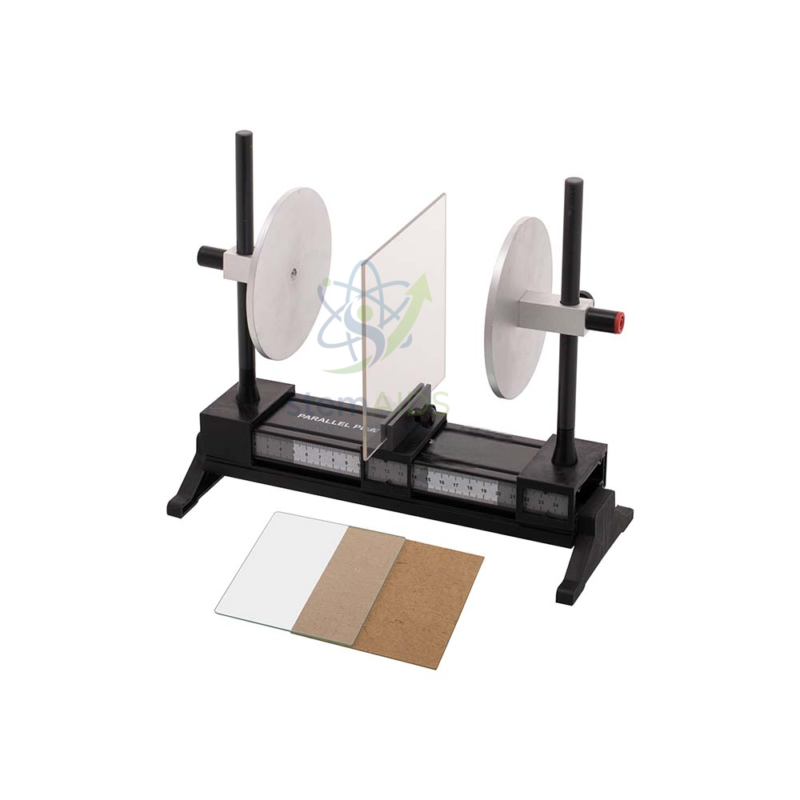
Quick Answer: The Plate Capacitor is a pair of circular metal plates on insulating rods, carried by sliding holders on a base so the gap between them can be set and changed. With the insulating sheets photographed alongside, the plate capacitor serves experiments on capacitance, the electric field between plates and the effect of a dielectric.
A Uniform Field Between Two Plates
Charge one plate positive and the other negative and an electric field forms between them. Away from the edges this field is uniform, pointing straight across the gap, with strength E = V/d. Near the rims the field lines bulge outwards, an edge effect that grows in importance as the gap becomes large compared with the plate diameter.
For that reason these plates give the cleanest results with small separations. The sliding holders in the product photograph, mounted on a black base with uprights, make it easy to keep the plates parallel and centred while the gap is changed.
Measuring Capacitance Against Separation
The standard experiment varies the gap d in steps and records the capacitance C at each. Theory predicts C = ε₀A/d for air, so a graph of C against 1/d should be a straight line whose gradient is ε₀A. Measuring the plate diameter gives A, and the gradient then yields a value for the permittivity of free space, a fundamental constant obtained on a school bench.
In practice the line does not pass exactly through the origin, because the leads and meter add a small stray capacitance. That offset is a useful discussion point about systematic error.
Applications
- Plotting capacitance against the reciprocal of separation and estimating ε₀
- Comparing the capacitance with air and with an insulating sheet filling the gap
- Discussing stray capacitance and edge effects as sources of error
- Demonstrating the uniform field between plates in electrostatics lessons
Care & Handling
- Keep the plates parallel and avoid knocking them; bent plates spoil the geometry
- Clean the plates and rods with a dry cloth and avoid touching the insulating rods with damp hands
- Discharge the plates after any experiment using a high-voltage supply
- Store the sheets flat and dust-free
Specifications
| Product | Plate capacitor: two circular plates on insulating rods |
| Mounting | Sliding holders on a base with uprights |
| Adjustment | Plate separation set by moving the holders |
| Sheets shown | Clear, white and brown insulating sheets |
| Experiments | Capacitance against separation, uniform field, dielectric effect |
Why Choose LabEquip
Colleges and upper-secondary schools pick this rail-and-stand apparatus when they want students to take a full set of separation readings and extract a constant from the graph. LabEquip supplies it with the parallel-plate capacitor and dielectrics set among its physics equipment; the contact page handles quantity questions.
Frequently Asked Questions
Can these plates be used to estimate the permittivity of free space?
Yes. Measure capacitance at several separations, plot capacitance against one over separation, and divide the gradient by the plate area. The result is an estimate of the permittivity of free space.
Why does the graph of C against 1/d not pass exactly through zero?
The leads, meter and plate supports add a small stray capacitance that does not depend on the gap. It shifts the whole line up by a constant amount, while the gradient remains correct.
How should the plates be aligned?
Set them parallel, facing each other squarely and on the same axis. Tilted or offset plates change the effective area and gap and give scattered readings.
What are the insulating sheets for?
They act as dielectrics. Placing a sheet that fills the gap raises the capacitance by the sheet’s relative permittivity, so the different materials can be compared.
Is a high-voltage supply needed?
Not for capacitance measurements with a meter. A current-limited high-voltage supply is used only for field and charge demonstrations, operated by the teacher with suitable precautions.
Why are electrostatics results poorer on humid days?
Moisture forms a thin conducting film on insulating surfaces, so charge leaks away from the plates and supports. Drying the apparatus and working in a dry room gives steadier readings.
Last Updated: October 2026








Reviews
There are no reviews yet.