
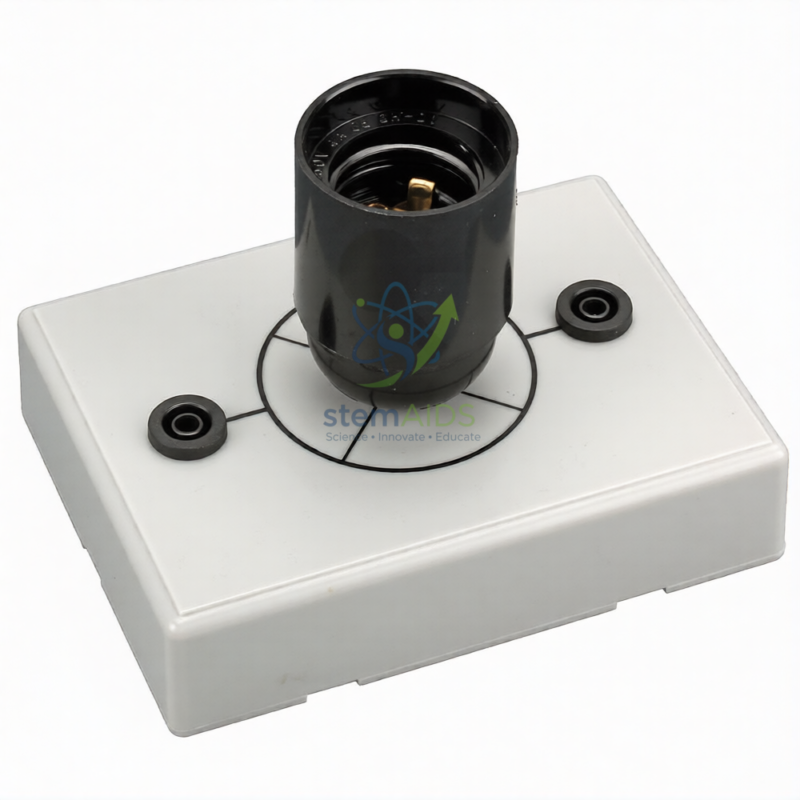
Quick Answer: The Socket E27 is a lamp holder for the full-size Edison screw (E27) cap used on standard household lamps. In the physics lab an E27 lamp socket lets teachers set up an ordinary lamp for light and heat experiments and for comparing how much electrical energy different kinds of lamp use.
The Standard Screw Lamp Size
The E27 designation follows the same scheme as every Edison screw cap: E for Edison and 27 for the nominal thread diameter in millimetres. It is the everyday size for household filament, compact fluorescent and LED lamps in many countries, which is exactly what makes it useful in teaching. A lamp a student uses at home can be fitted in the lab, and any E27 lamp can be swapped in to compare types. The socket does not decide the voltage; the lamp fitted must be rated for the supply it is connected to.
Comparing Lamps and Their Efficiency
With an E27 socket wired to a suitable supply through an energy or power meter, a class can compare a filament lamp, a compact fluorescent lamp and an LED lamp of similar brightness. The power each draws differs markedly, and most of a filament lamp’s input leaves as heat rather than light, which a thermometer held near the bulb confirms. That gives real numbers for efficiency calculations and for discussing why filament lamps have largely been replaced. Our educational electricity meter is designed for this kind of measurement.
The same set-up serves other topics: an E27 lamp as the source for inverse-square measurements of light intensity, as a heat source in radiation experiments with matt and shiny surfaces, or behind a slit or colour filter in simple optics demonstrations.
Lessons and Experiments
- Comparing the power drawn by filament, fluorescent and LED lamps
- Light-intensity and inverse-square investigations with a light dependent resistor or light meter
- Heat-radiation experiments with a filament lamp as the source
- Energy-efficiency demonstrations using everyday lighting
Specifications
| Type | Lamp holder (socket) |
| Cap size | E27 Edison screw (as titled) |
| Lamps | Any E27-capped lamp rated for the supply used |
| Use | Lamp comparisons, light and heat experiments |
| Mounting, cable entry and voltage rating | Confirm at enquiry |
Care & Handling
- E27 lamps are commonly mains-rated, so any mains wiring of the E27 lamp socket must be done by a competent person, with the holder enclosed and no exposed live parts.
- Switch off and disconnect the supply before changing a lamp, and let filament lamps cool before handling them.
- Do not fit a lamp of higher wattage than the socket and its fittings are rated for.
- Keep liquids well away from mains-connected lamp holders on the bench.
Why Choose LabEquip
Physics departments setting up energy and lighting demonstrations buy E27 holders so ordinary household lamps can become test subjects. The socket sits in our Physics Equipments range; tell us through the contact page how you plan to mount and wire it, and we will help you choose the right version.
Frequently Asked Questions
What does E27 mean?
E stands for Edison screw and 27 for the nominal diameter of the thread in millimetres. E27 is the standard screw size for household lamps in many countries, so ordinary filament, fluorescent and LED lamps with that cap fit the socket.
Can the E27 socket be used for low-voltage lamps?
Yes, provided the lamp fitted is rated for the low-voltage supply. The socket only provides the thread and contacts; the voltage is set by the lamp and supply. Low-voltage E27 lamps are less common than mains ones, so check availability before planning a practical around them.
How do I compare the efficiency of different lamps?
Connect the socket through an energy or power meter, fit each lamp in turn and record the power drawn when it gives similar light, measured with a light meter at a fixed distance. The lamp that gives the same light for the least power is the most efficient.
Is it safe for students to use an E27 socket?
Only when the socket is part of a properly enclosed, correctly wired fitting with no exposed live parts, and used under teacher supervision. Mains wiring should be done by a competent person, and students should never change lamps while the supply is connected.
Why does a filament lamp get so much hotter than an LED lamp?
A filament lamp makes light by heating a wire until it glows, and most of the energy it takes in comes out as heat and infrared rather than visible light. An LED lamp produces light directly from a semiconductor and wastes far less energy as heat.
Can an E27 lamp be used for inverse-square law experiments?
Yes. A small clear lamp behaves as a near point source at distances much larger than the bulb. Measure the light intensity at several distances in a darkened room and plot intensity against one over distance squared.
Last Updated: October 2026






Reviews
There are no reviews yet.