
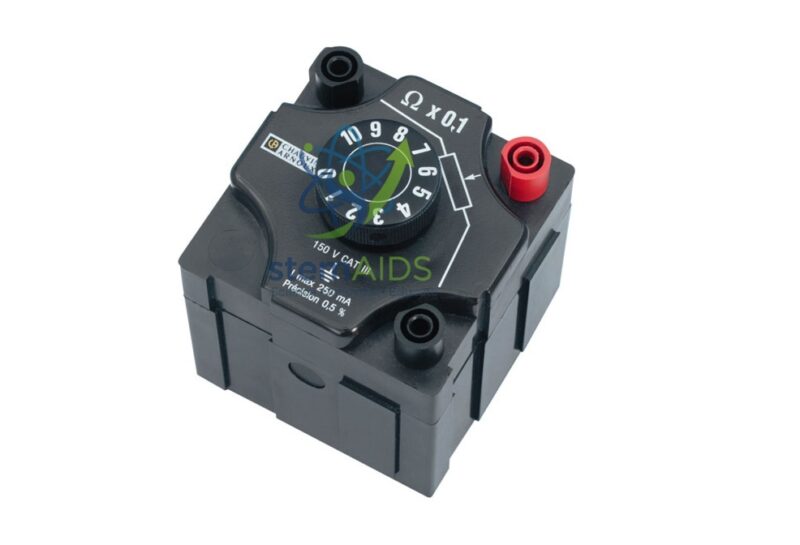
Quick Answer: The Decade resistance box listed here is a single decade resistance box: one rotary selector, as pictured, steps through equal multiples of a fixed resistance and brings the chosen value out to a pair of terminals. It provides a known, repeatable resistance for circuit practicals where one decade of adjustment is enough.
One Decade, Equal Steps
Inside, a chain of matched resistors is tapped by the selector switch. Each click of the dial adds one more resistor to the circuit, so the resistance rises in equal steps from zero to the top of that decade. Because the steps are fixed resistors rather than a sliding contact, a setting can be returned to exactly and its value is known without measurement, which is the main advantage over a rheostat.
A single decade suits experiments where a handful of known values are needed rather than fine adjustment. Where more resolution is wanted, several units can be connected in series, which is the principle behind modular boxes.
Finding the Internal Resistance of a Cell
One practical made simple by a decade box is measuring a cell’s internal resistance. Connect the box in series with the cell and an ammeter, set several resistance values R, and record the current I for each. Since the emf E = I(R + r), a graph of 1/I against R is a straight line with gradient 1/E, and extending it back until it meets the R axis gives minus r. Fixed, known steps make the data points evenly spaced and the analysis clean.
Applications
- Determining the emf and internal resistance of a cell from a graph of 1/I against R
- Providing known resistance steps when checking an ohmmeter or multimeter
- Varying resistance in steps for series-circuit and current-sharing practicals
- Serving as one decade of a larger box when linked with similar units
Specifications
| Type | Single-decade resistance box |
| Selector | One rotary dial with stepped positions, as pictured |
| Output | Two terminals carrying the selected resistance |
| Use | Known, repeatable resistance in low-power circuits |
| Step value and power rating | Confirm at enquiry |
Care & Handling
- Turn the dial only with the circuit switched off or at low current, to avoid sparking at the switch contacts.
- Do not pass more current than the resistors are rated for; warm resistors drift from their marked values.
- Keep the terminals clean and tight so contact resistance stays low.
- Store the box upright in a dry place, with the dial set to zero.
Why Choose LabEquip
Single-decade units are bought for class sets, where every bench needs a few known resistances but not a full multi-dial box. LabEquip also lists the modular resistance box for wider ranges and a bench decade resistance box in its Physics Equipments category.
Frequently Asked Questions
What does decade mean in a decade resistance box?
A decade is a set of steps related by a factor of ten. The dial on a decade box selects whole multiples of one step value, so each dial covers one digit of the total resistance.
How is a single decade box different from a multi-dial box?
A multi-dial box combines several decades in one case so any value can be set digit by digit. A single decade unit covers just one digit, which is enough for many class practicals and takes less bench space.
Why use a decade box instead of a rheostat?
A decade box gives known, repeatable resistance values without needing to measure them, while a rheostat varies smoothly but its setting must be measured. For calculations that need the resistance value, the decade box is quicker and more reliable.
Does the ammeter affect the internal resistance result?
Yes, slightly. The ammeter’s own resistance is in series with the cell, so the value found from the graph includes it. Using a digital ammeter with very low resistance, or subtracting its resistance, gives a more accurate result.
Can several units be joined together?
Yes. Connected in series, their resistances add, so units with different step values can be combined to cover more digits, which is how the modular version works.
Why should the dial not be turned under heavy current?
Each click briefly breaks and remakes contact inside the switch. Under heavy current this can spark and pit the contacts, raising their resistance over time, so switch off or reduce the current before changing the setting.
Last Updated: October 2026








Reviews
There are no reviews yet.