
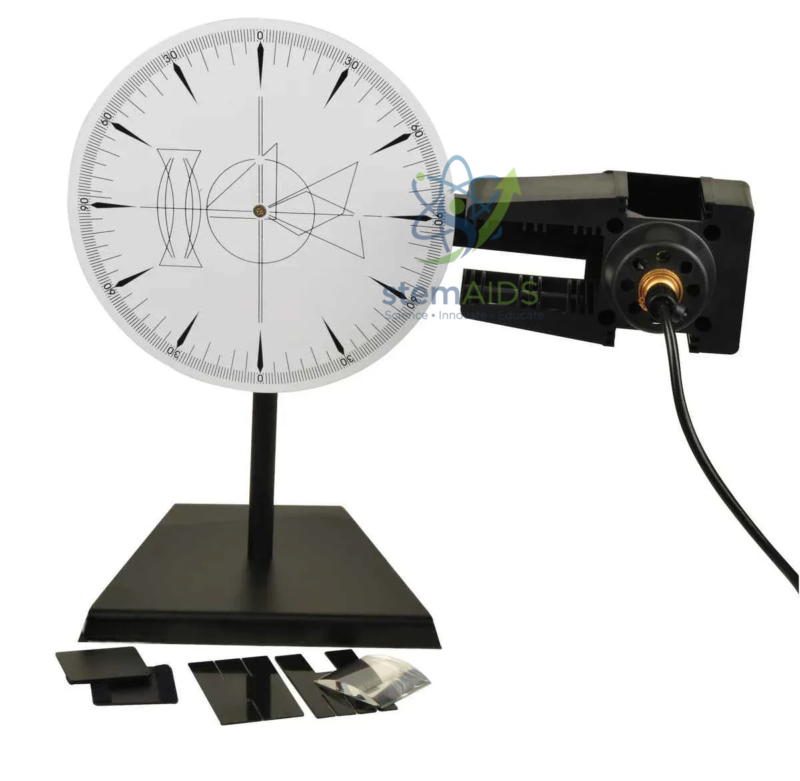
Quick Answer: This Hartl apparatus is a Hartl optical disc: a vertical circular disc graduated in degrees, with a light source that sends a narrow beam across its face, so that reflection and refraction by mirrors, prisms and glass blocks can be measured directly. The Hartl optical disc lets a group read angles of incidence, reflection and refraction from a single scale.
Reading Angles From a Graduated Disc
As pictured, the disc stands on a pillar with a lamp housing fixed at its edge, and a set of optical pieces lies beside it. The face of the disc carries a degree scale around its rim and a reference line through the centre that serves as the normal. A mirror, block or prism is fixed at the centre, and the narrow beam grazes across the white face so that its path is clearly visible. Turning the disc changes the angle of incidence, and the angles of the reflected and refracted beams are read where they meet the scale. The lamp rating, power arrangement and optical pieces supplied should be confirmed at enquiry.
Experiments on the Disc
With a plane mirror at the centre, the angle of reflection equals the angle of incidence at every setting. With a semicircular acrylic block, the beam bends at the flat face, and pairs of angles give the refractive index from Snell’s law, n = sin i / sin r. Sending the beam in through the curved face towards the centre and increasing the angle shows the refracted beam grazing the flat face at the critical angle and then total internal reflection. With a prism, the deviation can be measured as the disc turns, and the angle of minimum deviation found.
Why the Block Sits at the Centre
A beam aimed at the centre of the disc travels along a radius of the semicircular block, so it meets the curved surface at right angles and passes through it without bending. Only the flat face refracts the beam, which means each reading involves one surface and one pair of angles, making Snell’s law easy to test.
Experiments
- Verifying the laws of reflection with plane mirrors
- Measuring refractive index with a semicircular block and Snell’s law
- Finding the critical angle and showing total internal reflection
- Measuring prism deviation and the angle of minimum deviation
Specifications
| Type | Hartl optical disc apparatus |
| Scale | Circular disc graduated in degrees with a central reference line |
| Light | Lamp unit giving a narrow beam across the disc face, as pictured |
| Used with | Plane and curved mirrors, semicircular and rectangular blocks, prisms |
| Lamp rating, power supply and optical pieces included | Confirm at enquiry |
Care & Handling
- Allow the lamp to cool before touching the housing or packing the Hartl optical disc away.
- Avoid scratching the disc face; marks across the scale make readings harder.
- Clean blocks, prisms and mirrors with a soft cloth and store them in their box.
- Inspect the power lead before use and keep the apparatus away from water.
Why Choose LabEquip
Schools and colleges buy the Hartl disc when they want students to measure optical angles quickly and accurately without tracing rays on paper. LabEquip lists it with its physics lab equipment; the light projection device suits whole-class demonstrations of the same effects. Ask about the optical pieces supplied through the contact page.
Frequently Asked Questions
What is a Hartl optical disc used for?
It is used to measure angles of reflection and refraction directly on a degree scale. Mirrors, blocks and prisms are fixed at the centre of the disc, and a narrow beam shows the light path across its face.
Why does the beam pass straight through the curved face of the block?
The beam is aimed at the centre, so it travels along a radius and strikes the curved surface at right angles. Light meeting a surface along the normal is not bent.
How is refractive index found with the disc?
Measure several pairs of angles of incidence and refraction at the flat face of a semicircular block. The ratio of the sines of these angles is constant and equals the refractive index, according to Snell’s law.
How is the critical angle found?
Send the beam into the block through its curved face so it meets the flat face from inside. Increase the angle until the emerging beam just skims the surface; the angle of incidence then is the critical angle.
How does this differ from tracing rays on paper with a ray box?
On the disc the angles are read straight from a fixed scale, with no protractor or pencil tracing, so readings are faster and can be watched by a small group at once.
Does the room have to be dark?
Full darkness is not needed, but dimming the room makes the beam on the white disc easier to see, especially for students standing further away.
Last Updated: October 2026




Reviews
There are no reviews yet.