
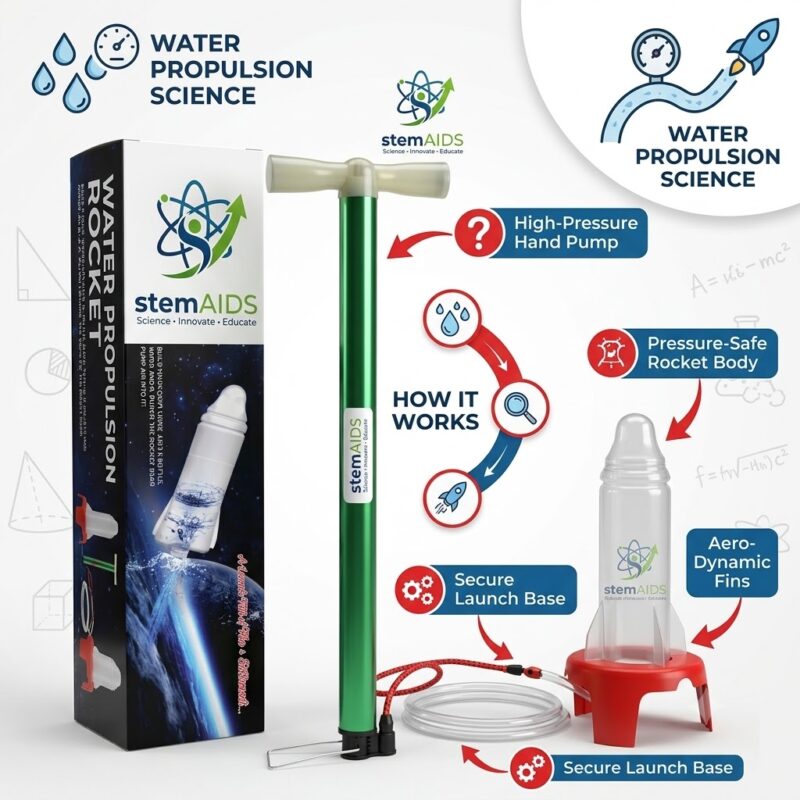
Quick Answer: The Water Propulsion Rocket Kit is a school STEM set for building and launching a water rocket. A plastic rocket body, partly filled with water, is pressurised with air from a pump until it is released from its launcher and water jets out of the nozzle. Pupils use it outdoors to study thrust, Newton’s third law and projectile motion.
How a Water Rocket Produces Thrust
A water rocket flies because compressed air forces water out through a narrow nozzle at high speed. The water is driven downward, and by Newton’s third law the rocket body is pushed upward with an equal and opposite force. Air on its own would give only a feeble push because it has so little mass; the water is the reaction mass, which is why the rocket is only partly filled before pumping.
The listing image for this water propulsion rocket kit shows a hand pump with a pressure hose, a finned rocket body and a stand that holds the rocket nozzle-down until launch. Once the pump has raised the air pressure inside, the rocket is released, the water empties in a fraction of a second, and the rocket then coasts upward before falling back as a projectile. That short sequence gives a class three phases to discuss: powered flight, coasting and descent.
Because every launch is quick to reset, the kit suits fair-test investigations. Groups change one variable at a time, such as the volume of water, the number of pump strokes, the fin shape or the launch angle, and measure the flight time or the distance travelled. The exact parts supplied, and whether a pressure gauge is included, should be confirmed when ordering.
Specifications
| Item | Water rocket set for pressurised-air launches |
| Propellant | Tap water expelled by compressed air |
| Pressurisation | Hand pump with hose, as shown in the listing image |
| Launch support | Base that holds the rocket upright until release |
| Suitable setting | Open playground or sports field under adult supervision |
| Parts list and pressure gauge | Confirm at enquiry |
Applications
- Demonstrating Newton’s third law with a launch that pupils can see and hear
- Fair tests of water volume against flight time, plotted as a graph
- Design challenges on fin shape, nose weight and stability
- Projectile-motion work in which the launch angle is varied and the range measured with a tape
- Science club activities on rocketry and space exploration
Care & Handling
- Before each session, inspect the rocket body and nozzle for cracks, splits or deformed threads, and withdraw any damaged part; a weakened body can burst under pressure.
- Pressurise only to the level the kit instructions allow, and release the pressure through the launcher rather than leaving a loaded rocket standing.
- Empty and dry the rocket and hose after use so that algae and mould do not grow inside.
- Store the pump and launcher out of direct sun, which hardens plastic parts and rubber seals.
Why Choose LabEquip
Physics teachers and school STEM clubs usually buy water rockets for field launches during a unit on forces and motion, and often order several so that groups can compare designs. LabEquip lists this kit in its STEM kits range, alongside the Floating Air Fan Apparatus, which shows the same action and reaction idea with a spinning propeller. Tell us your group numbers through the contact page.
Frequently Asked Questions
How much water should go into the rocket?
Start with about one third of the bottle volume and adjust from there. Too little water gives a short burst of thrust, while too much leaves little room for compressed air and adds weight. Finding the fill that gives the longest flight is itself a good class investigation.
Which safety rules apply during a water rocket launch?
Everyone except the launcher stands well back behind a marked line, and the person pumping wears eye protection. Never lean over a pressurised rocket, never aim it at people, buildings or overhead wires, and launch only in an open space on a calm day.
Why does a water rocket fly higher than one filled only with air?
Air has very little mass, so pushing it out produces only a small reaction force. Water is much denser, so expelling it carries far more momentum downward and gives the rocket a greater push upward. That is the central idea behind rocket propulsion.
What makes a water rocket fly straight?
Stability comes from keeping the centre of mass ahead of the centre of pressure. Fins at the tail move the centre of pressure backward, and a little extra weight in the nose moves the centre of mass forward. A rocket without fins tends to tumble soon after launch.
Which age group is the kit suited to?
Water rockets are widely used from upper primary to senior secondary level. Younger pupils focus on predicting and observing launches, while older students calculate average speed, analyse projectile range and discuss momentum. An adult should supervise every pumping and release.
Can the rocket be launched indoors?
No. Even a small water rocket travels fast and far, and it sprays water at launch. Use an open field or playground with plenty of clear space, away from roads, windows and spectators, and check the wind before each launch.
Last Updated: September 2026







Reviews
There are no reviews yet.