


Sale
In Stock
See Saw Water Pump
Original price was: $7.90.$3.84Current price is: $3.84.
Quick Answer: The See Saw Water Pump is a working model in which a see-saw lever drives two piston pumps that lift water from a reservoir. As the lever rocks, one pump draws water in while the other pushes water out, which shows how levers, one-way valves and air pressure combine in a simple pump.
How the Rocking Lever Pumps Water
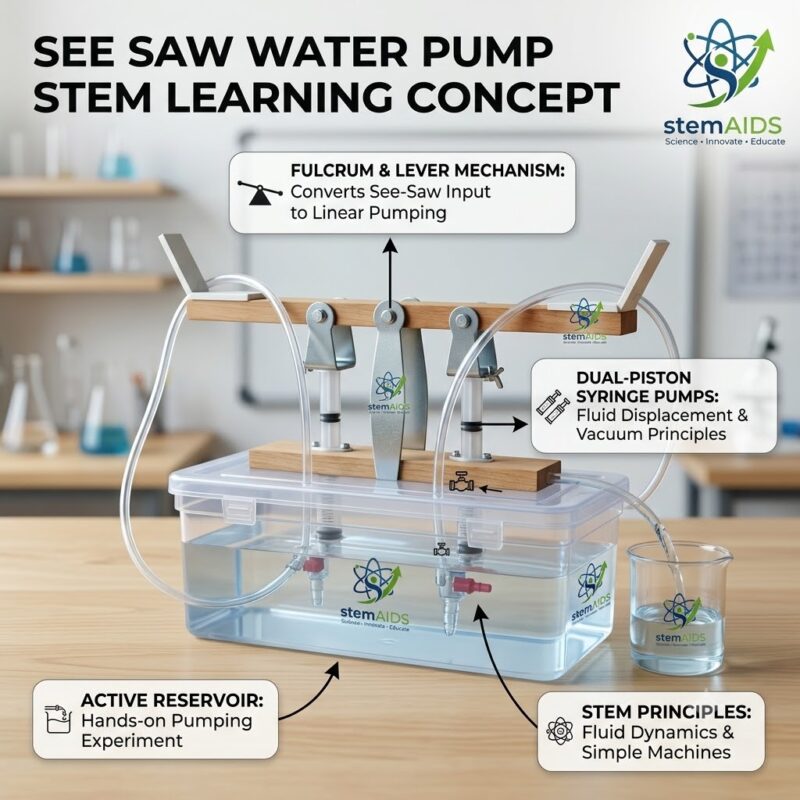
In the listing image, the see saw water pump has a wooden beam pivoted at its centre on a support above a clear water reservoir. Two syringe-type pumps hang from the beam, one on either side of the pivot, with tubes running from the reservoir and out to a collecting beaker. Pressing one end of the beam down pushes one piston in and pulls the other out, and rocking back reverses the action.
Each pump works through one-way valves. On the upstroke the piston increases the space in the cylinder, the pressure inside drops, and atmospheric pressure pushes water up from the reservoir through the inlet valve. On the downstroke the inlet valve closes and the water is forced out through the outlet valve. With two pumps working alternately, water is delivered on every movement of the beam instead of only every second one.
The model pulls together two topics at once. The beam is a first-class lever with the pivot between the two pumps, and the pumps are reciprocating pumps of the same kind as the village hand pump. Playground see-saws and roundabouts that pump water have even been built for schools in some regions, which students often find a striking application. Whether the model arrives assembled or as a build-it-yourself kit should be confirmed at enquiry.
Specifications
| Item | Lever-operated water pump model |
| Lever | Wooden see-saw beam on a central pivot (listing image) |
| Pumps | Two syringe-type piston pumps, one on each side of the pivot |
| Water path | Reservoir, inlet tubes, one-way valves and outlet tubes |
| Concepts | Levers, reciprocating pumps, one-way valves, atmospheric pressure |
| Assembled or kit form | Confirm at enquiry |
Lessons Built Around the Pump
- Demonstrating how a lever transfers force from one point to another
- Explaining suction as atmospheric pressure pushing water into a low-pressure space
- Showing why one-way valves are needed for a pump to work
- Measuring the water delivered per stroke and per minute
- Discussing hand pumps and water supply in communities without piped water
Care & Handling
- Use clean water, and empty and dry the reservoir and tubes after each lesson to prevent algae.
- Keep the syringe plungers moving smoothly; a trace of silicone grease helps if they stick.
- Rock the beam steadily rather than slamming it down, which strains the pivot and pump mountings.
- Check the valves and tube joints for leaks before a demonstration.
Why Choose LabEquip
Teachers of simple machines and of pressure often use the see saw water pump because it links both topics in one working model. LabEquip lists it in the STEM kits range with the Mechanical Pulley Working Model, another simple machine students can measure. Contact us on the contact page with your order.
Frequently Asked Questions
What do the one-way valves do?
They make the water flow in one direction only. The inlet valve opens as the piston draws water in and closes as it pushes out, while the outlet valve does the opposite. Without them the water would just move back and forth in the tube.
Is water really sucked up into the pump?
Not exactly. Drawing the piston back leaves a region of reduced pressure in the syringe, and the atmosphere, pressing on the open water surface of the reservoir, pushes water up the inlet tube into that space. What we call suction is really a pressure difference.
Why use two pumps instead of one?
With two pumps on opposite sides of the pivot, one is filling while the other is emptying. Water is delivered on every stroke of the beam, so the flow is steadier and less effort is wasted.
How does the lever make pumping easier?
The beam is a lever pivoted in the middle. Pushing down on the end, further from the pivot than the pumps, lets a smaller force produce the larger force needed at the pistons, at the cost of moving the hand a greater distance.
Is there a limit to how far a suction pump can raise water?
Atmospheric pressure can support a column of water only about 10 metres high, so no suction pump can lift water further than that from below. Deeper wells need the pump to be placed down near the water to push it up.
Can students measure the pump’s output?
Yes. Count a fixed number of strokes, collect the water in a measuring cylinder and divide to find the volume per stroke. Timing a minute of steady pumping gives the flow rate, which can be compared between students.
Last Updated: September 2026
You must be logged in to post a review.
Bestsellers

Sale

Sale
Sale


Reviews
There are no reviews yet.