






In Stock
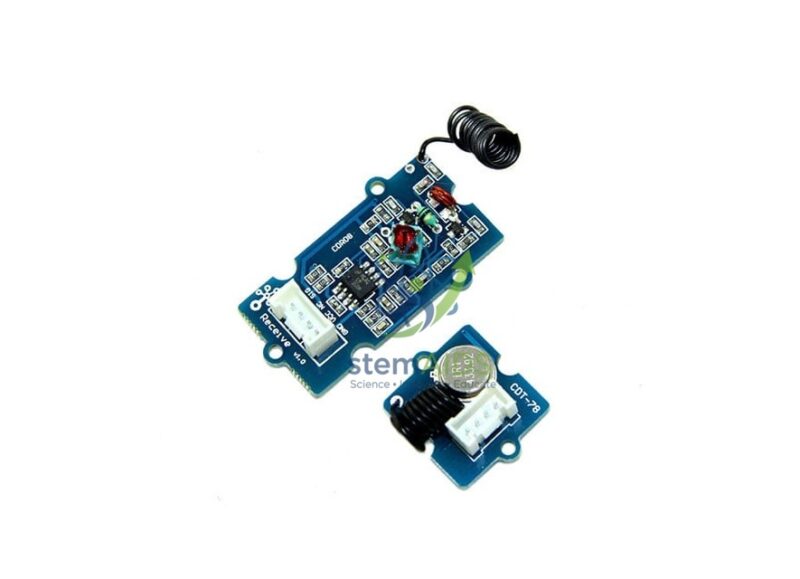
RF 433 MHz Grove Module
₹756.00
Quick Answer: The RF 433 MHz Grove Module is a short-range radio module for the 433 MHz band with a Grove connector, used to send simple digital data wirelessly from one microcontroller to another. In class it demonstrates remote control, wireless sensor readings and the basics of radio communication.
How a Simple 433 MHz Link Works
Basic 433 MHz modules use amplitude-shift keying: the transmitter switches its carrier on and off to represent data bits, and the receiver recovers that pattern and passes it to a second microcontroller. Grove 433 MHz products are commonly sold as a transmitter-and-receiver pair giving a one-way link. Radio libraries handle the timing, so students can send a number or a short message with a few lines of code.
Many everyday devices share the 433 MHz band, including garage-door remotes, doorbells and wireless weather stations, which gives students a real-world reference point. It also means interference is common, so projects show why data is sent with start patterns, checks and repeated messages. Range varies widely with antenna length, obstacles and supply voltage, which makes it a fair experiment to measure in the school grounds.
Whether this listing supplies a transmitter, a receiver or a matched pair is not stated in the title. Radio rules also differ by country, so schools should check that low-power 433 MHz use is permitted where they are.
Specifications
| Item | 433 MHz RF radio module with Grove connector |
| Band | 433 MHz, from the listing title |
| Link type | Simple one-way data link from transmitter to receiver |
| Modulation | Usually on-off keying (ASK) in basic modules |
| Connection | Grove cable to a digital port on each microcontroller |
| Transmitter, receiver or pair supplied | Confirm at enquiry |
Wireless Projects
- Wireless remote that switches an LED or buzzer on a second board
- Outdoor weather station sending temperature readings to an indoor display
- Measuring how range changes with antenna length and obstacles
- Lessons on radio frequency, modulation and error checking
Care & Handling
- Keep the antenna straight and clear of metal objects for consistent range.
- Mount the receiver away from motors and switching power supplies, which produce radio noise.
- Use low-power operation only and follow local radio regulations.
Why Choose LabEquip
Schools choose 433 MHz modules for projects in which two separate devices must communicate, such as a remote sensor and an indoor display. LabEquip lists this module in its STEM kits range, and a received reading can be shown on the Grove OLED display. Send quantities, and whether you need pairs, via the contact page.
Frequently Asked Questions
Do I need two boards to use the 433 MHz module?
Yes. The transmitter connects to one microcontroller and the receiver to another, each running its own program. One board sends the data and the other receives and acts on it, which is how students see a real wireless link.
How far can the module send data?
Range depends on the antenna, obstacles, interference and supply voltage, so it varies from a few metres indoors to considerably further in open space. Measuring the range with and without an antenna makes a good class experiment.
Can the 433 MHz module send data both ways?
A basic transmitter-and-receiver pair only sends data one way. For two-way communication each board needs both a transmitter and a receiver, or a transceiver module of the kind used in more advanced radio projects.
Why do I receive random data when nothing is being sent?
Simple receivers amplify background noise when no signal is present, and other 433 MHz devices nearby also transmit. A library that adds a start pattern and a checksum makes the receiver ignore anything that is not a valid message.
Is it legal to use 433 MHz in school?
Low-power 433 MHz devices are allowed without a licence in many countries, which is why remotes and doorbells use the band. Rules on power and duty cycle vary by region, so schools should check the local regulations for short-range devices.
What is the difference between 433 MHz modules and Bluetooth?
Bluetooth is a full protocol with pairing, two-way data and error handling built in. A basic 433 MHz module only sends on-off radio pulses, leaving the protocol to the program. That makes 433 MHz simpler hardware and a clearer way to learn how radio data works.
Last Updated: September 2026
You must be logged in to post a review.
Bestsellers

Sale

Sale

Sale


Reviews
There are no reviews yet.