

Sale
In Stock
Nuclear Fusion Educational Model
Original price was: $7.33.$3.55Current price is: $3.55.
Quick Answer: The Nuclear Fusion Educational Model is a teaching display that uses coloured balls for protons and neutrons to show two hydrogen isotopes, deuterium and tritium, joining to form a helium-4 nucleus and a free neutron while releasing energy. It helps students understand how stars shine and what fusion power research is trying to achieve.
The Reaction the Model Shows
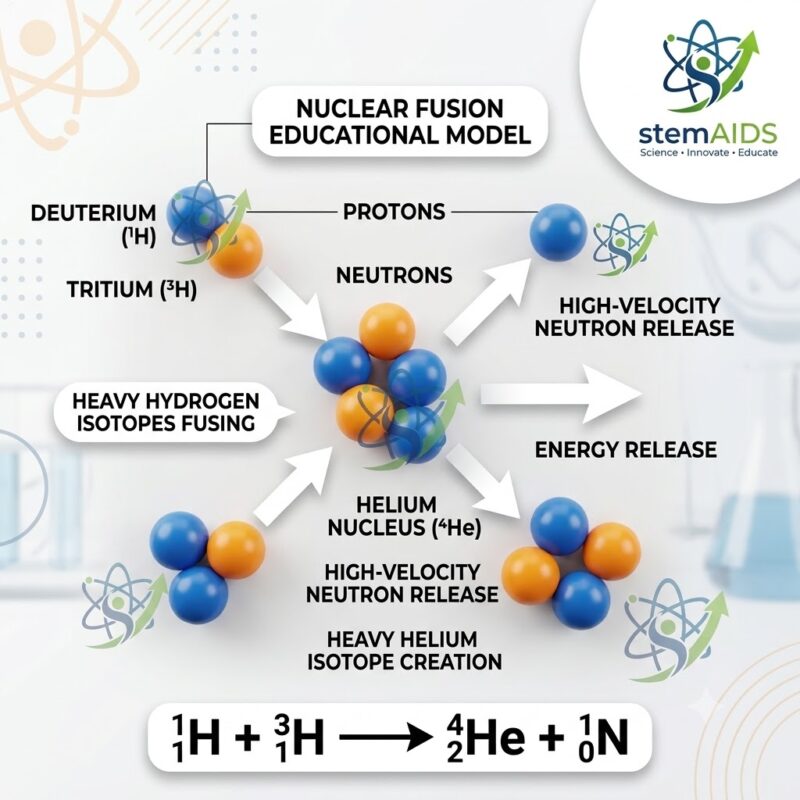
The listing image of the nuclear fusion educational model shows proton and neutron balls grouped into a deuterium nucleus (one proton, one neutron) and a tritium nucleus (one proton, two neutrons), which combine into a helium nucleus of two protons and two neutrons while one high-speed neutron leaves. The balanced equation is ²H + ³H → ⁴He + n, and students can check it by counting: five nucleons before and after, and two units of charge on each side.
Where does the energy come from? The helium nucleus and the neutron together have slightly less mass than the deuterium and tritium did, and that missing mass, the mass defect, is released as energy according to Einstein’s E = mc². Most of it is carried off as kinetic energy of the fast neutron, which is why fusion reactor designs surround the plasma with a blanket that captures neutrons and turns their energy into heat.
Getting nuclei to fuse is the hard part. Both carry positive charge and repel strongly, so the fuel must be heated into a plasma at over a hundred million degrees Celsius before the nuclei collide fast enough. The Sun manages fusion through its enormous gravity, turning hydrogen into helium in its core, while experimental machines called tokamaks hold plasma in magnetic fields and laser facilities squeeze tiny fuel pellets. Comparing this model with fission, where heavy nuclei split, is a natural next step.
Specifications
| Item | Nuclear fusion teaching model |
| Reaction shown | Deuterium + tritium → helium-4 + neutron + energy |
| Particles | Coloured balls for protons and neutrons, as shown in the listing image |
| Concepts | Isotopes, mass defect, conservation of nucleon number and charge |
| Level | Secondary and senior secondary physics |
| Size and mounting | Confirm at enquiry |
Applications
- Explaining how the Sun and other stars produce energy
- Balancing nuclear equations by counting nucleons and charge
- Contrasting fusion with fission in lessons on nuclear energy
- Discussing fusion research, tokamaks and future energy sources
Care & Handling
- Keep the model in a dust-free display case or cupboard; the small balls collect dust easily.
- Handle it by its base or mount rather than by the particle clusters.
- Keep any printed equation or label panel out of direct sunlight to stop fading.
Why Choose LabEquip
Physics teachers covering nuclear energy, and astronomy clubs studying the stars, usually buy this model because nuclei are easier to count on a model than in a textbook diagram. LabEquip lists it in the STEM kits range beside the Isotopes of Hydrogen Model, which introduces deuterium and tritium first. Send your enquiry through the contact page.
Frequently Asked Questions
What is nuclear fusion?
Fusion is the joining of two light nuclei to form a heavier nucleus. When the products have less mass than the starting nuclei, the difference is released as energy. It is the process that powers the Sun and other stars.
Why are deuterium and tritium used as fusion fuel?
The deuterium-tritium reaction happens at a lower temperature than other fusion reactions and releases a large amount of energy. Deuterium can be extracted from seawater, while tritium is rare and is usually bred from lithium.
Why is such a high temperature needed?
Nuclei are positively charged and repel each other. Only at extremely high temperatures do they move fast enough to overcome this repulsion and get close enough for the strong nuclear force to bind them together.
How is fusion different from fission?
Fission splits a heavy nucleus such as uranium into smaller ones, and it is used in today’s nuclear power stations. Fusion joins light nuclei such as hydrogen isotopes. Both release energy because the products have less mass than the starting material.
Where does the Sun get the conditions to fuse hydrogen?
The Sun’s enormous gravity squeezes and heats its core to millions of degrees at very high density. Under those conditions hydrogen nuclei fuse, in a series of steps, into helium, releasing the energy that reaches Earth as light and heat.
Is fusion used to generate electricity today?
Not yet commercially. Experimental reactors have produced fusion reactions, and research projects around the world are working towards machines that release more energy than they use, but fusion power stations are still in development.
Last Updated: September 2026
You must be logged in to post a review.
Bestsellers


Sale

Sale

Sale


Reviews
There are no reviews yet.