


Sale
In Stock
Hydraulic Force Demonstration Model
Original price was: ₹700.00.₹340.00Current price is: ₹340.00.
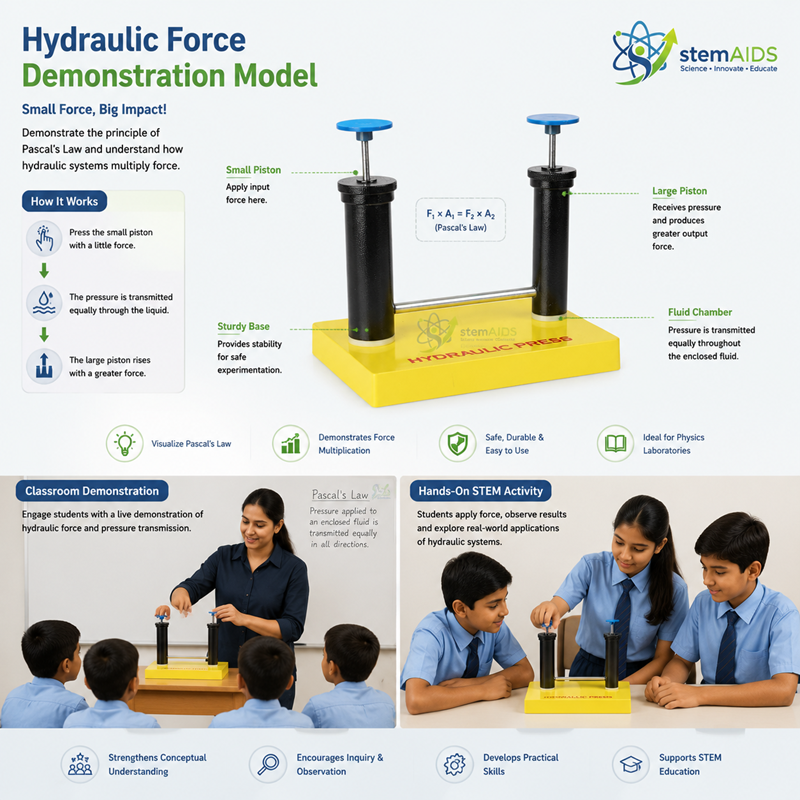
Quick Answer: The Hydraulic Force Demonstration Model shows how a hydraulic system multiplies force. The listing image shows a small piston and a large piston in upright cylinders on a sturdy base, joined by a fluid chamber, so pressing the small piston lifts the large one with a greater force, as Pascal’s law predicts.
Pascal’s Law with Two Pistons
Pascal’s law states that pressure applied to an enclosed fluid is transmitted equally to every part of the fluid. Pressing the small piston creates a pressure equal to the force divided by the small piston’s area. That same pressure acts on the large piston, and because the large piston has a bigger area, the upward force on it is larger: F1/A1 = F2/A2. The hydraulic force demonstration model makes that equation something students can push with their own hands.
The force gain has a price. Liquids are almost incompressible, so the volume pushed out of the small cylinder must equal the volume that enters the large one. The small piston therefore moves a long way while the large piston rises only a little, and the work done on each side is the same apart from losses. The model shows force multiplication, never energy creation.
The same principle runs car brakes, hydraulic jacks, excavator arms and adjustable chairs. The fluid used and the piston diameters in this model are not stated in the listing and should be confirmed when ordering.
Applications
- Demonstrating Pascal’s law and pressure transmission in liquids
- Calculating the force gain from piston areas
- Showing that the small piston moves further than the large one
- Explaining car brakes, jacks and construction machinery
Specifications
| Model type | Two-piston hydraulic force demonstrator |
| Pistons | One small and one large piston in upright cylinders, as pictured |
| Link | Enclosed fluid chamber joining the two cylinders |
| Base | Sturdy flat base |
| Principle | Pascal’s law, F1/A1 = F2/A2 |
| Fluid and piston diameters | Confirm at enquiry |
Care & Handling
- Push the pistons steadily rather than striking them, to protect the seals and joints.
- Check for leaks and air bubbles before class; trapped air makes the model feel spongy.
- Keep the model upright during storage so fluid does not seep past the seals.
- Wipe away any spilled fluid at once and keep the base dry.
Why Choose LabEquip
Physics teachers buy this model for the pressure topic because pupils feel the force difference directly instead of taking it from a diagram. LabEquip offers it in the STEM kits range, and the DIY Hydraulic Jack Model gives older students a build-it-yourself version of the same system. Place orders through our contact page.
Frequently Asked Questions
Why does the large piston push with a greater force?
The pressure in the fluid is the same everywhere, so the force on each piston equals that pressure times the piston’s area. The large piston has a bigger area, so it receives a bigger force from the same pressure.
Does a hydraulic system create extra energy?
No. The small piston must travel much further than the large piston rises, because the same volume of liquid moves between them. Force times distance, the work done, is equal on both sides apart from friction losses.
Why are liquids used instead of air?
Liquids are almost incompressible, so a push on one piston is passed straight to the other. Air would squash first, absorbing much of the movement and making the system slow and springy.
How do I calculate the force gain?
Divide the area of the large piston by the area of the small one. Because area depends on the square of the diameter, a large piston twice the diameter of the small one gives four times the force.
What happens if air gets into the system?
Trapped bubbles compress when the small piston is pushed, so part of the movement is wasted squeezing air and the large piston moves less than expected. Mechanics bleed car brakes to remove air for exactly this reason.
Where are hydraulic systems used in everyday life?
Car brakes, hydraulic jacks, excavators, forklifts, dentist and barber chairs, and aircraft control surfaces all use hydraulics to move heavy loads or apply large forces with small inputs.
Last Updated: September 2026
You must be logged in to post a review.
Bestsellers



Sale

Sale
Sale

Sale


Reviews
There are no reviews yet.