

Sale
In Stock
Human Respiratory System Jar Model
Original price was: $7.90.$3.84Current price is: $3.84.
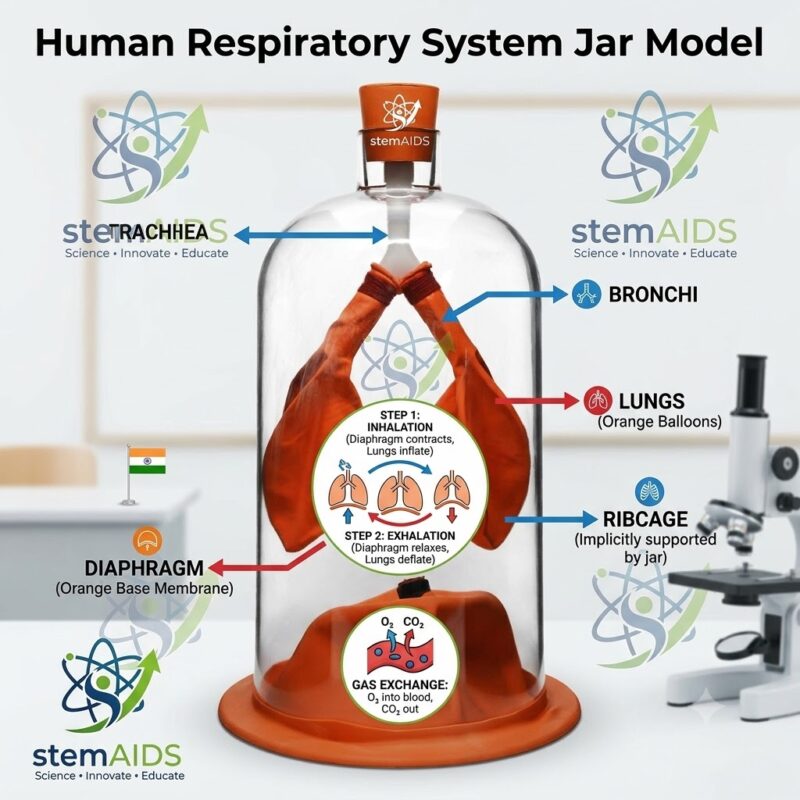
The Human Respiratory System Jar Model is a biology teaching aid used for demonstrating the basic mechanics of inhalation and exhalation. It helps students, teachers and laboratory instructors observe how changes in internal volume and pressure can expand or contract simulated lungs during a supervised classroom activity.
Product Description
The STEMAids Human Respiratory System Jar Model provides a simplified representation of breathing mechanics. The enclosed chamber represents the thoracic cavity, while flexible internal elements represent the lungs. A movable lower membrane represents the diaphragm and changes the volume inside the chamber.
Moving the membrane downward increases chamber volume and lowers internal pressure, causing the simulated lungs to expand. Moving it upward reduces chamber volume and causes them to contract. The exact jar, membrane, tubing and lung-simulation materials must be confirmed from the current STEMAids specification.
Key Features
- Demonstrates breathing mechanics: Shows how pressure and volume changes contribute to inhalation and exhalation.
- Represents diaphragm action: Uses a movable lower membrane to model diaphragm movement.
- Provides visible results: Learners can observe simulated lungs expand and contract during operation.
- Supports anatomy lessons: Connects the lungs, air passage, thoracic cavity and diaphragm in one demonstration.
- Explains pressure differences: Helps students understand why air moves into or out of the lungs.
- Suitable for guided learning: Supports teacher demonstrations, student observation and oral assessments.
- Reusable classroom model: Intended for repeated biology activities when flexible components are handled carefully.
Technical Specifications
|
Specification |
Detail |
|
Product name |
Human Respiratory System Jar Model |
|
Brand |
STEMAids |
|
Product category |
Human anatomy teaching model / respiratory-system demonstration apparatus |
|
Demonstration capacity |
One breathing-mechanics demonstration unit |
|
Learning concepts |
Inhalation, exhalation, diaphragm movement, thoracic volume and air-pressure change |
|
Intended users |
School students, biology teachers, laboratory instructors and science-learning centres |
|
Standards or certifications |
No product-specific certification publicly verified |
What’s Included in the Kit
- One transparent respiratory-system demonstration chamber
- Simulated lung elements
- Airway tube or branched-tube assembly
- Flexible diaphragm-simulation membrane
- Seals, connectors or retaining components
- Instruction sheet or classroom activity guide
Applications and Uses
- Demonstrating inhalation and exhalation.
- Explaining how diaphragm movement changes thoracic volume.
- Showing the relationship between volume and internal air pressure.
- Introducing the functions of the lungs, trachea and bronchial passages.
- Comparing the model with a labelled human respiratory-system diagram.
- Supporting biology practicals, science exhibitions and classroom assessments.
How to Use the Human Respiratory System Jar Model
- Place the model upright on a clean, stable table.
- Identify the chamber, simulated lungs, airway and lower membrane.
- Check that the chamber openings and connecting points are properly sealed.
- Pull the lower membrane downward slowly.
- Observe the simulated lungs as the internal chamber volume increases.
- Push or release the membrane upward as directed.
- Observe the simulated lungs contract as chamber volume decreases.
- Relate each movement to inhalation, exhalation and diaphragm action in humans.
Safety and handling: This model is a simplified teaching aid and does not reproduce every anatomical or physiological feature of human respiration. Do not overstretch flexible parts or place any component in the mouth.
Care & Maintenance
- Wipe the chamber with a soft, dry or lightly damp cloth.
- Keep flexible components away from sharp objects, oils and excessive heat.
- Inspect seals and tubing before use if the model does not respond correctly.
- Store the model upright without compressing or stretching its membrane.
Why Choose STEMAids
STEMAids develops and supplies educational models, laboratory products and project-based STEM resources for practical learning. Its catalogue includes educational science models, biology laboratory products, STEM learning kits and a broader range of scientific and educational products. The company serves schools, institutions and international procurement enquiries. Buyers should request the latest product image, component list and dimensions before approving an order.
Frequently Asked Questions
What is a Human Respiratory System Jar Model used for?
It is used to demonstrate how changes in thoracic volume and pressure contribute to inhalation and exhalation.
What does the jar represent in the model?
The enclosed jar or chamber represents the thoracic cavity surrounding the simulated lungs.
What does the lower membrane represent?
The flexible lower membrane represents the diaphragm. Moving it changes the volume and pressure inside the model chamber.
Does the model show gas exchange?
No. A basic jar model demonstrates ventilation mechanics, not oxygen and carbon-dioxide exchange across the alveoli.
What materials are used in the model?
The exact chamber, tubing and membrane materials are not publicly verified. Confirm them from the current STEMAids technical specification.
Is the respiratory-system model suitable for schools?
Yes. It is suitable for supervised biology lessons, breathing-mechanics demonstrations, revision activities and science exhibitions.
Explore more educational science models from STEMAids for anatomy, biology and classroom demonstrations.
Recommended primary image ALT text: Human Respiratory System Jar Model demonstrating inhalation and exhalation in a biology classroom.
Recommended component image ALT text: Respiratory jar model showing simulated lungs, airway tube and diaphragm membrane.
Recommended application image ALT text: Teacher operating a respiratory-system jar model during a supervised breathing lesson.
You must be logged in to post a review.
Bestsellers


Sale

Sale
Sale


Reviews
There are no reviews yet.