















In Stock
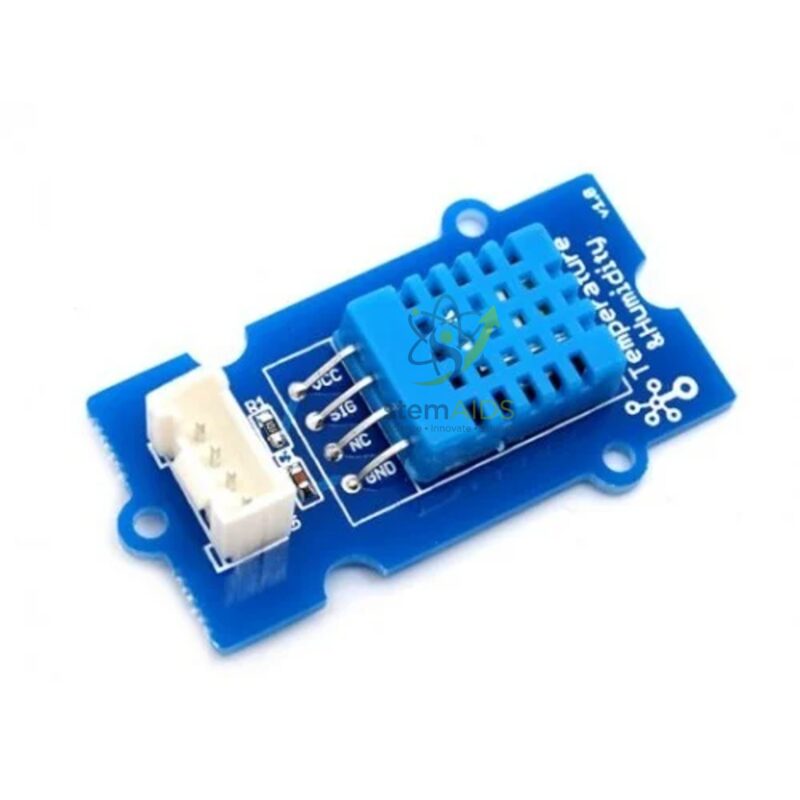
Grove Temperature and Humidity Sensor
₹230.00
Quick Answer: The Grove Temperature and Humidity Sensor is a digital sensor module on a Grove board that reports both air temperature and relative humidity to a microcontroller. It is used in classroom weather stations, greenhouse models and comfort monitors.
Two Measurements from One Module
Temperature is familiar to students, but relative humidity usually needs explaining. It compares the water vapour in the air with the most that air could hold at that temperature, expressed as a percentage. Because warm air can hold more vapour, the same amount of moisture gives a lower relative humidity on a hot afternoon than on a cool morning, and this sensor lets students see that relationship in their own data.
Sensors in this family send both values digitally over one Grove connection, and a library returns them as numbers ready to print or log. They respond slowly compared with a light or sound sensor, and many need a pause of a second or more between readings, so programs should read at a steady interval rather than as fast as the loop runs.
Grove temperature and humidity modules are built around different sensor chips with different ranges and accuracy, so confirm the chip, range and accuracy of this version before using it for quantitative experiments.
Applications
- Classroom weather stations showing readings on the Grove 2 x 16 Characters LCD Display
- Greenhouse or terrarium models that switch on a fan when it gets too warm, using the Grove Mini Fan
- Investigating how breath, warm water or a wet cloth in a sealed box changes humidity
- Logging classroom conditions through a day to discuss comfort and ventilation
- Calculating dew point from temperature and humidity in geography or physics lessons
Specifications
| Sensor | Combined air temperature and relative humidity sensor, Grove board |
| Output | Digital readings of temperature and relative humidity |
| Connection | Grove digital or I2C port, depending on the sensor chip |
| Reading rate | Slow; typical versions are read at intervals of a second or more |
| Sensor chip, range and accuracy | Confirm at enquiry |
Care & Handling
- Keep the Grove Temperature and Humidity Sensor out of direct sun and away from the controller’s own warm components, which bias the temperature reading.
- Do not let the sensor get wet or covered in condensation; move it gradually between cold and warm rooms.
- Leave the vents on the sensor housing uncovered so air can reach the element.
- Store it in a dry, dust-free box, since contaminants on the element slowly shift humidity readings.
Why Choose LabEquip
Science departments tend to buy combined temperature and humidity sensors for weather and environment units because one module supplies two variables to analyse. LabEquip lists this sensor in its STEM kits section and handles class orders through the contact page.
Frequently Asked Questions
What does relative humidity mean?
It is the amount of water vapour in the air as a percentage of the maximum the air could hold at that temperature. At 100 percent the air is saturated and water starts to condense.
Why does humidity fall when the room warms up?
Warmer air can hold more water vapour. If the actual amount of vapour stays the same, the percentage of the maximum falls as temperature rises, even though no water has been removed.
How often can I take readings?
Sensors of this type are slow, and typical versions should not be read more than about once every one or two seconds. For logging, a reading every few seconds or minutes is plenty.
Why is the temperature reading higher than a thermometer shows?
The sensor may be warmed by sunlight, the controller board or a hand. Mount it away from heat sources on a short cable, allow time to settle and compare with a reference thermometer in the same spot.
Can it measure soil moisture?
No. It measures moisture in the air. For wetness in soil, use a soil moisture probe, which works on a different principle.
Is it accurate enough for experiments?
It is suitable for comparisons, trends and classroom investigations. Accuracy depends on the sensor chip used in this version, so confirm it when you enquire if your experiment needs a stated tolerance.
Last Updated: September 2026
You must be logged in to post a review.
Bestsellers

Sale

Sale

Sale


Reviews
There are no reviews yet.