


Sale
In Stock
Carbon Atom Structure Model
Original price was: ₹650.00.₹315.00Current price is: ₹315.00.
Quick Answer: The Carbon Atom Structure Model is a chemistry display of the carbon atom, showing six electrons arranged 2,4 around the nucleus. Its four valence electrons explain why carbon forms four covalent bonds, which is the starting point for teaching tetravalency, catenation, carbon’s allotropes and organic chemistry.
Six Electrons, Four Bonds
The listing image shows the carbon atom structure model as an upright panel on a stand, with a central nucleus marked C and electron beads on two orbits, together with the electron configuration 1s² 2s² 2p² and the shell arrangement 2,4. Carbon-12, the common isotope, has six protons and six neutrons, and one twelfth of its mass defines the atomic mass unit used for every other element.
With four electrons in its outer shell, carbon is exactly halfway to a full octet. Losing or gaining four electrons would need too much energy, so carbon shares them instead, forming four covalent bonds; this is its tetravalency. In methane those four bonds point to the corners of a tetrahedron, and carbon bonds just as readily to other carbon atoms, building chains, branches and rings. That self-linking, called catenation, is why millions of organic compounds exist.
The same bonding explains carbon’s allotropes. In diamond each atom bonds to four others in a rigid network, in graphite each bonds to three in flat layers that slide over one another, and in fullerenes such as C60 the atoms form closed cages. A related isotope, carbon-14, with eight neutrons, is radioactive and underlies the radiocarbon dating of once-living material.
Applications
- Introducing tetravalency and covalent bonding
- Starting the carbon and its compounds chapter
- Explaining allotropes: diamond, graphite and fullerenes
- Discussing isotopes and radiocarbon dating
Specifications
| Item | Atomic structure model of carbon |
| Electron arrangement | 2,4; 1s² 2s² 2p² |
| Valence electrons | Four (tetravalent) |
| Nucleus of carbon-12 | 6 protons and 6 neutrons |
| Format | Upright display panel on a stand, as pictured |
| Size | Confirm at enquiry |
Care & Handling
- Stand the model on a flat surface where the base cannot be knocked off the edge.
- Dust with a soft brush and avoid wet cleaning of the printed text.
- Store it upright in a cupboard, away from direct sunlight.
Why Choose LabEquip
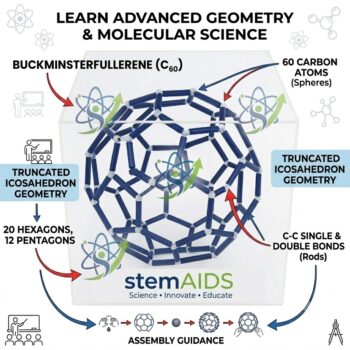
Teachers usually buy this model for the carbon and its compounds chapter, where tetravalency must be understood before hydrocarbons make sense. LabEquip lists it in the STEM kits range with the Bucky Ball Molecular Model, which shows one of carbon’s more surprising structures. Share quantities through the contact page.
Frequently Asked Questions
What is the electron arrangement of carbon?
Carbon has six electrons arranged 2,4: two in the first shell and four in the second. The four outer electrons are its valence electrons.
Why does carbon form covalent bonds instead of ions?
Forming an ion with a charge of four would require removing or adding four electrons, which takes too much energy. Sharing electrons in four covalent bonds lets carbon complete its outer shell far more easily.
What is tetravalency?
Tetravalency means having a valency of four. Carbon forms four bonds, which can be single, double or triple bonds in combination, as in methane, ethene and ethyne.
What is catenation?
Catenation is the ability of atoms of an element to bond to each other to form chains and rings. Carbon does this more than any other element, which is why there are so many carbon compounds.
How many neutrons does a carbon atom have?
Carbon-12, the most common isotope, has six neutrons. Carbon-13 has seven and radioactive carbon-14 has eight. All have six protons, which is what makes them carbon.
How does carbon’s structure explain diamond and graphite?
In diamond each carbon atom uses all four valence electrons to bond to four others, making a very hard network. In graphite each bonds to three, leaving one electron free to move, so graphite is soft, layered and conducts electricity.
Last Updated: September 2026
You must be logged in to post a review.
Bestsellers




Sale

Sale

Sale


Reviews
There are no reviews yet.