
Sale
In Stock
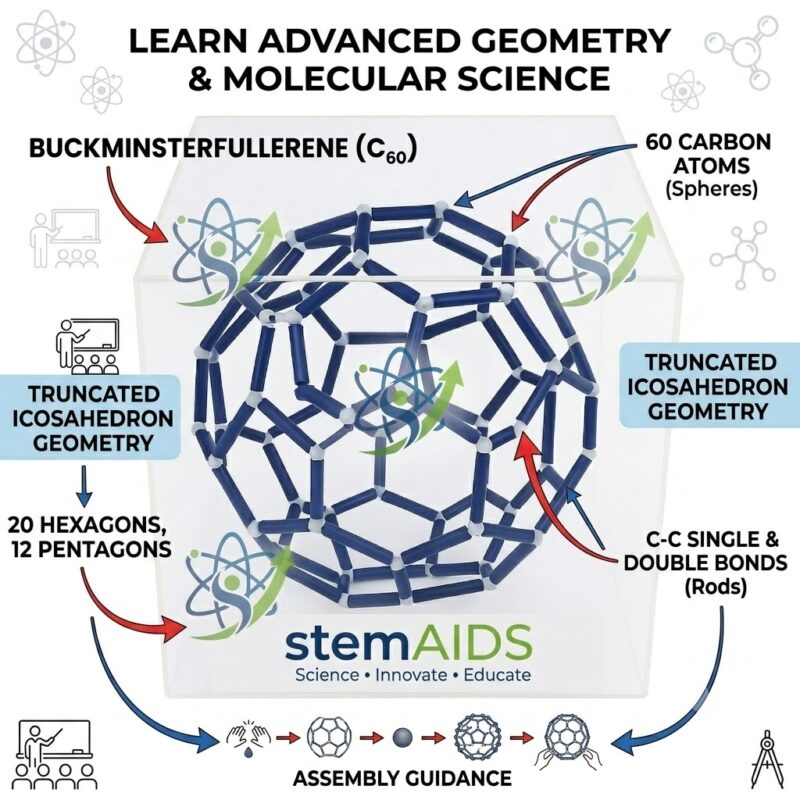
Bucky Ball Molecular Model
Original price was: $25.94.$12.86Current price is: $12.86.
The Bucky Ball Molecular Model is a chemistry teaching model used for explaining the molecular structure of buckminsterfullerene, or C60. It helps students, chemistry teachers and laboratory instructors visualise how 60 carbon atoms form a closed, approximately spherical cage made from pentagonal and hexagonal rings.
Product Description
The STEMAids Bucky Ball Molecular Model represents the carbon framework of buckminsterfullerene. The ideal C60 structure has the geometry of a truncated icosahedron, with 12 pentagonal rings and 20 hexagonal rings arranged in a closed cage resembling a football.
Each carbon atom in C60 is connected to three neighbouring carbon atoms. The model supports instruction in molecular geometry, carbon allotropes, nanoscience and fullerene chemistry. Its exact construction material, scale, assembly method and colour coding must be confirmed from the current STEMAids specification.
Key Features
- Represents the C60 framework: Provides a three-dimensional reference for the cage structure of buckminsterfullerene.
- Shows pentagonal and hexagonal rings: Helps learners identify the two polygon types that form the fullerene cage.
- Explains carbon connectivity: Illustrates how each carbon position connects with three neighbouring positions.
- Supports molecular-geometry lessons: Makes spatial relationships easier to interpret than a flat structural diagram alone.
- Introduces carbon allotropes: Supports comparison with diamond, graphite, graphene and carbon nanotubes.
- Useful for nanoscience instruction: Provides an accessible starting point for discussing fullerenes and nanoscale carbon materials.
- Reusable teaching format: Suitable for repeated classroom demonstrations when its joints and structural elements are handled correctly.
Technical Specifications
|
Specification |
Detail |
|
Product name |
Bucky Ball Molecular Model |
|
Brand |
STEMAids |
|
Product category |
Molecular structure model / chemistry teaching model |
|
Model capacity |
One C60 fullerene structure |
|
Represented molecule |
Buckminsterfullerene, C60 |
|
Ideal molecular geometry |
Truncated icosahedral carbon cage |
|
Structural composition |
60 carbon positions arranged in 12 pentagons and 20 hexagons |
|
Intended users |
Secondary-school students, college students, chemistry teachers and laboratory instructors |
|
Standards or certifications |
No product-specific certification publicly verified |
What’s Included in the Kit
- One Bucky Ball Molecular Model or assembly set
- Carbon atom elements or structural nodes
- Bond connectors or joining elements
- Supporting stand or display base
- Assembly diagram or molecular-structure guide
- Protective storage packaging
Applications and Uses
- Teaching the molecular geometry of buckminsterfullerene.
- Identifying pentagonal and hexagonal rings in the C60 cage.
- Comparing fullerenes with other carbon allotropes.
- Introducing molecular symmetry and closed-cage structures.
- Supporting lessons on nanochemistry and carbon nanomaterials.
- Conducting chemistry demonstrations, revision activities and science exhibitions.
How to Use the Bucky Ball Molecular Model
- Place the assembled model on a stable surface or construct it according to the supplied guide.
- Identify one pentagonal ring and count its five carbon positions.
- Locate the surrounding hexagonal rings and compare their geometry.
- Trace the connections from one carbon position to its three neighbouring positions.
- Rotate the model to examine its closed, approximately spherical cage.
- Compare the physical structure with a two-dimensional C60 diagram.
- Discuss how C60 differs structurally from graphite, diamond and graphene.
- Return detachable components to their storage container after use.
Safety and handling: Do not force connectors or suspend the model by one bond. Keep small components away from young children unless the product is specifically approved for their age group.
Care & Maintenance
- Remove dust with a soft, dry cloth or brush.
- Support the complete structure when moving an assembled model.
- Do not bend connectors or apply excessive pressure to atom elements.
- Store loose parts in a labelled container away from heat and direct sunlight.
Why Choose STEMAids
STEMAids develops and supplies educational models, laboratory products and hands-on STEM resources for institutional science learning. Buyers can explore related educational science models, chemistry laboratory equipment, STEM learning kits and the complete scientific and educational product range. The company supports schools, teachers and institutional buyers in India and abroad. Request the current model photograph, material specification and packing list before procurement.
Frequently Asked Questions
What is a Bucky Ball Molecular Model used for?
It is used to teach the three-dimensional molecular structure of buckminsterfullerene, a carbon molecule with the formula C60.
How many carbon atoms are in a buckyball?
Buckminsterfullerene contains 60 carbon atoms. Its molecular formula is therefore written as C60.
How many pentagons and hexagons are in C60?
The ideal C60 cage contains 12 pentagons and 20 hexagons arranged as a truncated icosahedron.
Is a buckyball the same as a football?
No. The comparison refers only to its geometric pattern. The molecular cage resembles the pentagon-and-hexagon arrangement used on a traditional football.
Does the model require assembly?
The supplied format is not publicly verified. Confirm whether the STEMAids model is delivered assembled or as a molecular construction set.
Is the Bucky Ball Molecular Model suitable for schools?
Yes. It is suitable for supervised secondary-school, college and introductory nanoscience lessons when matched to the learners’ curriculum level.
Explore more educational science models from STEMAids for chemistry, molecular structure and classroom demonstrations.
Recommended primary image ALT text: Bucky Ball Molecular Model showing the C60 fullerene carbon cage.
Recommended detail image ALT text: C60 molecular model displaying pentagonal and hexagonal carbon rings.
Recommended application image ALT text: Chemistry teacher using a buckyball model to explain fullerene molecular geometry.
You must be logged in to post a review.
Bestsellers

Sale

Sale

Sale


Reviews
There are no reviews yet.