
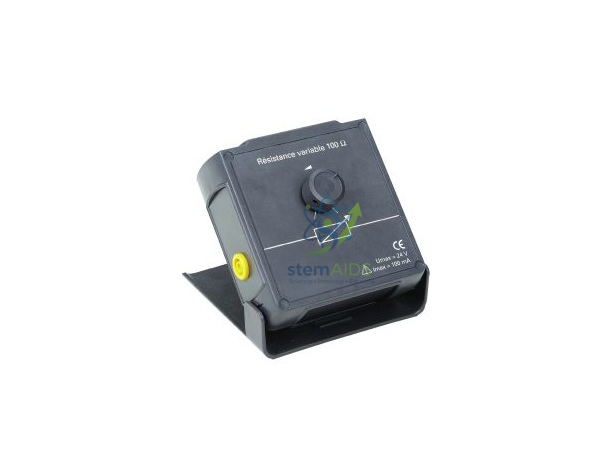
Quick Answer: This 100 ohm variable resistor is a rotary-knob component in a compact case with a fold-out stand, as pictured: turning the knob moves a sliding contact along a resistive track, setting the resistance anywhere from close to zero up to 100 Ω. It is used to control current or divide voltage in low-voltage school circuits.
Two Ways to Wire a Variable Resistor
Variable resistors of this kind have a resistive track between two end connections and a wiper, joined to a third connection, that presses on the track. Used as a rheostat, only one end and the wiper are placed in series with the circuit; turning the knob changes the length of track in use, and with it the resistance and the current. This is the arrangement for dimming a lamp or setting the current through a component.
Used as a potential divider, the two ends go across the supply and the output is taken between the wiper and one end. The output voltage can then be varied smoothly from zero up to the supply voltage, which a series rheostat can never do because some resistance always remains in the circuit. For plotting a full current-voltage graph from zero, the potential-divider connection is the right choice.
Staying Within the Current Limit
A compact rotary track is rated for a limited power. Because the power in a resistor is I²R, the largest safe current equals the square root of the rated power divided by the full 100 Ω, and that limit holds at every knob position. The danger comes at low settings: with the knob near zero the total circuit resistance is small, so the current can rise past the limit while flowing through only a short length of track. Start every experiment with the knob at maximum resistance, increase the current gradually and watch the ammeter.
Applications
- Varying the current through a lamp or resistor to plot its current-voltage characteristic
- Providing an adjustable voltage from a fixed supply in potential-divider circuits
- Dimming a lamp or controlling the speed of a small motor in demonstrations
- Setting a chosen current when comparing two ammeters
Specifications
| Type | Rotary variable resistor (knob-operated) |
| Maximum resistance | 100 Ω, as stated in the product name |
| Adjustment | Knob turning a wiper along a resistive track |
| Housing | Compact case with fold-out stand, as pictured |
| Power rating, maximum current and terminal layout | Confirm at enquiry |
Care & Handling
- Turn the knob gently and stop at the end positions; forcing it past the stop can damage the wiper.
- Switch off the supply if the case becomes warm or the reading becomes unsteady.
- Keep the unit dry and dust-free, since dirt on the track causes crackling, jumpy readings.
- Store it in a dry drawer away from heavy items that could crack the case or bend the knob spindle.
Why Choose LabEquip
Compact variable resistors are bought for student circuit work where a bulky sliding rheostat is unnecessary and currents are small. For higher-power circuits LabEquip also lists the Rheostat 160 W; browse more in the Physics Equipments category or send quantities through the contact page.
Frequently Asked Questions
What is the difference between a rheostat and a potentiometer connection?
A rheostat connection uses one end of the track and the wiper in series with the circuit to vary the current. A potentiometer, or potential-divider, connection puts both ends across the supply and takes an adjustable voltage from the wiper.
Can the resistance be set to exactly zero?
Not quite. A small resistance remains from the wiper contact and the leads, so the minimum setting is close to zero rather than zero. For low-resistance work, measure the actual setting with a multimeter.
How much current can a 100 ohm variable resistor carry?
The limit comes from its power rating: the maximum current is the square root of the rated power divided by the full 100 ohms, and it applies at every knob position. Check the rating before driving lamps or motors that draw large currents.
Why does the reading crackle when I turn the knob?
Dust or wear on the track makes the wiper lose contact for an instant. Turning the knob back and forth a few times often clears it; if not, the unit should be serviced or replaced.
Can it be used with mains electricity?
No. It is intended for low-voltage laboratory circuits supplied from cells or a low-voltage power supply. Mains voltage needs components and enclosures designed for that purpose.
Why start with the knob at maximum resistance?
Starting at maximum resistance keeps the initial current at its lowest, protecting meters, lamps and the resistor itself. The current can then be raised step by step while watching the readings.
Last Updated: October 2026




Reviews
There are no reviews yet.