
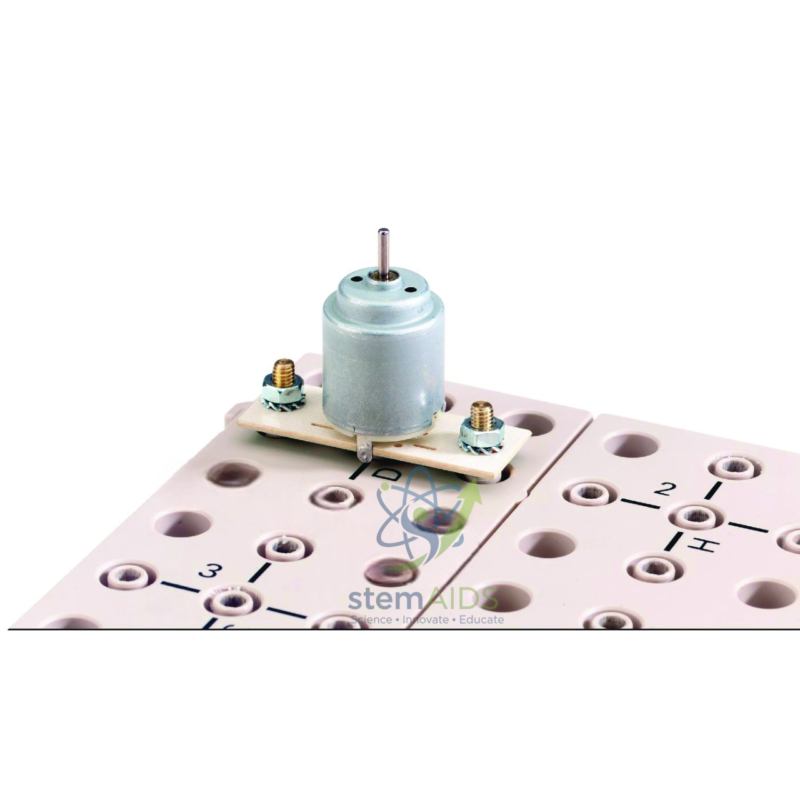
Quick Answer: The UME motor module is a small DC electric motor fixed to a plate that plugs into the UME connection board, as pictured, so a motor can be added to a circuit as easily as a lamp or resistor. The UME motor module turns electrical energy into rotation that students can see, compare and reverse.
A Motor as One Module Among Many
On a module board a circuit is built by plugging components into a grid of sockets rather than by wiring leads between loose parts. With the motor in the same format, it can replace a lamp in a series circuit, sit in parallel with another load or run through a switch module without a single extra lead. That speed of rebuilding lets a class compare several circuits in one lesson.
The photograph shows a small can-type DC motor with its shaft upright, fixed to a plate whose plugs drop into the board sockets. A paper disc or small flag on the shaft makes the direction and rate of turning easy to follow from across the room.
Specifications
| Product | UME motor module (DC motor) |
| Construction in photograph | Small can-type DC motor on a plug-in plate |
| Format | Plugs into the UME connection board |
| Motion | Shaft rotation, reversed by reversing the supply |
| Operating voltage | Confirm at enquiry |
Investigations With the Motor Module
Swap the two supply connections to the UME motor module and it reverses: the force on the current-carrying coil in the magnetic field reverses with the current, the rule students meet as Fleming’s left-hand rule. Put a diode module in series and the motor turns only when the diode is forward biased, a neat demonstration of a diode as a one-way valve for current.
With a lamp in series, the motor and lamp share the supply voltage. Lightly slowing the motor makes the lamp brighten, because a slower motor generates less back EMF and draws more current, a memorable way to show that a motor’s current depends on its mechanical load.
Lesson Uses
- Showing motor reversal when the supply connections are swapped
- Comparing a motor and a lamp as loads in series and parallel circuits
- Demonstrating a diode controlling whether a motor runs
- Linking motor current to mechanical load through back EMF
Care & Handling
- Use the low-voltage DC supply the motor is intended for
- Do not hold the shaft stalled for long with power applied; the winding heats up
- Keep fingers and hair clear of anything fitted to the shaft
- Store the module with the shaft protected so it is not bent
Why Choose LabEquip
Schools teaching electricity on the UME board choose the motor module so energy transfer to motion sits in the same circuits as lamps and switches. For bench work away from the board, the DC electric motor on bracket is the stand-alone alternative; contact LabEquip to extend your module set, or view our physics lab equipment.
Frequently Asked Questions
How do I reverse the motor module?
Swap the two supply connections on the board. Reversing the current reverses the force on the coil in the magnet’s field, so the shaft turns the other way.
Why does a lamp in series brighten when the motor is slowed?
A turning motor produces a back EMF that opposes the supply. Slowing it lowers the back EMF, so more current flows round the circuit and the lamp in series glows brighter.
Can the motor be driven through a diode module?
Yes. It runs only when the diode is forward biased, so reversing the supply stops it. This shows a diode’s one-way behaviour with a moving result.
What is the difference between the UME motor and a motor on a bracket?
The UME motor plugs straight into the module board for quick circuit building. A bracket-mounted motor is a stand-alone unit connected with leads and clamped where a mechanical set-up needs it.
Why does the motor get warm if the shaft is held still?
A stalled motor has no back EMF, so the current is limited only by the winding resistance. The larger current heats the winding, which is why stalling is kept brief.
What voltage should the motor be run at?
Use a low-voltage DC supply; the listing names the module but not its rating, which can be confirmed at enquiry. Start low and increase gradually while watching the speed.
Last Updated: October 2026




Reviews
There are no reviews yet.