
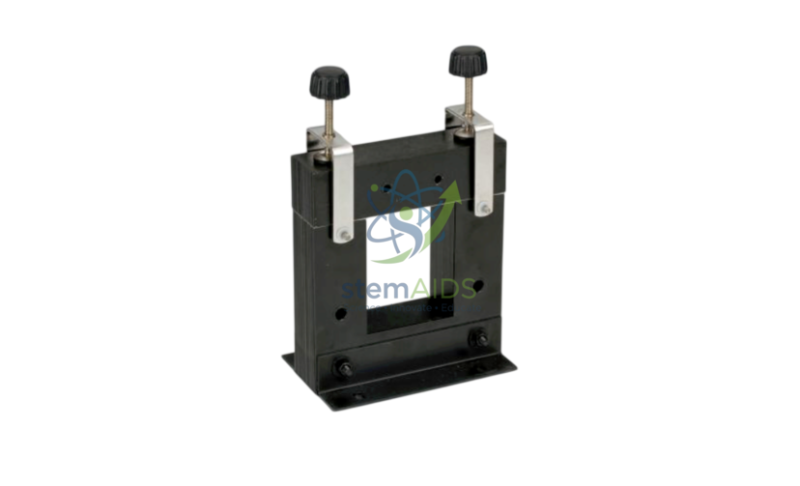
Quick Answer: The U core is a U-shaped soft iron core held upright in a stand, with a straight yoke clamped across its top by two screws in the product photograph. Coils slide onto its two limbs, and closing the yoke completes a magnetic circuit for transformer, electromagnet and induction experiments.
Why Transformers Need a Core
Two coils placed side by side in air share only a small part of their magnetic flux, so a transformer made that way performs poorly. Soft iron is far more permeable than air: it concentrates the flux and guides it round a closed path from one coil to the other. With both coils on the limbs and the yoke clamped across the open ends, most of the primary’s flux passes through the secondary.
The magnetic circuit behaves rather like an electric circuit. The iron is the easy path, and any air gap acts as a high-resistance section; magnetic reluctance is the name for this opposition. Even a thin gap between the limbs and the yoke cuts the flux noticeably, which is why the clamping screws are tightened before readings are taken.
Laminations and Soft Iron
Cores for alternating current are normally built from thin insulated sheets of soft iron rather than one solid block. A changing flux would drive large eddy currents round a solid core, heating it and wasting energy; the insulation between the sheets breaks those current paths. Soft iron is chosen because it magnetises and demagnetises easily, which keeps hysteresis losses low and leaves little magnetism behind when the current stops.
Experiments
- Building demountable transformers with interchangeable coils
- Making an electromagnet with pole pieces for eddy-current pendulums
- Showing how an air gap in the core reduces the secondary voltage
- Demonstrating the hum and magnetic pull of a closed core on AC
Specifications
| Shape | U-shaped core with a clamping yoke |
| Mounting | Upright stand with clamping screws, as pictured |
| Material | Soft iron core for AC magnetic circuits |
| Used with | Interchangeable coils and pole pieces |
| Limb cross-section and window size | Confirm at enquiry |
Care & Handling
- Tighten the yoke screws evenly so the joint faces meet flat
- Keep the contact faces clean and lightly oiled against rust
- Switch off the supply before removing the yoke, which is held strongly while the core is magnetised
- Do not drop the core; bent sheets leave gaps at the joints
Why Choose LabEquip
A U core is the backbone of most demountable transformer sets, so schools often buy extra cores to let more groups work at once. LabEquip supplies it with coils such as the 6-turn coil, the Lenz’s law accessories and other physics lab equipment.
Frequently Asked Questions
What is the yoke for?
The yoke is the straight bar clamped across the open ends of the U. It closes the magnetic circuit so the flux has an all-iron path round both limbs.
Why does an air gap reduce the output so much?
Air is far less permeable than iron. Even a small gap adds a large reluctance to the magnetic circuit, so much less flux links the coils.
Why is soft iron used instead of steel?
Soft iron is easily magnetised and loses its magnetism when the current stops. Hard steel would keep some magnetism and waste more energy in each cycle.
Why does a closed core hum on AC?
The magnetic forces between the parts of the core rise and fall twice in each cycle of the supply, making the laminations vibrate slightly and produce a hum.
Can the U core be used with direct current?
Yes, as an electromagnet. With the yoke removed and pole pieces fitted, a coil carrying direct current makes a strong magnet across the gap.
Which coils fit the core?
Coils with a central opening that slides over the limbs. The size of the limbs should be compared with the coils the school already owns.
Last Updated: October 2026




Reviews
There are no reviews yet.