
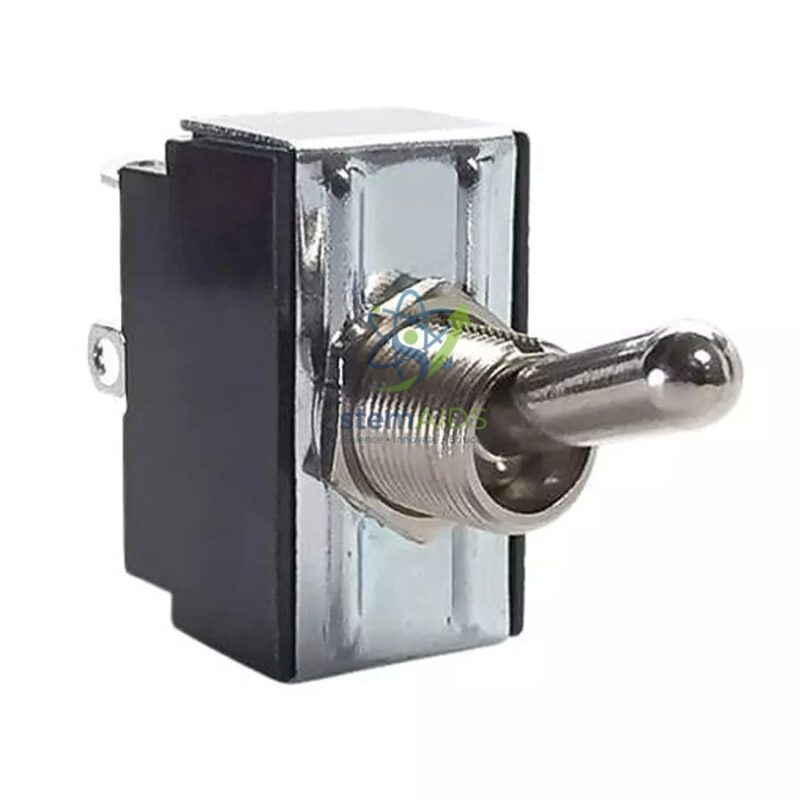
Quick Answer: The Toggle Switch on Bracket is a lever-operated toggle switch with a metal mounting bracket and screw terminals, as pictured, for fixing to a circuit board, panel or stand. Flicking the lever snaps the contacts open or closed, giving a positive on and off action in experimental and demonstration circuits.
How Snap Action Works
Inside a toggle switch the lever does not push the contacts directly. It compresses a spring which, once the lever passes its centre point, drives the moving contact quickly to its new position. The contacts therefore open and close at a speed that does not depend on how fast the lever is moved, which keeps arcing short and reduces wear. The lever stays firmly in either position, so the state of the circuit is obvious at a glance.
The bracket is what distinguishes this item from a loose panel switch. It lets the switch be screwed to a baseboard, a project panel or a demonstration frame, so it stays put while students wire and operate it, and the terminals remain accessible for leads or wires.
Switches as Logic
Two switches wired in series with a lamp form an AND arrangement: the lamp lights only when both are on. Wired in parallel, they form an OR arrangement: either switch lights the lamp. These two simple circuits are a hands-on introduction to logic gates and truth tables, and they lead naturally to burglar alarms, car door lights and other control circuits in project work. If the switch has a changeover contact, two of them can also make the two-way staircase circuit used in house wiring.
Applications
- Switching lamps, motors and buzzers in student circuits
- Building AND and OR switch circuits to introduce logic and truth tables
- Panel and baseboard projects such as model alarms and control boxes
- Isolating part of a demonstration circuit while other parts stay powered
Specifications
| Type | Lever (toggle) switch with snap action |
| Mounting | Metal bracket for fixing to a board, panel or stand |
| Terminals | Screw terminals, as pictured |
| Use | Low-voltage laboratory and project circuits |
| Pole and throw arrangement and contact rating | Confirm at enquiry |
Care & Handling
- Tighten terminal screws onto clean wire ends or spade connectors; loose terminals heat up and give intermittent contact.
- Keep within the switch’s contact rating, especially with motors and coils, which spark when switched.
- Fix the bracket firmly so the switch does not twist when the lever is flicked.
- Use the switch only in low-voltage teaching circuits unless a qualified person fits it in a proper enclosure.
Why Choose LabEquip
Toggle switches on brackets are bought for project work and permanent demonstration boards, where a switch needs to be fixed rather than left loose on the bench. LabEquip lists it with the open-contact single pole knife switch for comparison in its Physics Equipments category; send quantities through the contact page.
Frequently Asked Questions
What is the difference between a toggle switch and a knife switch?
A knife switch has an exposed blade, so students can see the contacts open and close, which is useful for teaching. A toggle switch encloses its contacts and uses snap action, making it more compact, safer to touch and better suited to fixed boards.
What does snap action mean?
A spring inside the switch flips the contacts to their new position once the lever passes its midpoint. The contacts move quickly however slowly the lever is moved, which reduces sparking and wear.
Can the switch be used to build logic circuits?
Yes. Two switches in series with a lamp make an AND circuit, and two in parallel make an OR circuit. This is a simple, practical way to introduce truth tables before electronic logic gates.
Why do the terminals need to be tight?
A loose terminal has a higher contact resistance, which heats up and can make a circuit flicker or fail. Tightening the screws onto clean conductors keeps the contact reliable.
Is the switch suitable for mains wiring?
In school use it is intended for low-voltage circuits. Any use on mains needs a switch rated for that voltage, mounted in a proper enclosure and installed by a qualified person.
How is the bracket fixed?
The bracket is screwed or bolted to a baseboard, panel or frame, so the switch stays in place when the lever is operated. Choose fixings to suit the board material.
Last Updated: October 2026




Reviews
There are no reviews yet.