
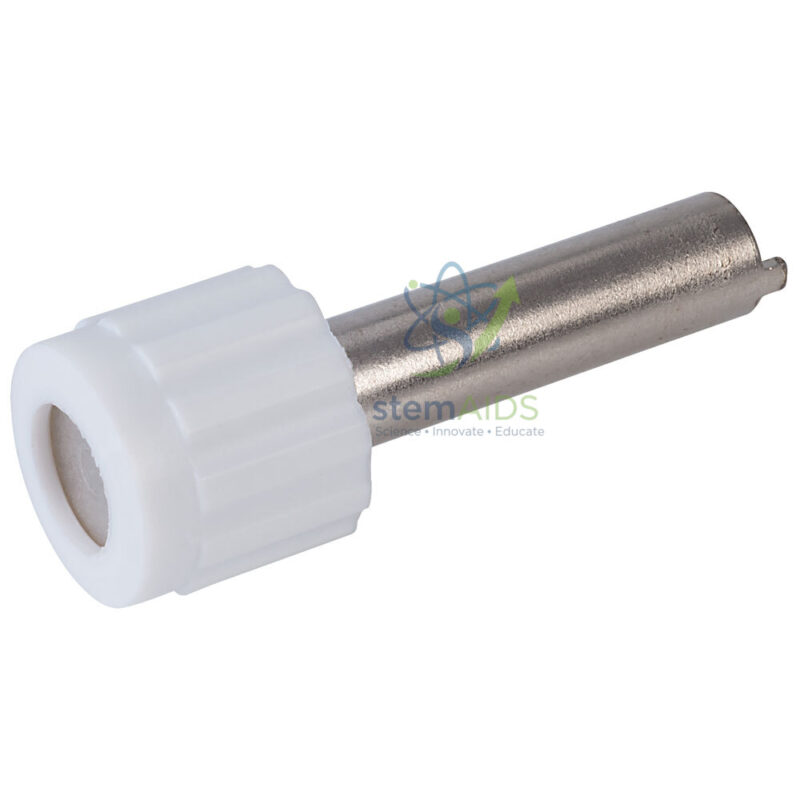
Quick Answer: The Setting Tool for 4mm Sockets is a hand tool, a metal shaft with a white plastic end in the product photograph, used when fitting 4 mm laboratory sockets into panels, boxes and module housings. A setting tool for 4mm sockets helps seat each socket squarely so its insulation and contact are not damaged during fitting.
Where 4 mm Sockets Are Fitted
The 4 mm socket is the standard connection on school and college electrical equipment: power supplies, meters, component boards and home-made modules all use it, so a 4 mm plug lead fits any of them. When a department builds its own panels or repairs equipment, sockets have to be mounted in drilled holes, held straight and secured, and the setting tool is made for that job.
A socket fitted crooked or forced in with pliers can crack its insulating body or distort its contact, leaving a loose fit for every plug that follows. Using the setting tool for 4mm sockets keeps the socket square to the panel while it is fixed.
Fitting a Socket Step by Step
Drill the panel to the size the socket maker specifies and deburr the hole so its edge cannot cut the insulation. Insert the socket from the front, fit any washer and nut from behind, and use the setting tool to hold or press the socket in place while the fixing is tightened. Finish by checking that a plug enters smoothly and grips firmly.
Test each new socket with a multimeter: continuity from the socket contact to its wire or tag, and no connection between the socket and a metal panel. Colour-code sockets red and black, or by function, to match the rest of your equipment.
Specifications
| Product | Setting tool for 4 mm sockets |
| Construction in photograph | Metal shaft with a white plastic end piece |
| Socket size, from title | 4 mm |
| Use | Fitting 4 mm sockets into panels, boxes and module housings |
| Compatible socket types | Confirm at enquiry |
Workshop Uses
- Building custom connection panels for demonstrations
- Fitting sockets to home-made module housings or project boxes
- Replacing worn or broken sockets on existing equipment
- Training technicians who maintain the lab electrical apparatus
Care & Handling
- Keep the end piece clean and undamaged; a burr can mark the socket
- Use the tool only for the socket type it suits
- Wipe off swarf and dust after drilling work
- Store it with the workshop tools so it is not used as a punch or lever
Why Choose LabEquip
Lab technicians and electronics teachers who build or repair equipment buy the tool so every socket on every panel is fitted the same way. It is often ordered with 4 mm safety banana plugs for soldering for making matching leads; contact LabEquip to check which sockets it suits, or browse more physics lab equipment.
Frequently Asked Questions
Why not fit sockets with pliers?
Pliers grip unevenly and can crack the insulating body or bend the contact. A tool made for the job keeps the socket square and spreads the force.
What hole size does a 4 mm socket need?
The 4 mm refers to the plug that fits the socket, not the mounting hole. The hole size depends on the socket body, so follow the socket maker’s figure.
How do I check a newly fitted socket?
Push a plug in to feel the grip, then use a multimeter for continuity to the wire or tag and for no connection to a metal panel.
Why do sockets work loose over time?
Repeated plugging, twisting of leads and vibration can slacken the fixing nut. Re-tightening it while holding the socket still restores a firm fit; a cracked socket body is replaced.
Should sockets be colour coded?
Yes. Red for positive and black for negative or common, with other colours for particular functions, helps students connect circuits correctly and makes faults easier to trace.
Which sockets does the tool fit?
It is listed for 4 mm sockets. Socket bodies vary between makes, so the types it suits can be confirmed at enquiry.
Last Updated: October 2026






Reviews
There are no reviews yet.