
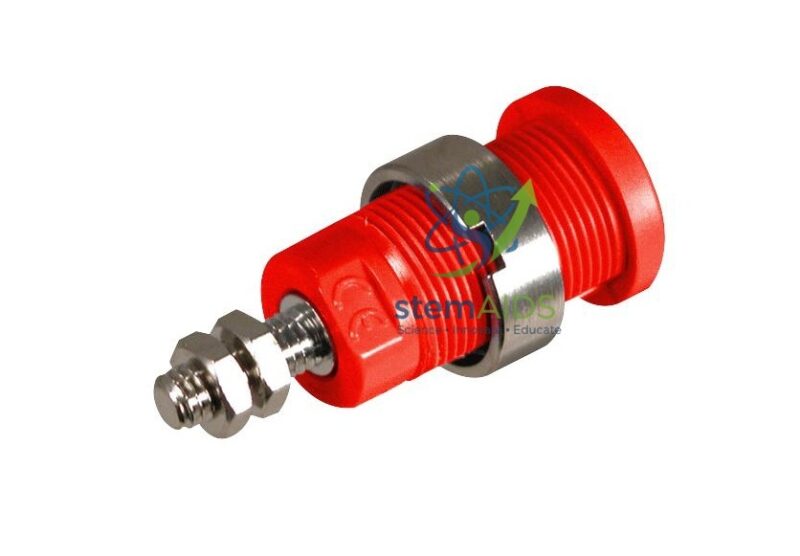
Quick Answer: These screw terminal safety sockets are shrouded, panel-mounting sockets that accept safety banana plugs at the front and clamp a wire with a screw at the back. They are used to fit safety connections to home-made apparatus boxes, module panels and student project enclosures without soldering.
Building Shrouded Connections Into a Panel
The red socket in the product photograph shows the familiar arrangement: an insulating shroud at the front, a threaded metal body behind it, and a nut that clamps the socket to a panel. A hole is drilled in the panel, the socket goes in from the front, and the nut tightens it from behind. The internal wire is then fixed to the terminal at the back by a screw, so no soldering iron is needed and a connection can be undone later if the panel is rewired.
Shrouded sockets of this type accept the sleeved plugs of safety leads. Once a lead is pushed home, the plug sleeve and the socket shroud together cover all the metal, which is why many laboratories now prefer them on new apparatus. Fitting them to a teacher-built box, such as a component board or a set of resistors in a project case, makes that box compatible with the department’s safety leads.
Screw Clamp Versus Solder Tag
These sockets have a sibling with a solder connection, the solder-terminal safety sockets. A screw terminal is quicker to fit and easy to change, which suits prototypes, school workshops and panels that may be modified. A soldered joint is more permanent and resists loosening from vibration, but it needs a soldering iron and some skill. For a screw terminal, a crimped ferrule or a neatly twisted wire end gives a firmer clamp than loose strands, and the screw should be checked again after the first few days of use.
Applications
- Fitting safety connections to teacher-built apparatus boxes and component panels
- Student electronics and physics projects housed in plastic or metal enclosures
- Replacing damaged sockets on existing module panels
- Making junction boxes for distributing low-voltage supplies on a bench
Specifications
| Product | Safety sockets with screw terminal |
| Front | Insulating shroud for safety banana plugs |
| Mounting | Threaded body with nut, for a drilled panel |
| Wire connection | Screw clamp at the rear |
| Colour in the photograph | Red |
| Panel hole size and colours available | Confirm at enquiry |
Care & Handling
- Tighten the panel nut firmly but not so hard that the shroud cracks or the panel deforms
- Recheck screw terminals after a few days, as a clamped wire can settle and loosen
- Use a red socket for positive or signal and a black one for negative or common, and keep to the scheme across a panel
- On metal panels, keep every internal wire and strand well clear of the case
Why Choose LabEquip
Technicians and teachers who make or repair their own apparatus panels are the usual buyers of these sockets. LabEquip can supply them in mixed colours along with standard safety adapters for older equipment; ask for quantities through our contact page or browse physics lab equipment.
Frequently Asked Questions
What is the difference between screw terminal and solder terminal safety sockets?
Both have the same shrouded front for safety plugs. The screw terminal type clamps the wire with a screw and can be rewired easily; the solder type needs the wire soldered to a tag, giving a permanent joint that resists vibration.
How are the sockets mounted?
Drill a hole in the panel, push the socket through from the front and tighten the nut on the threaded body from behind. The shroud then sits on the front face and the terminal is inside the box.
Do these sockets accept ordinary banana plugs?
They are designed for the sleeved plugs of safety leads. Some plain banana plugs may fit, but the safety benefit depends on using shrouded plugs, so use safety leads with these sockets.
Can the sockets be used on a metal panel?
Yes, provided the socket design insulates its contact from the panel and the internal wiring is kept clear of the metal. On an earthed metal case, follow local electrical practice for the enclosure as a whole.
Why use different colours?
Colour coding shows polarity and function at a glance: red for positive or signal, black for negative or common, and other colours for additional outputs. A consistent scheme reduces wiring mistakes when students connect leads.
What wire is suitable for the screw terminal?
Flexible stranded wire of a size suited to the expected current is usual inside apparatus boxes. Twist the strands or fit a ferrule so that no stray strand escapes the clamp.
Last Updated: October 2026






Reviews
There are no reviews yet.