


Sale
In Stock
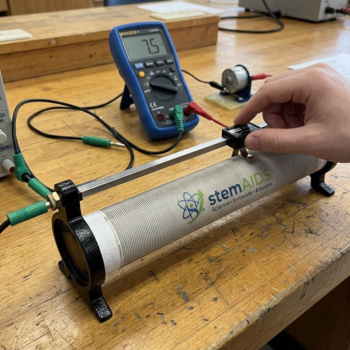
Wire Wound Rheostat 12 Inch
Original price was: ₹1,050.00.₹515.00Current price is: ₹515.00.
Quick Answer: The Wire Wound Rheostat 12 Inch is a laboratory variable resistor that lets students progressively change resistance in a circuit using a sliding contact, making it a standard apparatus for studying current, voltage and resistance in school and college physics laboratories. It is part of the LabEquip Rheostat range.
Product Description
This Wire Wound Rheostat 12 Inch from LabEquip is an adjustable resistance apparatus built for practical electricity experiments. In a wire-wound rheostat, a movable sliding contact changes the effective length of resistance wire included in the circuit, allowing the resistance to be varied progressively rather than in fixed steps.
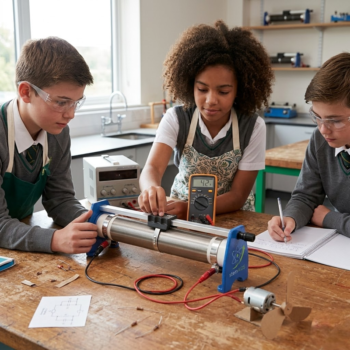
In a typical laboratory session, students connect the rheostat in series with a cell, ammeter and voltmeter, then slide the contact to observe how changing resistance affects circuit current and voltage readings. This makes it a core apparatus for verifying Ohm’s law and for general circuit-behaviour experiments in physics laboratories.
This model is identified by its 12-inch nominal size and wire-wound construction. The exact resistance range, current rating, resistance-wire alloy and other detailed specifications have not been verified for this specific listing and are best confirmed directly with LabEquip before ordering for a specific experiment.
What This Helps Students Learn
- Understand how a variable resistor changes current in a circuit.
- Verify Ohm’s law using measured voltage and current at different resistance settings.
- Read and use an ammeter and voltmeter correctly in a laboratory circuit.
- Observe the relationship between resistance, current and voltage experimentally.
- Build and safely operate a simple series circuit.
Specifications
| Attribute | Detail |
|---|---|
| Product Name | Wire Wound Rheostat 12 Inch |
| Brand | LabEquip |
| Product Category | Physics laboratory electrical apparatus / variable resistor |
| Nominal Size | 12 inch |
| Construction Type | Wire wound |
| Recommended For | School, college and technical physics laboratories |
| Resistance Range, Current Rating & Other Details | Contact us for detailed specifications |
Safety Note
This is an electrical laboratory apparatus and should be used only under teacher or lab-instructor supervision. Always connect and disconnect circuits with the power supply switched off, avoid exceeding the rheostat’s safe current rating, and inspect wiring and terminals for damage before each use.
Care & Maintenance
- Wipe the frame and terminals with a dry cloth after use.
- Check the sliding contact moves smoothly and terminals are secure before each session.
- Store in a dry location away from moisture to prevent corrosion of the resistance wire.
Why Choose LabEquip
LabEquip is a supplier of physics lab equipment for schools and colleges. Alongside this rheostat, we offer the Physics Lab Sliding Rheostat and the Rheostat 8 Inch 100 Ohm 1.6A. Browse our full Rheostat category for more variable-resistance apparatus for your physics laboratory.
Frequently Asked Questions
What is a wire-wound rheostat used for?
It is used to vary resistance in a circuit so students can study how resistance affects current and voltage, commonly for verifying Ohm’s law.
How is resistance changed on this apparatus?
A sliding contact moves along the resistance wire, changing the effective length of wire included in the circuit and therefore the resistance.
Is this suitable for college-level laboratories, not just schools?
Yes, wire-wound rheostats of this type are commonly used in both school and college physics laboratories for circuit experiments.
Do you supply other rheostat sizes?
Yes, LabEquip also supplies the Physics Lab Sliding Rheostat and the Rheostat 8 Inch 100 Ohm 1.6A within our Rheostat category.
What precautions should be taken when using this apparatus?
Always switch off the power supply before connecting or disconnecting the circuit, avoid exceeding the safe current rating, and use it under teacher supervision.
Last updated: September 2026
Bestsellers

Sale
Sale
Sale

