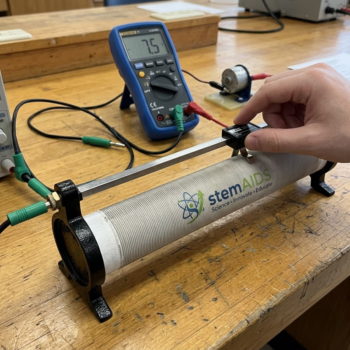
Quick Answer: The Rheostat 8 Inch 100 Ohm 1.6A is a 100 ohm rheostat with a sliding contact and a 1.6 A current rating, in an 8-inch nominal size. Students use it to vary resistance in a circuit and to study how current and voltage change in Ohm’s law experiments.
What the Three Numbers Mean
The title gives this rheostat’s three working figures. The 8-inch figure is its nominal size. One hundred ohms is the total resistance between the end terminals, and the slider picks off any value from close to zero up to that maximum. And 1.6 A is the largest current the winding is rated to carry.
The current rating matters most at the low-resistance end. With the slider near the zero end, only a few ohms may be in circuit, so even a 6 V supply could push more than 1.6 A through that short section of wire and overheat it. In normal Ohm’s law work the rheostat sits in series with the resistor under test, so the total resistance keeps the current down, but students should still start with the slider at the maximum-resistance end and reduce resistance gradually.
At the other end, the full winding of 100 ohms carrying 1.6 A would need 160 V across it, far beyond school supplies, so in practice the rating limits the low end of the range, not the high end. A 100 ohm value suits circuits that need fine control of small currents and works well as a potential divider, where its relatively high resistance draws little current from the supply.
Specifications
| Type | Sliding-contact rheostat (variable resistor) |
| Nominal size | 8 inch |
| Total resistance | 100 Ω |
| Current rating | 1.6 A maximum |
| Voltage across full winding at rated current | 160 V (calculated: 1.6 A × 100 Ω) |
| Typical practicals | Ohm’s law, V-I characteristics, potential divider circuits |
Applications
- Verifying Ohm’s law by plotting voltage against current for a fixed resistor
- Controlling current in series circuits with a lamp or resistance coil
- Potential divider circuits giving a voltage adjustable from zero upwards
- Studying the characteristics of components such as diodes, with a suitable series resistor
Care & Handling
- Begin each experiment with the slider at the maximum-resistance end.
- Switch off the supply before changing connections.
- Keep the sliding contact clean and dry so it moves smoothly and makes good contact.
- Store the rheostat in a dry place to prevent corrosion of the resistance wire.
Why Choose LabEquip
Physics labs usually keep this compact 100 ohm rheostat for Ohm’s law and potential divider work, and add the longer Wire Wound Rheostat 12 Inch where a different range or finer adjustment is wanted. Both sit in the Rheostat category, and the contact page accepts bench-wise quantities for a physics lab.
Frequently Asked Questions
What do 100 ohm and 1.6 A mean on this rheostat?
100 ohm is the total resistance between the end terminals, and the slider selects any value up to it. 1.6 A is the maximum current the winding should carry at any setting.
How can the current rating be exceeded in a school circuit?
By setting the slider near the low-resistance end with little else in the circuit. Only a few ohms of wire are then in use, and a low-voltage supply can drive more than 1.6 A through them.
How is a rheostat wired as a potential divider?
The supply is connected across both end terminals and the output is taken between one end terminal and the slider. Moving the slider changes the output voltage from zero up to nearly the full supply voltage.
Is a 100 ohm rheostat suitable for verifying Ohm’s law?
Yes, for most school resistors. In series with a resistor of a few ohms and a low-voltage supply, it gives a good spread of currents. Start at maximum resistance and take readings as resistance is reduced.
How does the 8 inch rheostat compare with the 12 inch wire wound model?
The 8 inch model is more compact and its ratings are stated as 100 ohm and 1.6 A. A longer rheostat of the same total resistance changes resistance more gradually per centimetre of slider travel, giving finer adjustment.
What precautions should students take?
Switch off before wiring, start with maximum resistance, keep the current below 1.6 A, avoid touching the winding while current flows and report any loose terminals or a sticking slider.
Last Updated: October 2026