
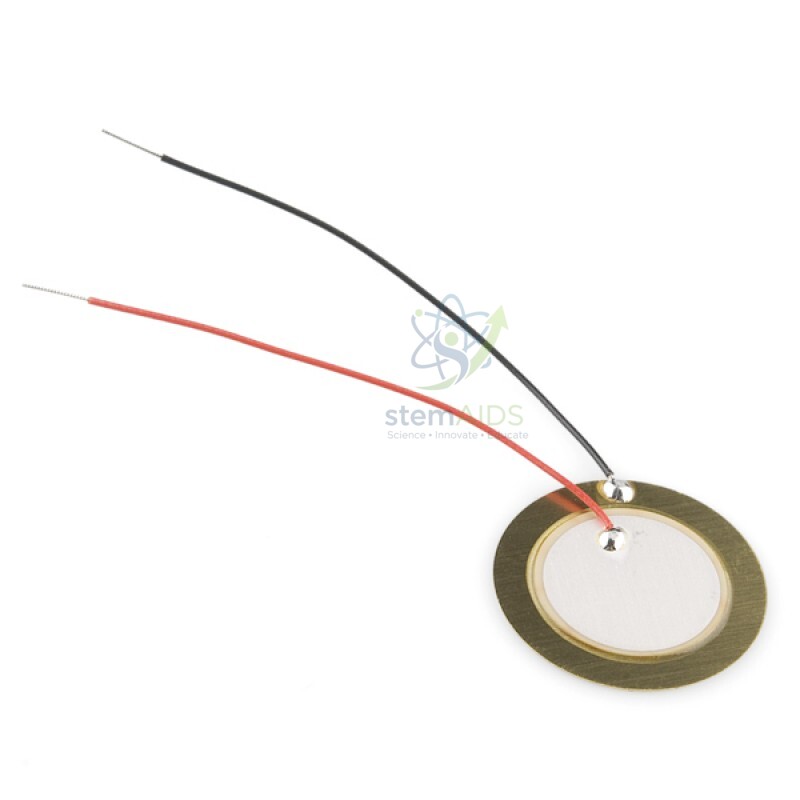
Quick Answer: The Piezoelectric Disc 27 mm is a thin metal disc 27 mm across carrying a layer of piezoelectric ceramic, which produces a voltage when it is flexed and flexes when a voltage is applied. A piezoelectric disc is used in physics practicals to demonstrate the piezoelectric effect and as a sounder, knock sensor and contact microphone.
The Piezoelectric Effect in Both Directions
Certain crystals and ceramics develop electric charge on their faces when squeezed or bent, because the deformation shifts the positive and negative charges in their structure relative to one another. This is the direct piezoelectric effect. The reverse also holds: apply a voltage and the material changes shape slightly, the converse effect. A piezo element of this kind usually consists of a brass plate with a thinner ceramic layer bonded to one face and a silvered electrode on top, with one lead to the plate and one to the electrode.
Because the ceramic is bonded to the metal, it bends the whole disc rather than simply thickening, turning a tiny change in the ceramic into a noticeable flex. Tapping the disc gives a sharp voltage pulse; driving it with an alternating signal makes it vibrate and push the air, producing sound. The same component is therefore both sensor and actuator, which makes it a neat demonstration piece.
Experiments With the Disc
Connect the two leads to an oscilloscope and tap the disc with a pencil: a surprisingly large voltage pulse appears from a light tap. Pressing slowly gives far less, showing that the output depends on how quickly the strain changes. Next connect a signal generator and sweep the frequency: the sound is much louder near the disc’s resonant frequency, where its natural vibration matches the drive. Holding the disc by its edge or at its centre shifts that resonance, a simple investigation in itself.
Applications
- Demonstrating the direct and converse piezoelectric effects
- Making a knock or vibration sensor that triggers an LED or counter
- Using the disc as a contact pickup on a string instrument or tabletop
- Finding the resonant frequency with a signal generator, compared with an electromagnetic buzzer
Specifications
| Component | Piezoelectric disc (bender element) |
| Diameter | 27 mm (as titled) |
| Construction | Usually a ceramic layer bonded to a metal plate |
| Function | Generates voltage when flexed; flexes when driven |
| Resonant frequency and lead arrangement | Confirm at enquiry |
Care & Handling
- Do not bend the piezoelectric disc sharply; the ceramic layer is brittle and cracks easily.
- Solder to the electrode quickly and with modest heat, since prolonged heat can lift the silver layer or weaken the ceramic’s polarisation.
- When the disc feeds a sensitive input, add a resistor across its leads, because a hard knock can generate a large voltage.
- Store discs flat and separated so the leads do not pull on their solder joints.
Why Choose LabEquip
Piezo discs are an inexpensive way to show a real transducer at work, so teachers often buy them in sets for class investigations. They are part of our school physics apparatus; ask through the contact page about quantities.
Frequently Asked Questions
How does a piezoelectric disc make a voltage?
Bending the disc strains the ceramic layer, which displaces the positive and negative charges in its crystal structure and leaves opposite charges on its two faces. The electrodes collect these charges, giving a voltage between the leads while the strain is changing.
Why does a slow press give almost no voltage?
The charge produced leaks away through the meter or oscilloscope input and the disc’s own resistance. A quick tap produces the charge faster than it can leak, giving a clear pulse, while a slow press lets it leak away as it forms.
Can the disc be used as a buzzer?
Yes, when driven by an alternating or pulsed signal, such as from a signal generator or oscillator circuit. Unlike a self-drive buzzer, a bare disc has no built-in oscillator, so a steady DC voltage only bends it once and gives a click rather than a tone.
What is the resonant frequency?
It is the frequency at which the disc vibrates most readily, set by its size, thickness and the way it is held. Driven near that frequency it gives much louder sound for the same drive voltage. It can be found by sweeping a signal generator and listening or measuring.
Is it safe to connect the disc straight to a microcontroller input?
Not without protection. A sharp knock can generate a voltage high enough to damage sensitive inputs. A resistor across the disc, plus a series resistor with clamping diodes or the input’s own protection, keeps the pulse within safe limits.
Where is the piezoelectric effect used outside the lab?
Piezoelectric elements are found in buzzers and beepers in appliances, knock sensors, contact pickups for musical instruments and ultrasonic transducers. Gas lighters use a related piezoelectric element struck by a spring-loaded hammer to make a spark.
Last Updated: October 2026






Reviews
There are no reviews yet.