


Sale
In Stock
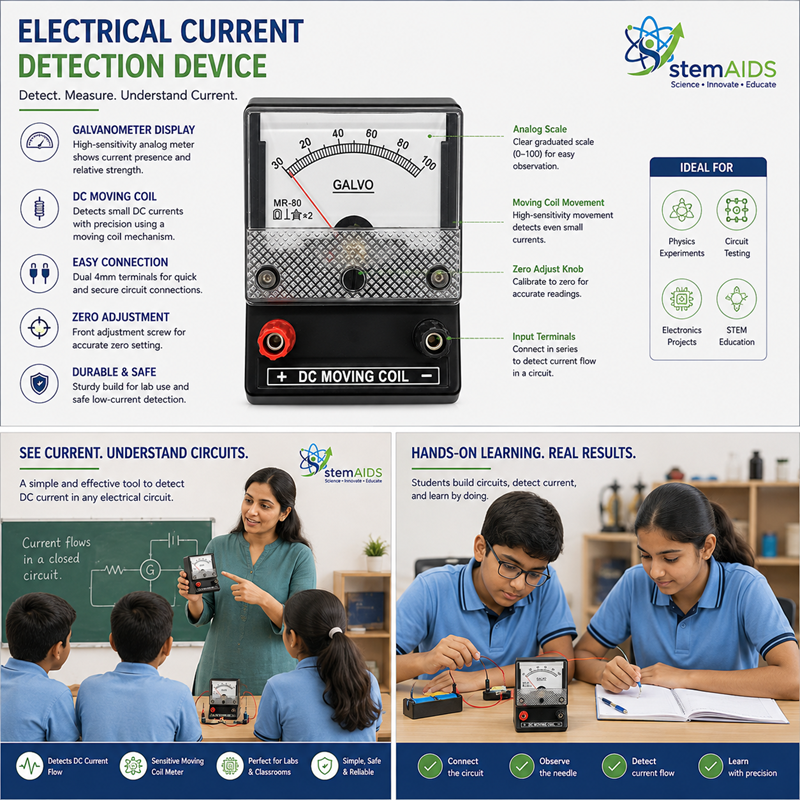
Electrical Current Detection Device
Original price was: ₹290.00.₹135.00Current price is: ₹135.00.
Quick Answer: The Electrical Current Detection Device is a basic laboratory tool used to show whether current is flowing through a circuit, without necessarily giving a precise numerical reading. It helps students distinguish between an open circuit, a complete circuit, and a circuit carrying detectable current, using an observable response such as pointer deflection, a light, a sound, or a digital indication depending on the design supplied.
Description
This device is aimed at qualitative circuit investigation rather than precision measurement: its purpose is to confirm current presence, response or direction, not to state an exact current value. Students connect it into a test circuit and observe its response — for example a needle moving, an indicator lighting up, or a tone sounding — to build an intuitive understanding of how current flows through series and parallel arrangements, how switches and breaks affect a circuit, and how conductors compare with insulators. Because it is designed around detection rather than calibrated measurement, it is a good complement to (not a replacement for) a calibrated ammeter when a class needs to first demonstrate the basic concept of current flow before moving on to numerical measurement. The specific indication method (pointer, light, sound or digital) and sensitivity of the unit supplied should be confirmed with our sales team for your exact teaching requirement.
Specifications
| Attribute | Detail |
|---|---|
| Product name | Electrical Current Detection Device |
| Function | Detects presence/response of current in a test circuit (qualitative, not precision measurement) |
| Indication method | Confirm with our sales team (pointer deflection, light, sound or digital display depending on model) |
| Sensitivity/threshold | Confirm with our sales team for the specific model |
| Typical use | Teaching open/closed circuit concepts, conductor vs insulator testing, basic circuit-building practicals |
Care & Maintenance
- Keep test leads and terminals clean and free of corrosion for a reliable response.
- Do not connect the device directly across a high-voltage or high-current source unless it is specifically rated for that use — check the rated input before connecting.
- Store in a dry place away from moisture when not in use.
- Inspect leads and connectors periodically for fraying or loose contacts.
- Handle any pointer or indicator mechanism gently to avoid mechanical damage.
- If battery-powered (for a light or sound indication model), replace batteries as needed to maintain a clear response.
Why Choose LabEquip
LabEquip supplies a full progression of electrical measuring equipment, from basic detection devices for introductory concepts through to calibrated meters for quantitative work. Once students are ready to move from detection to numbers, our Digital Electrical Parameter Meter and Industrial Digital Ammeter are natural next steps. Browse our full Measuring Instruments range, or contact our team to confirm the exact indication method and sensitivity for your classroom needs.
Frequently Asked Questions
Does this device give a numerical current reading?
No, it is designed to detect and indicate the presence or response of current, not to display a calibrated numerical value. For numerical readings, a dedicated ammeter is needed.
How does it show that current is flowing?
Depending on the specific model, it may show a response through pointer deflection, a light, a sound, or a digital indication. Please confirm the indication method with our sales team.
What is it typically used to teach?
It is commonly used to demonstrate open vs closed circuits, to test whether a material conducts electricity, and to help students build a basic intuition for current flow before moving to numerical measurement.
Can it be connected to any circuit?
It should only be connected within its rated input range. Please confirm the safe operating range for your specific model with our sales team before use with any given power source.
Is it suitable for younger students?
Yes, its simple, observable response makes it well suited to introductory physics and electronics lessons.
How is it different from a galvanometer?
A galvanometer is a specific type of sensitive current-detecting instrument with a calibrated deflection scale. This device may use a simpler indication method; please confirm the exact mechanism of your model with our sales team if you specifically need galvanometer-style deflection.
Last Updated: September 2026
Bestsellers


Sale


Sale


Sale

