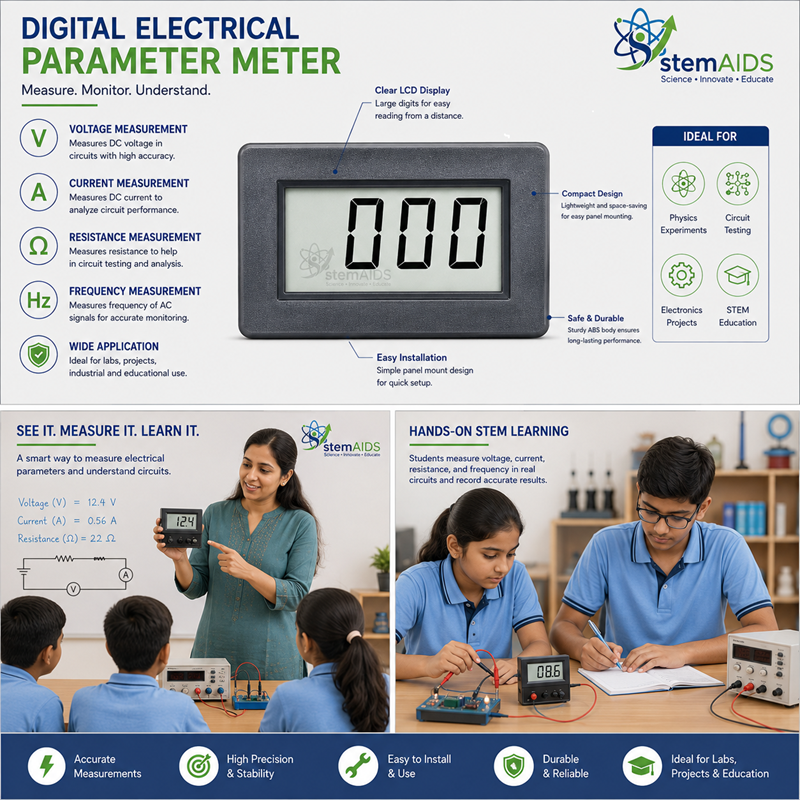
Quick Answer: The Digital Electrical Parameter Meter is a panel-mounted digital instrument that displays one or more electrical circuit values numerically, giving students and technicians a clear, easy-to-read alternative to analog pointer-scale meters during electrical experiments, demonstrations and training panel builds. The specific parameter(s) it displays depend on the configured model.
Description
Where a conventional analog meter uses a needle moving across a printed scale, this digital electrical parameter meter converts the circuit signal into a direct numerical readout, removing the need to interpolate between scale divisions or worry about parallax error when reading the value. This makes it well suited to teaching settings where students are learning to record precise numerical data rather than estimate a pointer position. Depending on the specific model supplied, the meter can be configured to display voltage, current, power, frequency, resistance or another circuit quantity, and some configurations support more than one parameter. Because the exact measurement function and display range depend on the model variant selected, please confirm the parameter(s), range and mounting format you require with our sales team before ordering, so the unit matches your syllabus or panel-building requirement precisely.
Specifications
| Attribute | Detail |
|---|---|
| Product name | Digital Electrical Parameter Meter |
| Display type | Digital numerical readout |
| Measured parameter(s) | Confirm with our sales team (model-dependent — voltage, current, power, frequency or resistance) |
| Measuring range | Confirm with our sales team for the specific range required |
| Mounting format | Panel-mount laboratory/training instrument |
| Typical use | Electrical measurement practicals, demonstrations, training panel builds |
Care & Maintenance
- Keep the display face and terminals clean and free of dust; wipe with a dry, soft cloth.
- Confirm correct terminal polarity and connection before energising the circuit to avoid incorrect readings or damage.
- Do not exceed the meter’s rated input range — always check the configured measuring range before connecting to a live circuit.
- Store in a dry location away from direct moisture and excessive heat when not mounted in a panel.
- Have wiring and connections checked periodically by a competent person if the meter is part of a permanent training panel.
- Avoid physical impact to the display window, as this can crack the readout or damage the internal circuitry.
Why Choose LabEquip
LabEquip supplies a wide range of analog and digital electrical measuring instruments for schools, colleges and technical training institutes. If you are comparing digital and analog options for your lab, you may also find our Digital Voltage Display Meter and Industrial Digital Ammeter useful points of comparison. Browse our full Measuring Instruments range, or contact our team to confirm the exact parameter, range and panel format that suits your requirement.
Frequently Asked Questions
What electrical parameter does this meter display?
The specific measured parameter depends on the configured model — it may display voltage, current, power, frequency or resistance. Please confirm the exact parameter you need with our sales team before ordering.
Is this a digital or analog instrument?
It is a digital instrument with a numerical display, unlike a traditional analog pointer-and-scale meter.
Can it measure more than one parameter at once?
Some configurations support multiple parameters; please confirm multi-parameter capability for your required model with our sales team.
Is it suitable for classroom demonstrations as well as student practicals?
Yes, a clear digital readout works well both for whole-class demonstrations and for individual student measurement exercises.
What measuring range does it cover?
The measuring range depends on the specific model. Please confirm the range you require with our sales team so the correct variant is supplied.
How should the meter be connected safely?
Always confirm correct terminal polarity and stay within the rated input range before connecting the meter to a live circuit, and have connections checked by a competent person for permanent panel installations.
Last Updated: September 2026