

Quick answer: Young’s Single Slit (Adjustable) is an optics instrument for demonstrating Fraunhofer single-slit diffraction, letting students vary the slit width and observe how it changes the width, intensity and spacing of the resulting diffraction pattern.
Product Description
The LabEquip Young’s Single Slit (Adjustable) supports practical study of single-slit diffraction. When monochromatic light passes through a sufficiently narrow slit, it spreads out and forms a central bright maximum with weaker secondary maxima on either side.
The adjustable aperture allows students to compare diffraction patterns at different slit settings, making the apparatus useful for exploring the relationship between slit width, wavelength and pattern spacing. Exact slit-width range, mount dimensions and materials are not stated in this listing; we have not invented these figures and recommend confirming them with our sales team before ordering.
Specifications
| Specification | Detail |
|---|---|
| Product name | Young’s Single Slit (Adjustable) |
| Brand | LabEquip |
| Product category | Physics laboratory apparatus; diffraction and wave-optics instrument |
| Primary function | Demonstrating single-slit diffraction with an adjustable slit width |
| Slit-width range / mount dimensions / materials | Not stated in this listing — confirm with our sales team |
Suggested Procedure
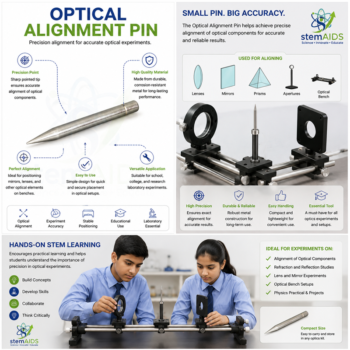
- Mount the slit apparatus on an optical bench with a suitable monochromatic light source, such as a laser.
- Set an initial slit width and observe the diffraction pattern on a screen at a fixed distance.
- Adjust the slit width and record how the central maximum and secondary maxima change.
- Compare results at several slit widths to relate slit width to pattern spacing.
- Follow standard laser safety precautions if a laser source is used.
Care & Maintenance
- Keep the adjustable slit mechanism free of dust to maintain smooth, precise adjustment.
- Avoid touching the slit aperture directly with fingers.
- Store the apparatus in its case or a dry, dust-free location when not in use.
- Handle the adjustment screw gently to avoid damaging the fine slit mechanism.
Why Choose LabEquip
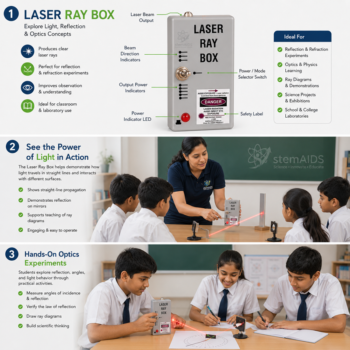
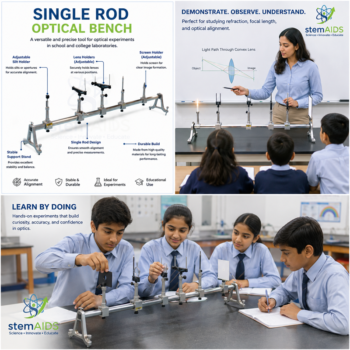
For related wave-optics apparatus, see our Laser Ray Box, Optical Spectrometer, and Single Rod Optical Bench, or visit the LabEquip homepage to browse our full catalogue.
Frequently Asked Questions
What does Young’s Single Slit (Adjustable) demonstrate?
It demonstrates Fraunhofer single-slit diffraction, showing how a narrow slit spreads monochromatic light into a central bright maximum with weaker secondary maxima.
What slit-width range is available?
The exact slit-width range is not stated in this listing. Please confirm with our sales team before ordering.
What light source should I use with it?
A monochromatic light source, such as a laser, is typically used; please follow standard laser safety precautions when doing so.
Is this suitable for college-level physics labs?
Yes, it is designed for senior-secondary, college and university physics laboratories studying wave optics and diffraction.
How should I maintain the adjustable slit mechanism?
Keep the mechanism free of dust, avoid touching the aperture directly, and store the apparatus in a dry, dust-free location when not in use.
Last Updated: September 2026




Reviews
There are no reviews yet.